0
0

 ISLAMABAD, Aug 12: A big majority of students approve the PPP-led coalition government’s decision to lift the ban on student unions but not the return of politics to campuses because of bitter past memories on that count, according to a nationwide survey.
Conducted by a Gujranwala based national youth forum, Bargad, and released here on Tuesday on the occasion of the International Youth Day, the national scientific survey on Student Politics 2008 has been conducted in all 23 nationwide public universities with 909 respondents.
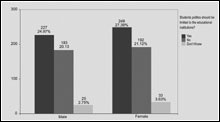
Seventy per cent of the respondents welcomed the lifting of the ban on student union imposed by the then dictator, Gen Ziaul Haq, in 1984. But, a majority of the students (61.2 pc) are not in favour of student politics. Almost half of the respondents said students should not take part in national politics and political movements individually. But, over 42 pc, however, are in favour of politics on campus. While, the encouraging thing is that about one-fifth of female students are ready to participate in political movements in individual capacity too.
Almost 63pc of the students have no knowledge of earlier structure or working of campus politics and student unions. About 16 pc think positively about the student politics before the ban, while 13 pc view it in a negative way.
“We can easily see that the prejudice against student politics is highly uninformed and has been taken for granted.”
 The study states that student politics played a vital role in the 1960s in the democratic struggle against the military dictatorship of Gen Ayub Khan. But, the one who followed him (Gen Zia) banned the student unions and purged the campuses of politics. Over the years, student politics and student unions have been disparaged and accused of engaging in violence and thus causing the decline of the educational standards in Pakistan.
But, violence on campus was not the norm during the heydays of student union activism up to the 1970s. Armed and organised violence on campus first emerged in 1980s, when the country was under the occupation of an unconstitutional and illegitimate regime that was engaged in gun-running for a super power as part of an unholy tripartite alliance comprising the US, Pakistan military and religious organisations. Militarisation of politics was part of the agenda of the then ruling clique during the Cold War against the Soviet Union. Campuses and student politics were actually victims of power politics being played out at the national and international level.
More than half of the respondents support politics should be confined to campus. But, over 41 pc report that such restriction is unreal. An overwhelming majority comprising over 72pc respondents opposed the affiliation of student organisations with political parties, while only about 22pc favoured it. Majority of the respondents did not want political parties to have student wings, as only 28 pc supported the idea.
Nearly half of students are skeptical about similar political loyalties of teachers and students in a certain campus and say that it would not have positive effect on the educational institutions. But, one-thirds thinks rather the other way over the issue. More than two-third respondents see it important that the university administration imposes a strict code of conduct on student organisations to ensure that there is no violence in campus. Nearly two-third respondents are in favour of banning those student organisations which promote sectarian, religious, gender, caste or racial discrimination by their literature and action. A vast majority (over 70pc) stands for open access to information regarding student union and university funds. The respondents also favoured representative women quota in the university unions. The survey has recommended the higher education commission to integrate its recommendations in the mid term development framework.
Iqbal Haider Butt, who authored the survey, said in the foreword that if student politics was responsible for decline in educational standards, the quality of education should have shown some improvement after student unions were banned. On the contrary, academic standards continued to deteriorate. Perhaps the responsibility lies in the fact that education is not a priority for the state and that student unions cannot be made scapegoat for the state’s failure.
Vice chancellors from a number of universities and politicians and Parliamentarians attended the consultative meeting on women leadership in campuses during which the survey report was launched.