Resurrecting a ghost
DR A.Q. Khan is back in the news, retracting by implication the confessionary statement he made in 2004 and asserting that he was forced to make it. Given the political situation today, it is obvious who he was referring to when he said he was made to come on TV and read out the statement. Besides making happy those now going after President Pervez Musharraf’s skin, Dr Khan would be hard put to ascribe any other motive to his decision to break his silence and restart the debate on an awkward aspect of Pakistan’s nuclear programme. That he was the man who put Pakistan on the world’s nuclear map and many in the nation regard him as a hero goes without saying. However, for a scientist he had an unusual trait — he spoke too much. Scientists, scholars and researchers, especially those who work on sensitive projects, the world over keep a low profile. A scientist seeking publicity is like a judge turning himself into a political activist. This was, however, less of the grotesque in the metallurgist; the greater part of the anomaly lay in his alleged role as a disseminator of nuclear technology.
He has now told DawnNews TV he did not do anything that was ‘illegal or unauthorised’. Evidence that was described as incontrovertible was collected to show that Dr Khan indeed ran a clandestine network that tried to make technology for making nuclear weapons available to ambitious governments ranging from North Korea to Iran and Libya. It is true that Pakistan is not a signatory to the Nuclear Non-Proliferation Treaty. The legality or otherwise of his actions notwithstanding, now that he has chosen to break his silence Dr Khan needs to clarify what he means when he says he didn’t enter into any ‘unauthorised’ deals.
It is not a secret that all aspects of the country’s nuclear programme have remained in the hands of the military. Therefore, the implication that his actions were not just his own assumes added significance at a time when some in the West are questioning Pakistan’s ability to keep its nuclear weapons secure. We won’t get into the debate here whether Pakistan is safer and stronger for having nuclear weapons. We would, however, say that most damage to the country in recent years, and more so in recent months, has not been done by any external enemy but by loose talk within. And it is time political leaders in and out of government, ex-generals, scientists and others just paused and thought through the consequences of their words before they so generously share them with everyone.
The subsidy issue
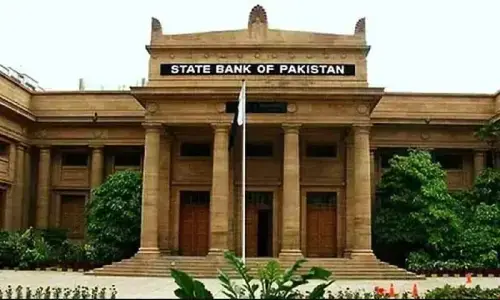
THE mixed signals emanating from our economic managers on the issue of subsidies betray a lack of policy direction. Just about the time when the finance minister was assuring Praful Patel, the World Bank vice-president, of Pakistan’s intention to eliminate subsidies on imported oil in the upcoming budget, other powerful voices were heard suggesting possibilities of a 60 to 80 per cent increase in subsidies on oil, wheat, electricity and fertiliser. The government, quite clearly, is at its wits’ end in finding ways to mitigate the impact on the poor of soaring oil and food prices. Double-digit inflation is expected to boost subsidies for the current fiscal year to Rs320bn — oil alone accounting for Rs180bn. Rising oil prices have pushed inflation to an all-time high of nearly 12 per cent, with food inflation hovering at around 20 per cent. The blame, in part, lies with the previous government which avoided passing on the impact of rising oil prices to consumers, in view of political expediency. The burgeoning budget deficit, expected to reach 9.5 per cent of GDP by the end of June, is at the heart of the problem. Subsidies inarguably boost domestic short-term bank borrowings causing inflation.
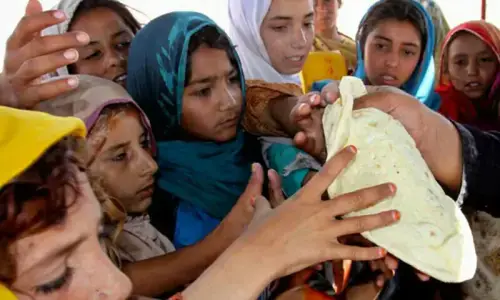
But one cannot deny that it is the duty of the state to protect the poor. Officially, 71.2 million people live below the poverty line or are vulnerable — accounting for 44.4 per cent of the country’s population. More people are likely to be pushed below the poverty line. Hence social justice demands that the next budget should focus on the food subsidy. Budget 2007-08 had allocated a ridiculously small sum of Rs1.8bn to this head, which worked out to just around Rs2 per month per head for the 71 million poor of the land. There is need to devise a credible method to identify the groups that need help to prevent leakages. It would be difficult to take issue with the fact that subsidy is an inefficient economic mechanism as it triggers spending and consumption while discouraging savings. An option would be for the government to concentrate on raising prices of agricultural produce, decreasing corporate and personal taxation, raising individual incomes and creating jobs. Of course it is all more easily said than done. But if the finance minister intends to keep his promise to the WB, the government will have to be selective in its approach. Nobody is likely to lament the elimination of huge subsidies on inefficient sectors, but food subsidies must remain in place.
PM’s prison reforms
PRISONERS’ rights may not strike a chord in a scarred society where many favour burning ‘criminals’ alive irrespective of their guilt. Nonetheless, prison reform is long overdue and fortunately its importance has not escaped the notice of the prime minister. Spurred into action perhaps by his own ordeal behind bars, Yusuf Raza Gilani has acted on this front with remarkable swiftness. First his government ordered the release of all convicts who had served their prison terms but were still in jail due to non-payment of fines. The centre footed the bill and dozens of prisoners were set free. Now, according to a recent media report, thousands more could be released under a far-reaching prison reform package that includes new legislation. All undertrial prisoners accused of minor crimes would be at liberty until their cases are decided, and it is estimated that some 80,000 inmates may benefit from this landmark proposal. In the press report, Mr Gilani describes the ‘inhuman conditions’ prevailing in the country’s jails and the plight of prisoners languishing behind bars for years on end without ever getting their day in court. People accused of petty crimes, he rightly says, become hardened criminals in jail and family members, particularly children, suffer grievous harm in their absence. The prime minister is reportedly also seeking advice on how women and children currently languishing in jail can be rehabilitated and restored to society. Mr Gilani’s plans for sweeping prison reforms are laudable and we hope they will be implemented in letter and spirit.
Besides offering relief to undertrial prisoners charged with minor crimes, a reduction in inmates will also improve conditions for convicts serving their time. Due to gross overcrowding, small-time thieves who may have resorted to crime in desperation end up rubbing shoulders with murderers, rapists, gunrunners and heroin peddlers. Teenagers are left at the mercy of sexual predators. Remedial measures such as those outlined by the prime minister are desperately needed in a country where people are picked up on the flimsiest of excuses and sent to jails that are plagued by violence, drug addiction and other evils. Shoddy investigation is routine and framing of innocents by the police is not unknown either, even in heinous crimes. Given these practices, it is suggested that an overhaul of the judicial system should also be initiated so that hearing of cases can be expedited and justice delivered. It is unacceptable that many prisoners spend more time in jail awaiting trial than they would if they were convicted.
OTHER VOICES - Bangladesh Press
Bleak days for Bangladeshis in Bahrain
Amar Desh
BAHRAIN has banned work permits for new Bangladeshi workers in the small Gulf kingdom. Our nightmare has come true. About 100,000 Bangladeshis working in the kingdom face an uncertain future after the Bahraini interior ministry announced it would not renew their work permits once they expired. The murder of a Bahraini man by a Bangladeshi national is at the centre of the controversy. The killing stemmed from a row over payment for the welding of the Bahraini national’s car. The Bangladeshi who had killed the Bahraini car owner with an iron rod was remanded for seven days in custody for interrogation.
Following the incident, the Al Asala (conservative Sunni) bloc in the Bahrain parliament urged the authorities to implement a yearly or quarterly quota for the number of Bangladeshi nationals allowed to work in the country. Seven members of parliament, tied to the conservative Sunni bloc, also pressed for the expulsion of all Bangladeshis. If the proposal is approved in parliament, all Bangladeshis may have to leave the country. The allegations of the seven MPs against the Bangladeshis are grave. They have been blamed for their involvement in murder and other crimes in Bahrain. But Bahrain is not the only country to go against Bangladeshis. Saudi Arabia and Kuwait have also come up with a number of allegations against Bangladeshi workers there.
Any restrictive decision by Bahrain or other countries will put a strain on foreign currency earnings. Bangladesh must come forward to stand by its people abroad and get them out of trouble and provide proper training and enough orientation for new workers before they are sent to foreign countries for jobs. Bangladesh has failed in both. And the present crisis is rooted in this failure.
Bangladeshis who migrate overseas in search of jobs get trapped by swindlers and scammers. Promises by recruiting agencies remain unfulfilled in many cases. Disappointment runs high. We urge the government to help Bangladeshi workers in Bahrain. Human-rights groups there have opposed the idea of punishing all for the crimes of an individual. We expect a quick response from the foreign ministry in Bangladesh and its mission in Bahrain. Foreign affairs advisor Iftekhar Ahmed Chowdhury telephoned the concerned Bahraini minister, and we hope he will keep up his effort. — (May 29)
Selected and translated by Arun Devnath
EU move to build closer partnerships
THE European Union is spreading its wings once again. The 27-nation bloc may have put its plans for further enlargement on ice for the moment but, after years of gloomy introspection, EU governments are once again seeking to expand their influence both to the south and the east.
This time around, however, the focus is on building closer partnerships with neighbouring states, not welcoming them into the EU club. Significantly also, the drive for closer links with neighbours is being spearheaded by EU governments rather than the European Commission, the bloc’s executive arm.
Earlier this year, French President Nicolas Sarkozy announced plans to build a Mediterranean Union linking the EU’s southern states to their North African neighbours as well as Turkey.
Now, the leaders of Poland and Sweden have joined hands to demand the EU turn its attention to countries on its eastern borders and forge closer relations with Ukraine, Moldova, Georgia, Armenia and Azerbaijan. Significantly, all five countries are resource-rich and strategically located former Soviet republics in which a resurgent Russia is struggling to reassert its influence.
With plans for further enlargement now suspended because of financial constraints — and fears that the bloc is getting too big and unwieldy — the flurry of regional cooperation initiatives spotlight EU countries’ renewed determination to use their ‘soft power’ tools of trade, aid and diplomacy to ensure there is peace and stability in their immediate neighbourhood.
But neither the French-inspired Mediterranean Union which will be launched at a summit in Paris in mid-July nor the Eastern Partnership proposed by Polish Premier Donald Tusk and his Swedish counterpart, Fredrik Reinfeldt are universally popular.
Sarkozy’s plans for the Med Union initially ran into stiff opposition from Germany and the European Commission which said the initiative would duplicate the Euro-Mediterranean partnership launched in 1995. German Chancellor Angela Merkel demanded that the French blueprint be watered down and instructed the European Commission to merge it with the rather lacklustre Euro-Med plan.
EU External Relations Commissioner Benita Ferrero-Waldner makes no bones about the rationale behind the plan: “The more we can develop the region in the south, the less illegal migration there will be…. The more prosperity we can give, the less terrorism, the less criminality will be there.”
Potential tasks for the new Union will be to open new sea traffic routes, clean up Mediterranean waters, improve maritime security and exploit solar power in northern Africa to help meet Europe’s energy needs.
However, Sarkozy had hoped for a much more tightly knit alliance restricted to territories with Mediterranean shores. He had touted his vision as a potential avenue for peace between Israel and the Palestinians and had hinted it might be offered to Turkey as an alternative to EU membership.
Turkey remains deeply sceptical and has only agreed to participate if its membership bid — still fiercely contested by France — is not affected. Russia is expected to be just as uneasy about the new Eastern Partnership proposals although both Poland and Sweden have said they intend to cooperate with Moscow.
The initiative focuses on Ukraine, Moldova, Georgia, Armenia and Azerbaijan but Belarus, which has been ostracised because of its dictatorial regime, will be invited to participate — albeit on a reduced level.
Participating countries will be offered liberalised trade with the EU, the lifting of travel restrictions, cultural exchanges and increased aid. The eastern partners, in return, would be expected to push ahead with political and economic reforms.
In addition, smaller, bilateral projects would also be launched on student exchange, environmental protection and energy supply. There will be no discussion, however, of the controversial topic of EU membership perspectives.
Unlike the Mediterranean Union, the Eastern Partnership would not have its own secretariat, but would be run by the European Commission and financed from the European neighbourhood policy budget.
Poland hopes to secure formal approval of the plan at the EU summit in June and to start detailed work on the ‘partnership’ by the end of the year. But while Germany, the UK and the Netherlands have voiced initial support, Spain and Italy have yet to be convinced of the proposal.
The EU’s interest in its neighbourhood is clearly welcome. The bloc has the funds and the clout to push for reform and modernisation in both the south and the east. However, critics point out that both the French and Polish-Swedish proposals have been tried before — and not with much success.
The 1995 Euro-Med partnership has never really taken off because of the Middle East conflict, with Arab states often using the forum to criticise Israeli policies. There is also criticism that billions of euros in EU funds have not been used effectively and that the bloc has not pushed as hard as it should have to demand human rights and good governance in the southern Mediterranean states.
EU policies in the east have, of course, been much more successful. EU funds and help in modernisation of the economy and political structures of former eastern European communist nations resulted in the May 2004 EU entry of eight of these countries. Romania and Bulgaria joined the EU on January 1, 2007.
The focus in Brussels now is on ensuring peace and stability in the Balkans — not an easy task given the tensions with Serbia over Kosovo — so as to make sure the volatile region does not revert to violence.
One key reason that the EU stance in the east has been more successful than in the south is clearly that while eastern neighbours have been offered membership of the bloc, no such prospect is available to southern nations. Eastern European countries therefore have had an incentive to reform, knowing that modernisation would lead to EU entry. Southern Mediterranean countries, on the other hand, see EU attempts at promoting reform as meddling in their internal affairs.
It is unclear if the new French and Polish blueprints would be able to succeed where collective EU action continues to face serious challenges. However, with enlargement plans now on the backburner, EU governments’ call for extending a stronger hand of friendship to neighbouring states is a welcome sign that the bloc is not turning inwards.
The writer is Dawn’s correspondent in Brussels.
Culture and the mind
SOME representatives of Palestinian cultural organisations met delegates of the German parliament in Ramallah on April 16 to discuss the issue of ‘culture and society’ in Palestine.
A number of issues came up for discussion: our concept of culture, the role of Palestinian cultural institutions, the effects of Israeli occupation on the cultural structure of society, relationship with the Israeli culture and so on. The question was also raised as to whether this was a collaborative relationship. What was our goal in organising cultural activities? The discussion did not answer all the questions. That prompted me to carry on the discussion with those concerned.
How do we define Palestinian culture? Is it a culture that is mixed with politics? What do cultural events mean to us? What is the role of donor institutions? Do they approach us with readymade plans? If yes, then to what extent does their interference hinder our cultural activity? What do we consider taboo? How do we deal with it? What is the role of the element of humour in our artistic works? Is there any social security for Palestinian artists and intellectuals?
I will start by answering a few of the questions raised, and leave the rest for the readers to answer in the hope of establishing a tradition of extended dialogue relating to our cultural issues.
I start with the cultural question asked by people all over the world. Does culture suffice by itself? Is culture confined to the particularly civilised and to the educated elite?
Does it dominate, control and become superior? Or does the concept of culture broaden to portray the spiritual, financial, ideological and emotional features of all societies? In other words, does it encompass art and literature, ways of life, human rights, value systems, traditions and beliefs so that it opens up a multilateral dialogue that ingrains in the people the right to differ and the ability to understand the other?
What about the Palestinian culture? Is it open to other cultures? Or is it isolated from its surroundings? The answer comes not only by organising the Contemporary Dance Festival in Ramallah but through theatrical performances, cinema, video performances and literary, linguistic and cultural conferences, and through exhibitions of the visual arts, photographic works, handicraft in Palestinian cities, villages and refugee camps all over the country.
What do cultural performances mean to us? What role do they play in our lives? Why do we organise them in the first place? Or participate in them? Or watch them? Is it a personification of the Palestinian identity? Does it provide the means for artistic pleasures? Or is it a summary of all of the above?
Let us view the meaning of organising a cultural performance, the Ramallah Contemporary Dance Festival, through the voices of those who discussed the concept on the Internet:
“We seek life as much as we could! What sort of seeking permits us to work on a festival to dance on the blood of the children of Gaza?! What sort of life permits us to dance with dancers from Denmark? We are witnessing the most severe boycott in history with their leaders, people and products. What sort of life brings about dancing while we are drowning in waterfalls of divisions?” — Enas Salma
“All forms of the arts, including dance, is an indispensable part of our cultural identity. Cultural and artistic festivals bring us life yet again, and give us a spark of hope for a better and more beautiful future. What happens in Gaza is painful, but Palestine lives on this land. No one can dominate this grief or claim to be more concerned than others.” — Lubna Ghanayem
“Please participate in the discussion in a civilised manner, a manner that befits the people that produce culture and produce struggle as a historically-rooted, self-defence culture. Dance is a humane art, and cannot be looked upon as an instinct, or purely as the shaking of the waist. Criticising culture should thus be left to those who produce it, and talk of resistance should be left to those who invent the means to take it to its real ends; and not that crazy mess in Ramallah and Gaza.” — Khaled Al-Ghoul
“With sun-oil burnished bronze bodies dancing for Baal or Dionysius, the ancients used to express their joy of life as re-animated on earth, in this ‘geo-spiritual’ spot, at this time of the year. And now, with what has remained of the gush of life, we, the survivors, though not salvaged completely, express with dancing our joy for what the occupation could not take possession of — our soul’s phoenix feather…. Dancing as well, we are joined by friends whom we deeply appreciate for coming from all around the world in response to our invitation ... Zionist propaganda aims at concealing our cultural and civilised aspect to justify its daily-committed crimes against us, and to make our self-defence a manifestation of violence and terrorism.” — Sareyyet Ramallah/First Ramallah Group
Do culture and politics combine or separate?
What does it signify for some art groups from Norway, Serbia, Italy, Switzerland, France, Portugal, Belgium, Finland, Germany and Spain in accepting the invitation of the Sareyyet Ramallah/First Ramallah Group to participate in the activities of the Ramallah Contemporary Dance Festival from April 17 to May 5, 2008?
What does it signify for solidarity when foreigners from Norway, Sweden, Italy, Spain, America, Germany and Portugal join the families of Bil’in village in their weekly demonstration against the segregation wall, suppression, the confiscation of land and the checkpoints?
Culture and politics, don’t they integrate clearly through such popular demonstrations, and through participation in cultural activities? The exchange of expertise and experiences, the development of capacities and capabilities, don’t they form solidarity and support for the steadfastness of the Palestinian people?
Every time the enlightened line of thought is subjected to attack, we feel danger and initiate action. We, the writers, intellectuals, artists and democrats, are required, however, to maintain our daily action, to entrench a culture of enlightenment, and open up windows on other cultures, and deepen the dialogue on two fields: culture and politics.
Shouldn’t we work together to sustain the gains brought about by the Palestinian contemporary revolution in all fields of life: in politics, society and culture? Thus we will also entrench the role of the woman partner and abandon times of patriarchy! n
faihaab@gmail.com