0
0

Access to justice
AFTER many a languorous year marred by poor implementation, it is heartening to note that the ADB-funded Access to Justice Programme (AJP) has picked up pace at least in the NWFP. And as well it should, considering that the Asian Development Bank will close the remaining $20m component of its $350m loan to Pakistan in June this year. In September 2007, when two loans together worth $330m were closed, countrywide programme loan utilisation stood at 73 per cent while that of the technical assistance component was a paltry nine per cent. In a project review released in 2006, the ADB found several flaws in the programme’s implementation, which the bank described as ‘disappointing’ and ‘uneven’. In particular the ADB noted that instead of outsourcing implementation, as was agreed upon earlier, the law ministry assigned the task to the Law and Justice Commission of Pakistan even though the latter lacked the requisite resources and experience. Some things, it seems, never change, even in areas so critical to the country and its citizens as judicial and police reform.
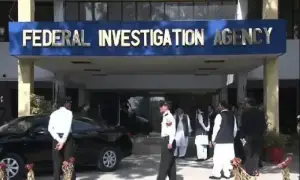
Despite these hiccups, work is said to be in progress on some 36 AJP-related schemes in the NWFP. Forty of the
110 new courtrooms envisaged under the project have already been built, over a hundred new additional sessions and civil judges have been recruited, residences are being constructed for judges and land has been acquired for judicial complexes in several districts. Among other facilities, district investigation headquarters, medico-legal wards and a criminal records office are also on the cards.
While the emphasis on capacity-building and enhancement of a woefully inadequate judicial and police infrastructure is understandable, the problem is that little money is left for anything else. For instance, a comprehensive and sustained campaign is required to make the public, especially its most disadvantaged sections, aware of their legal rights and the routes by which redressal may be sought. A similar effort is in order to educate officials in the justice and police departments about their responsibilities as public servants. An introduction to gender sensitivity must be part of this campaign. Given that the police is the first point of contact for most citizens with a complaint, how will more judges and courtrooms improve access to justice if the thana culture remains unchanged? How will the prosecution secure verdicts if investigation continues to be as shoddy and easily influenced as it is today? Funds also ought to be set aside for a legal aid fund for the needy, for access to justice is impossible if you can’t afford a lawyer’s services. Finally, and this is a job for parliament, laws with an inherent gender or religion bias must be amended or abolished, for judges can act only in accordance with what is on the statute books. Easier access to a court of law does not necessarily mean access to justice.
Yellow signals
ONE does not have to be lily-livered to cringe at the prospect of the Prime Minister’s Programme for the Control and Prevention of Hepatitis turning into a debacle. Launched in 2005, the Rs2.5bn-initiative has remained mired in pitfalls for long — the first blow came in Lahore where Pakistan Baitul Maal withdrew funds for crucial PVR tests for the disease. However, the programme’s most lethal undoing may be a combination of abysmal outreach, poor planning and execution. As a result, a staggering number of people — some seven million plus Hepatitis-C patients — remain untouched by its promised subsidised benefits. Figures available with medical authorities show that about five to six per cent of the population is infected with Hepatitis-C with three to four per cent Hepatitis-B sufferers in the country. Sadly, according to a report in this newspaper, the number of patients registered under the programme is in fact negligible — a mere 34,000 Hepatitis-C sufferers have enrolled from across the country, of which more that 10,000 patients have not received therapy. The primary obstacles are registration glitches and limited supplies of Interferon injections. Also, patients have to undergo a specialised Polymerade Chain Reaction (PCR) test prior to enrollment which is expensive and keeps most sufferers at bay. Experts also believe that the unfair treatment meted out to the project in different provinces has hindered productivity.
Be it an absence of political will, plain negligence or another ill-planned welfare project, the main victims are poor, common citizens. Intention can never become a concrete reality without adequate, precise action; clearly lacking in this programme as most sufferers are ignorant of its existence. There is grossly limited awareness of preventive measures — personal hygiene, perils of used needles and promiscuity — which were once being preached through media campaigns but have vanished of late. The need for an aggressive, public education campaign should top the list of Hepatitis advocates and NGOs must play their part so that these are not halted for paucity of funds. Authorities must also address the despicable state of inmates and some hostels that are virtual breeding grounds of the disease. Another way forward may be incorporating aspects of the scheme such as testing into routine clinical interaction along with recording potential risk factors such as drug use in a patient’s history. This will not only close the chasm between general practitioners and specialists but will encourage patients to move ahead with long term treatment. Finally, there is little doubt that accessible, effective, affordable and ably advertised treatment can promise drastically reduced Hepatitis incidents and mortality.
Balochistan: still waiting
FOR all the government’s reconciliatory gestures towards the embittered province of Balochistan, it is amply clear that nationalist forces have not been mollified as the recent spate of attacks on railway tracks and military intelligence personnel demonstrates. The latest incident occurred on Tuesday when two MI men were killed in Khuzdar, with the Balochistan Liberation Army claiming responsibility. Indeed, anger and frustration in Balochistan will only grow if the government fails to act on its pledge of giving political autonomy to the province and rectifying its population’s socio-economic grievances soon. It is not enough for the Baloch to see a change of rulers in their province; they now expect quick action on the part of a seemingly sympathetic government to put it on the track of economic development and greater political sovereignty.
True, the new government has taken some positive steps towards alleviating Baloch woes, especially with reference to the withdrawal of cases against Baloch leader Akhtar Mengal and calling for an All Parties Conference. But while such actions might mark the beginnings of a comprehensive solution to the Balochistan situation, far more needs to be done lest they are seen as merely token gestures. For starters, the issue of Balochistan’s numerous missing people, allegedly whisked away by the intelligence, needs to be pursued urgently. Also, the presence of the military in the restive province needs to be restricted as this is at the root of the political crisis. The speedy rehabilitation of those who have been displaced — and they number in the thousands — on account of the army action is also a pressing matter. Issues like the restoration of the judiciary should not be an excuse for the government to shelve its plans for Balochistan. It must show the will to act now and the gumption to stand up to those elements — like the military — that prefer the status quo to the curtailment of their interests.
OTHER VOICES: Middle East Press
Sound party bases
The Jordan Times
TWELVE political parties recently rushed to rectify their situations and meet the requirements of the recently adopted Political Parties Law. Twenty-four others had to dissolve for failing to meet the new conditions.
The new guidelines call for at least 500 founding members before a party may be licensed; the old requirement was of 50 only. The latter figure, in all honesty, is ridiculous for a grouping to call itself a political party, especially in a country where extended families can easily top this figure.
The amendment, therefore, is sensible; the larger number of founding members offers some sort of assurance the party has enough popular base and sufficient constituency to enter political life … and exert some influence over the course of things.
Since a party is supposed to serve the entire country and address national issues away from parochial concerns, it makes sense that its members should represent most of the country.
Now that the parties’ legality is settled and, hopefully, their platforms expressed clearly, the only way to test the viability and effectiveness of the new legislation … is to try it out for a few rounds of parliamentary elections. It could help discern whether the new rules truly serve national interests… — (April 25)
Syria and Israel
Khaleej Times
ISRAEL’S indirect communication to Syria that it is willing to withdraw from the Golan Heights raises fresh hopes and concerns about the Middle East imbroglio. For starters, it opens a new chapter in the peace process.
Olmert recently hinted at progress with Syria, implying each side knew well what the other wanted, and Tel Aviv’s throwing in the Golan card means it expects Damascus to cease support of Hamas and Hezbollah for peace to materialise.
Though technically still at war, both sides have indicated desire for peace. Jimmy Carter only just confirmed that a good 85 per cent of differences have already been settled, including water rights, the presence of international forces, even the matter of borders…
Only recently, Israel commenced with its largest-ever war games, simulating all manners of attacks from neighbouring countries. It is still hell-bent on revenge over the embarrassment it faced at the hands of Hezbollah in the summer of ’06…
.…It’s been proved … that the Jewish state is good for honouring neither its word nor international law. Therefore, the prospect of making momentary peace with Syria only to strengthen its own grip on the region might not be entirely the stuff of imagination. — (April 25)
Obama, Hillary and the pastor
A WATERSHED moment for America appears to be coinciding with a watershed moment for Barack Obama. If after he has come so close to nomination, winning a clear majority of elected delegates, the Democratic party’s super-delegates ditch Obama and give Hillary Clinton the ticket — even if they do so for completely non-racial reasons, such as her greater electability, real or supposed — the Democratic party as it has been known for decades may cease to exist.
Offended African-Americans, who in successive elections have provided the party with a quarter of its vote, may desert it, returning God knows when. Not only will McCain win in November, Democrats will stand to lose control in the Senate, in the House of Representatives, in several states, and in numerous cities.
Practical politicians that they are, the super-delegates may avoid — are likely to avoid — this suicide. But Obama too must play his part: he has to show that he will fight for the white working class which in recent primaries has voted almost overwhelmingly for Clinton, notably in the vital states of Ohio and Pennsylvania.
I make these comments as a professor teaching, for the time being, in America’s Midwest.
Polls in North Carolina and Indiana, where primaries are due on May 6, show Obama ahead in North Carolina, where African-Americans have an almost 40 per cent share in the Democratic electorate, and the two tied in Indiana, where blacks are less than 10 per cent of the population. If the 10 per cent or so in Indiana presently shown as ‘undecided’ between Obama and Clinton end up voting as the ‘undecided’ did in Ohio, Pennsylvania and also Texas, Clinton may win in Indiana too.
While Clinton has to win in Indiana to stay in the race (she may stay even if she loses), Obama does not have to win there. But he has to show a resolve, not merely a wish, to enlist the white working class. And he needs to show it soon. Poor whites don’t seem to know the real Obama, and the reverse may also be true, at least to a degree.
This need not be shocking. Shortly after his birth in Hawaii, Barack spent about five years in Indonesia, another 10 years back in Hawaii, two years studying in Los Angeles, another two years at Columbia University in New York, four years or so working in Chicago’s deprived (largely non-white) areas, and three years at Harvard before embarking on a career in law and teaching. Since 1996 he has been in state-level or national politics.
In his interactions he has shown an astonishing capacity to be totally race-free. His most passionate backers are young whites who in their tens of thousands have become his campaigners across America. His mother and the grandparents who raised him after the early divorce of his parents were white.
In fact, the depth of his ‘blackness’ was a question when his candidacy was first announced.
However, he is yet to build a strong and active relationship with working class whites, many of whom have mixed feelings about blacks. Moreover, these working class whites do not know how to relate to a brilliant Harvard-trained lawyer and senator who is black. In developing a relationship with them, Barack Obama has to take the lead.
Blue-collar whites need to hear from him that he wants to get close to them and will fight fiercely for their rights. Obama will need their support to win elections — and to run America if he becomes president.
The inescapable rivalry between America’s working class whites and blacks, and between Hispanics and blacks, has helped Hillary remain close in her contest with Obama.
Yet Obama has repeatedly shown that he has the gifts, when he makes the effort, to create partnerships where tensions exist.
Desperate for victories in each remaining primary (three more are due in May after Indiana and North Carolina, and another three in June, though none will produce a large number of delegates), the Clinton campaign has accused Obama of elitism and utopianism.
An influential black Congressman, Jim Clyburn of South Carolina, who has not yet committed himself to either Obama or Clinton, has warned that the Clinton campaign’s attacks may leave Obama critically wounded when, as is probable, he fights McCain in November.
The Clinton campaign did not initiate the attack on Obama based on the ‘exposure’ of views expressed five years ago by his former pastor Rev Jeremiah Wright, now retired. Elements in the American right started the attack and have repeatedly aired Wright’s remark that on 9/11 America’s chickens had come home to roost. Hillary Clinton has, however, said of Wright, “He would not have been my pastor.”
Obama has rejected Wright’s angry statements but not disowned his relationship with the pastor, who officiated at Barack’s marriage with Michelle Obama, baptised their two daughters, and came up with the title of Obama’s successful book, The Audacity of Hope.
Disowning Wright totally is neither possible nor politically safe for Obama. No matter how much you disapprove of your long-time pastor’s views or words, you cannot, in all honour, deny your relationship with him, or what you and your family received from him.
As I write this, Obama’s supporters are expressing concern that currently Wright is being interviewed in the media and is speaking at public events. They fear that, as a result, Wright’s strong remarks in the past, whether or not torn from their context, will become the centre of political debate, grievously damaging Obama’s candidacy, and also that Wright may make new controversial statements.
It is hard to predict what impact Wright’s latest appearances will have on the election. What is not hard to say is that Obama’s possible rise will improve America’s image worldwide.
His impromptu utterances on what he may do as president in respect of Pakistan and other ‘dangerous’ parts of the world may not have been as careful or wise as desired, but perhaps he should not be judged by those remarks.
For the first time in many a year, it seems possible that a fresh, young, gifted and listening individual, born into the ranks of the oppressed but eager to heal wounds and unite peoples, one who prefers the gains of dialogue to the politics of fear, may be elected to lead the world’s strongest power. It will be of wide interest, and importance to see what America does with the opportunity, and how Barack Obama himself deals with it. n
The writer is research professor, Centre for South Asian and Middle Eastern Studies, University of Illinois at Urbana-Champaign.
rajmohan.gandhi@gmail.com
Open letter to Asif Zardari
Dear Mr Asif Ali Zardari,
THE election result was an answer to the prayers of the nation. However, the forces of evil forces have been bending over backwards trying to sabotage the democratic process and incite the lawyers into entering into a confrontation with the new government.
They need to be told that we are not the gullible sheep of the past. I am a born optimist, and while writing this, a part of me tells me not to be silly. I want
to believe that the Bhurban accord will be honoured and that the tenure will be as it was on Nov 2.
The nation is absolutely not prepared to consider such a humiliating option. It is humiliating for the deposed judges, who for the sake of this ravaged country, put their families at risk. You must have experienced that fear too when Shaheed Mohtarma Benazir Bhutto returned to Pakistan last October.
It will be an insult to her memory because she risked her life for democracy, and she, above all, knew what an independent judge meant.
It is trivialising the sacrifices of the lawyers, who, despite all odds, have stood their ground for over a year. The world has already accepted Justice Iftikhar Chaudhry and the 60 honourable judges as icons of the struggle for an independent judiciary. Theirs and the names of thousands of brave lawyers have already gone down in history for all times.
A compromised restoration will be an insult to the memory of Hammad Raza, the first precious life lost after March 9, 2007. What about the massacre on May 12, the carnage the day Benazir landed in Karachi, the brutality unleashed on lawyers and civil society, the inhuman act of burning lawyers alive in Karachi? It will be insulting the memory of Shaheed Mohtarma Benazir Bhutto, whose mission was to restore democracy, and who better than her knew the value of an independent judge. The nation lost a great leader on that tragic day.
Too much water has flowed under the bridge, and it is unthinkable that after getting this far, there can be talk about actually penalising the judges. Because that’s exactly what this act would be.
Mr Zardari, I am fully aware of your sufferings, the brutal act of cutting your tongue, your long years in prison, and the fact that you did not have a pleasant experience with the judiciary at the time. We condemned it then and we condemn it now. But, sir, it was a different Pakistan then, which I say with regret. As I said earlier, we were a nation of sheep. Why am I not writing to President Musharraf? Because one pleads before someone who you have faith will relate to you — and that’s the beauty of democracy.
My late father, Justice Safdar Shah, was a victim of an amendment in the Constitution by Mr Z.A. Bhutto when he was chief justice of the Peshawar High Court, identical to the one I am writing about. An ideal person to be appointed judge of the Supreme Court by Gen Zia and to be party to the judicial murder of the very same man. Fortunately, he refused to sell his soul, and the rest is history. At least today I can hold my head up high.
Many other honourable judges have stood up for the independence of the judiciary in
the past, but they were not supported the way these judges were.
The nation has suffered long enough. The president has ravaged the country for nine years and wants five more. Yet time is being wasted on whether the deposed judges (real for me) should have their wings clipped. The president uses words such as ‘scum of the earth’ for a man whom the world has honoured, and gets away with it. We are stuck with an attorney-general whose father was party to the judicial murder of Mr Bhutto. Certain ministers are visiting the man who wrote in his book that the worst thing that happened to this country was Zulfikar Ali Bhutto.
Why is there intrigue and jealousy against the likes of Aitzaz Ahsan? Should we forget how Muneer Malik was tortured? Men of principle like Ali Ahmad Kurd, Justice Tariq Mehmood and so many others who led this movement are a rare commodity. Why are people like Sharifuddin Pirzada and Maulvi Iqbal Haider allowed to assist the Supreme Court in mutilating the Constitution?
Yet priceless assets like the honourable Justices Wajihuddin and Fakhruddin G. Ebrahim are ignored. Mr Zardari, I recall clearly the conversation between late Mohtarma Benazir Bhutto and my late father just before she returned to Pakistan in 1986. Amongst other things, he repeatedly told her not to surround herself with sycophants, and that Mr Bhutto’s fate was because of such elements.
Mr Zardari, do you realise the importance of the opportunity God has given you? In the past we have had independent judges but never an independent judiciary.
The hearts of the nation are with you in the torment you must feel for your children since the loss of their mother. You can either prove yourself to be a selfless, pragmatic leader, rising above personal grudges, or you can go down in history as the man who deprived this nation of an opportunity that can come only once in a lifetime.
Sir, I have confidence that inshallah you will do the right thing, and that you will put the wishes of the people and the salvation of Pakistan first.
gminallah@gmail.com