0
0

KARACHI, April 28: Health professionals stressing the need for structural reforms in the health care system of Pakistan called for a basic policy shift from treatment and cure-oriented system to the adoption of a prevention-based approach.
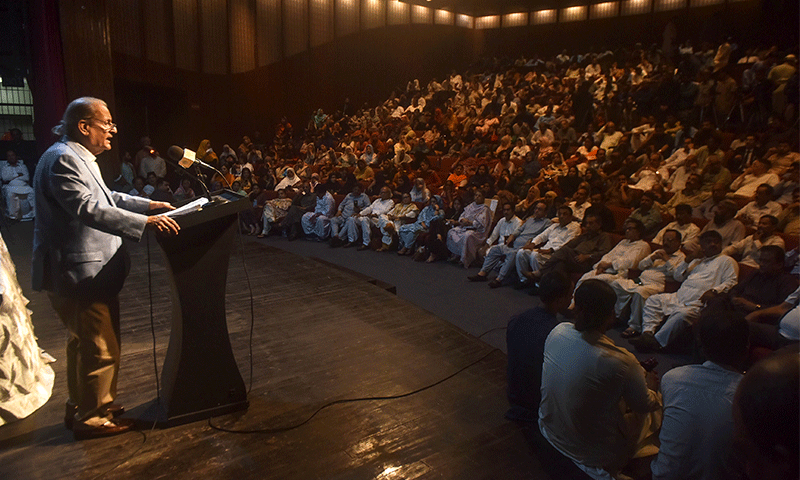
They were speaking at an inaugural-cum-plenary session of the 45th annual medical symposium of the Jinnah Postgraduate Medical Centre (JPMC) held here on Monday. This year’s theme of the moot is “Health for the underprivileged”.
The health experts also explicitly discussed the co-relation between poverty and health.
Dr Badar Siddiqui said that infectious and parasitic diseases were responsible for the 78 per cent of the total outbreaks of diseases in the country followed by other conditions, which could easily be countered through improved public health services.
Expressing his reservations over the national health priorities, he said 40 per cent of the annual health budget went to the tertiary care facilities, which cater to a minute fraction of the total population followed by 45 per cent for secondary health care that catered only nine per cent of the population and only 15 per cent for primary health care attended to the health care needs of 90 per cent of the population.
He said it was mainly due to this unrealistic approach that one child died every minute due to diseases that could be prevented through vaccinations, diarrhoea and acute respiratory tract infections claimed 400,000 infants in the first year if their lives, 30,000 women died of pregnancy-related conditions as 80 per cent births took place at home. The expert added that as many as 500,000 cases of malaria were reported every year with a growing number of cerebral malaria cases.
Dr Siddiqui deplored that despite the fact that several projects had been initiated during the past 60 years, most of them failed to yield the desired results due to a lack of political will.
The expert said that majority of the interventional strategies initiated in the country were found to be vertical with funds going to any single specific area and that these were also mainly donor driven.Stressing the need for a proper ‘public eye care service’ in the country, Prof Saleh Memon said that around 22.8 per cent of the people reporting with various eye ailments comprised children. And 67 per cent of them suffered from minor problems like Vitamin-A deficiency, etc and most of them could be tackled easily, he said.
“Only seven per cent of the people reporting with eye-related conditions required tertiary care,” said the former head of ophthalmology department, JPMC.
He said that the ophthalmology ward of the JPMC attended around 15,000 patients on a daily basis while many of these patients did not need to be there but only required basic health care facilities located near their homes.
“There is a need to change the system,” the senior ophthalmologist said calling for the adoption of an efficient public health care system.
Prof Memon was of the view that the policymakers and the medical community must differentiate between the actual needs and artificial demands.
Retired Justice Nasir Aslam Zahid in his presentation “Constitutional Prescription” said that theoretically provision of the health care facilities to each and every citizen was the responsibility of the state. However, taking into account the ground realities, eradication of poverty was a must to overcome a number of problems, he added.
He said that the February 2008 general elections had provided an opportunity to set right the priorities in accordance with the actual needs of the nation, with major focus on education, health and a dignified life.
Prof Riaz Qureishi discussed the fundamentals of family medicine. Prof Naim Jaffery, S. Kaiser Waheed, Dr Kaiser Bengali, Prof Mehtab Karim, Prof Affan Seljuq and others also spoke.
Earlier, the chairman of the symposium committee, Prof Mussarat Hussain, presented the welcome address and Dr Syed Waqar Ahmed conducted the proceedings.—APP