Harking back to Zia days?
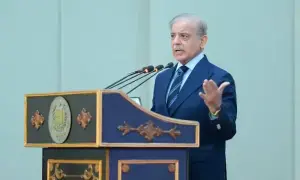
SYED Yusuf Raza Gilani’s speech at the reception he gave for the army chief and the formation commanders on Thursday contains points that deserve to be noted because of the variety of their thought contents, including what would appear to be a stupefying bit of aberration. Some of the ideas needed to be emphasised — like the need for striking a balance between the military and civilian institutions, strengthening democracy, and forging ahead without arguing about the ‘colossal mistakes of the past’. He stressed the need for moving away from bigotry and poverty, establishing the rule of law and giving the people ‘a decent life, a peaceful society and a friendly administrative system’. One could understand if the prime minister talked animatedly about the army at a dinner that was given in honour of the army’s elite and which brought President Pervez Musharraf and some of his bitter enemies to the same table. There is a thing called courtesy: he thanked all those ‘stakeholders’, including the armed forces, who helped in the transition to democracy, paid tributes to the army’s professional competence and welcomed Gen Parvez Kayani’s decision to call the army officers back from civilian departments. However, while speaking of the army’s ‘delicate responsibility’, the prime minister, according to the government agency APP, said the army had to defend ‘the ideological boundaries along with the geographical boundaries’ of this country. How come?
The talk of the army having ideological frontiers to defend was invented during the regime of Ziaul Haq. Ayub and Yahya had introduced unabashed military rule in the country, but neither of them talked about the army having an ideological job. The fiction about the army’s ‘ideological’ role was designed to make the nation believe that Gen Ziaul Haq was personally involved in a formidable task, and that was to defend ‘the ideology of Pakistan’. Having postponed the election, because he was not sure of ‘positive results’, Zia relied, with help from obscurantist parties and elements, on the ideology stunt to transform what was promised to be a 90-day stint into an 11-year nightmare for the Pakistani people.
The prime minister had no reason to harken back to Ziaul Haq’s days and borrow from his lexicon. The Feb 18 vote was clearly in favour of moderate parties, none of which garnered votes on the forgotten ideology issue. Instead, the common points among the victors related to food inflation, the independence of the judiciary, fighting terrorism and restoring the 1973 Constitution to its parliamentary character. The prime minister would do well not to resurrect a controversy that did immense harm to Pakistan in the past.
Abolish the death penalty
MANY find capital punishment to be repugnant on moral grounds. Two wrongs can never make a right and then there is the question of whether any human being is entitled to take the life of another person. Depending on personal belief, so irreversible a fate ought to be the dictate, and dictate alone, of divine authority or the course of nature. Some would argue that only hubris of the highest order — or perhaps the law of the land or a combination of both — can convince an individual that he or she is qualified to deem another human being to be worthy of death. This is an argument without closure if morality is to be the benchmark, and as such it is best to stick to raw practicality and examine how ‘justice’ is doled out in Pakistan. The fate of death-row inmate Sarabjit Singh, an Indian national convicted of involvement in deadly bomb blasts, is also incidental to a debate which should not be individual-specific but ought to instead focus on the inherent value of life.
We welcome the news that the government is considering a plan to substitute the death penalty with life in prison, for the following reasons. Given the increase in heinous crimes punishable by death, there is no evidence on the ground to suggest that capital punishment deters hardened criminals. The inefficiency and corruption rampant in the police and the lower judiciary means that ‘history-sheeters’ and influential persons know full well they can get away with any manner of crime, heinous or petty. Consider also the interrogation methods of the law-enforcement agencies. Torture is routine in our police stations and jails, as are the resulting ‘confessions’ by people who will admit to anything so long as the pain stops. Whether it is due to graft or a lack of training and motivation, the Pakistani police will resort to anything to ‘solve’ a case. To them it matters little if the accused is guilty or not. Then there is the question, not at all specific to this country, of competent representation in a court of law. All over the world, even in seemingly advanced western societies, the poor are poorly served by public defenders or cheap private lawyers while the resourceful have the means to hire big guns that can defend almost any case presented by the prosecution. Mistakes, grave mistakes, are made in the process as innocent people are sent to the gallows. Advancements in DNA technology have of late overturned several death sentences in the US, where investigation is far more thorough than in our own land. But there is no reprieve for those killed for no reason.
Stolen humanity
FOR perhaps the first time in Karachi’s history, petty crimes have proved far costlier in terms of human lives than, say, bank heists. For most, small-time felony is a sure bet for a fast buck but the stakes are rising with each instance. The real loss is of blood as established by the recently reported tragic deaths of young schoolchildren. Two girls of eight and six years of age were killed by stray bullets allegedly fired by the police in a bid to stop two suspects from snatching the two-wheeler of a schoolboy. Another innocent victim was 11-year-old Salman who took a bullet in his chest on his walk home from school. The child fell prey to a crossfire following an attempted cell phone robbery. According to Citizens-Police Liaison Committee (CPLC) reports, last month saw a record rise in street crime — 5,199 mobile phones were taken away at gunpoint, motorcycle theft stood at 1,490 and 635 automobiles were stolen. This sudden upsurge in ‘trivial’ thievery certainly points towards the fact that excessive price hikes, particularly in food items, are feeding an alien brand of depravity that makes people trigger happy.
Crime figures against the affluent may have dropped because they have the luxury to assume protective lifestyles — auto steering locks, deployment of security guards, tracker and alarm systems keep them safe. But what of the hapless millions who have to either battle or lose their lives to a cocktail of lack of opportunity, poverty, social pressure, avarice and downright survival? Another strange aspect is that the prevalence of these crimes is not restricted to specific localities but most victims belong to low-income groups. There is a definite need for widespread, enhanced police patrolling, surveillance cameras and more helplines to prevent both incidents and delays. Predictably, however, these measures can only curtail the symptoms of a deeper, dire malaise that generates not only crime but callousness. The most tragic manifestation of this deplorable malaise is the sinking to new depths of debasement of human nature and the devaluation of human life. We now have an abundance of criminals who are ready to kill just to snatch a few hundred or thousand bucks.
OTHER VOICES - Indian Press
Keeping the race alive
The Hindu
HILLARY Rodham Clinton won the April 23 Pennsylvania Democratic primary by a handsome 10 percentage point margin over Barack Obama. Ms Clinton’s win of her third big state in a row however has not helped her reduce significantly Mr Obama’s overall lead…. Ms Clinton’s last remaining hope lies in convincing a significant majority of … 796 super-delegates that she and not Mr Obama would prove the stronger contender against the Republican nominee John McCain….
The New York senator … has won nearly all the big, industrialised states … that traditionally lean Democratic.
One hidden card working in Ms Clinton’s favour is the consistent evidence that she has greater resonance with blue-collar voters…. The fear of a race divide working in favour of the Republican candidate in November might influence the calculations of the super-delegates. ….
But there is another side…. Can the super-delegates deny Mr Obama the nomination despite his winning more states, a greater share of the popular vote, and a larger number of those elected to participate in the party convention? If they do so, they will be accused of acting as a cabal strangling the spirit of democracy. Even worse, they could alienate African-American voters. — (April 24)
Coalition nuances
The Asian Age
….RECENT developments have shown that coalition politics in India has its own dynamics and does not adhere to any fixed or predetermined pattern. It is a political truism now that what is acceptable in coalition politics at the national level is not necessarily applicable to politics in general, and electoral politics in particular, at the state level.
The two major multi-party alliances that have tasted power at the centre have seen to it that differences between and among the partners do not come in the way of political stability at the centre….
Interestingly, while it is the “one for all and all for one” philosophy that rules at the centre, it is “each one for himself” in the states. Nothing exemplifies this better than the nature of contests we witnessed in Gujarat, Uttarakhand, Himachal Pradesh, Bihar, Punjab, Orissa and earlier in Maharashtra, and the one we are about to witness in Karnataka….
In Karnataka, the Congress and the Janata Dal (Secular), and subsequently the BJP and the Janata Dal (Secular) partnered each other in coalition governments. Now each of them are on their own, and what is more, the BJP and the Janata Dal (United) that are part of the NDA at the centre have just jettisoned the coalition spirit on the eve of the May polls. — (April 25)
EU’s new focus on Pakistan
AS recent visits to Pakistan by the European Union’s most senior foreign policy official, Javier Solana, and British Foreign Secretary David Miliband illustrate, building a stronger, more comprehensive and sustained relationship with Pakistan is — finally — climbing up the 27-nation bloc’s agenda.
Both Solana and Miliband have voiced enthusiastic support for the country’s new democratically-elected leaders and said Europe will help Islamabad face up to the challenge of consolidating democracy and fighting extremism. Assistance to tackle economic problems has also been promised.
Europe’s new focus on Pakistan is clearly to be welcomed. The EU is Pakistan’s biggest market and while European aid levels are not as impressive as the billions of dollars in assistance provided by the US, EU funds are spent on health and education, not military equipment.
Pakistan’s new leaders could also learn a great deal from the EU’s success in encouraging political and economic reform in eastern European states, its spotlight on developing civil society organisations and focus on human rights.
However, neither side should be under any illusion: building strong political and economic ties between the EU and Pakistan will require time, energy and effort. Creative and innovative thinking will be necessary. Both sides will also have to keep their eye on the bigger picture even in the event of short-term problems and disappointments.
The challenge for policymakers in Islamabad is to shift the focus from the US to Europe. Clearly, Washington will continue to loom large on Pakistan’s political landscape. However, Pakistan stands to gain both politically and in economic terms if it succeeds in forging a strong partnership with the EU.
EU officials and European foreign ministries must also make a determined effort to enlarge their view of Asia to include not only China and India but also Pakistan, Indonesia, Thailand and Malaysia — Asian nations whose profile in Europe is often dwarfed by the long shadow cast by Beijing and Delhi.
Certainly, the current mood in EU capitals favours both a quick rapprochement as well as long-term engagement with Pakistan. The European Commission and EU governments believe that the Feb 18 elections were an important step in Pakistan’s democratic development, that the country has a pivotal role to play in combating global terrorism and fighting religious extremism — including in Afghanistan — and that greater attention now needs to be given to building and reforming Pakistan’s institutional structures.
As Solana told this correspondent before leaving for Islamabad, a stable and democratic Pakistan, which respects the rule of law, will be a key long-term partner for the EU and has a very important role to play as a stabilising factor in the region.
As Solana pointed out, the EU is ready to engage more with Pakistan in all fields and to intensify its cooperation in areas such as internal stability, regional relations, security sector reform, migration, human rights, counter-terrorism and non-proliferation.
EU foreign ministers are scheduled to review the bloc’s relations with Pakistan on April 28 amid demands from several states that EU-Pakistan ties should climb higher up the European agenda.
“Pakistan is an important partner for the European Union in many fields; including in the efforts to tackle terrorism which are vital not only for the stability of Pakistan itself but for the whole region,” said Solana, adding that international efforts to promote stability at a regional level — notably in Afghanistan — also required stronger ties and cooperation with Pakistan.
Aides say Solana was impressed and encouraged by his meetings in Islamabad with the country’s new political leaders, believing that they are committed to deliver on promises on democracy and the need for a more comprehensive approach — involving military, economic and political measures — to fight militants.
While clearly rejecting any unconditional concessions to extremists, both Miliband and Solana made clear that reconciliation efforts should be pursued with militants who renounce violence. For Britain, the stakes are very high. As Miliband underlined, about 70 per cent of the terrorist plots currently under investigation in Britain can be traced back to Pakistan.
Similarly, Solana insisted that the EU backed reconciliation with militants, provided it was “under the umbrella of the rule of the country and the Constitution”.
The EU is also listening carefully to Islamabad’s repeated warnings on the economic challenges facing the country in the wake of high fuel costs and rising food prices. Solana and others in Brussels agree that Pakistan’s short- and long-term needs are most pressing in the economic area and that economic development is the key to fighting radicalism, insurgency and terrorism.
No promises have been made to increase EU aid or trade benefits. But the EU is sensitive to Pakistan’s argument that its access to the European market should be improved in view of the duty-free import regime granted to Bangladesh and the free trade agreement being negotiated with India. Any changes in trade policy towards Pakistan will, however, have to wait until the second half of 2008 when the results of an EU study on the impact of the bloc’s trade policies on Pakistan are available.
EU aid to Pakistan worth 50m euros a year is not expected to be increased in the coming years. But the bloc is aware of the need to better target such assistance to include the tribal areas and further focus aid on health, education and job training.
Having taken a key role in monitoring the February elections, the EU is also pushing for improvements in the electoral framework and officials say they are very heartened by the new government’s determination to follow up on European calls for reform in this sector.
Other areas of cooperation worth exploring include potential EU help in police and judicial reform and border management. European governments also want to encourage the development of Pakistan’s civil society and ensure long-term freedom and independence for the media.
More generally, policymakers in the EU and in Islamabad have to work out how to cooperate in key areas such as consolidating democracy, improving the rule of law and ensuring good governance.
The time is ripe for such cooperation. Both the EU and Pakistan are looking at each other with more interest than at any time in the recent past. The challenge for the two sides is to move from goodwill and promises to effective, results-oriented cooperation.
The writer is Dawn’s correspondent in Brussels.
Moving on the road to peace
A CROSS-SECTION of the Indian intelligentsia is convinced that the momentum in the normalisation of relations with Pakistan is likely to continue even if Musharraf has no role to play in the country in the coming years.
While Pakistan’s misadventure in Kargil has now been all but forgotten, President Musharraf’s bold peace initiative, the positive statements of PPP leader Asif Zardari and PML-N’s Nawaz Sharif have been quite reassuring for Delhi opinion-makers.
But this does not mean that the president’s distant dream to exit the political scene after ‘solving’ the 60-year-old Kashmir imbroglio is in sight.
Certain previous government insiders had confided that much progress had been made on the Kashmir issue between the two governments. According to them, “The differences have been narrowed and a quasi-independent Kashmir is possible with joint management by Pakistan and India allowing free movement and trade between the two parts.” The president, they said, would give this as a parting gift, thanks to his friend George Bush who is facilitating the move.
Most journalists, former diplomats, retired civil servants and corporate leaders I talked to on my recent visit to Delhi, however, pointed out that no major breakthrough should be expected in the coming 18 months, as the election process in the Indian states is starting from May 2008 and the Lok Sabha elections are due in spring next year.
Veteran journalist and president of Safma (South Asian Free Media Association) in India, K. Katyal, says that no political party in India can afford to take a major decision on the Kashmir issue in the election year. A keen Pakistan-India relations watcher for the last three decades, Katyal feels that the normalisation process is not reversible now and the Musharraf factor will not interrupt the momentum of the peace process. His view is that the Indian government has consciously kept itself aloof from the domestic political conflict between the president and the coalition parties.
But Ashok Jaitly, who has served as the chief secretary of Indian Kashmir, feels that Musharraf had taken a bold stand by offering an out-of-the-box solution to the Kashmir issue despite the failure of the Agra summit. “This opportunity was not utilised by us,” he lamented. Jaitly thinks that India and Pakistan could not focus on the Kashmir issue in the last one year because of the domestic political situation in Pakistan and now the Indian leadership would find it difficult to move ahead because of its own elections.
A counter-question asked by most Indian intellectuals is whether the solutions to the Kashmir dispute offered by the Musharraf regime have the backing of the new military establishment and the leading coalition government political parties. My contention was: firstly, the normalisation policy with India has the support of our ruling classes, which are now led by a majority of the big industrialists. They have been pushing for better trade and economic relations since the nineties.
Secondly, the military leadership also realises that in the post 9/11 world, Kashmir cannot be kept bleeding by encouraging jihadi organisations to destabilise the Indian-held state. The time has come to disassociate the government from these organisations. They have already started to convince these organisations that the final solution would have to be negotiated at the table and will have to be acceptable to the Kashmiris.
From his experience in the Valley as chief secretary, Ashok Jaitly also thinks that fatigue is setting in as far as the Kashmiri indigenous movement is concerned and its supporters are looking for a workable solution.
As far as the major coalition government partners — the PPP and the PML-N — are concerned, both have a history of moving forward towards normalisation with India as evident when they were in power in the 1990s. Ms Bhutto made a breakthrough with Rajiv Gandhi and Nawaz Sharif’s moves got a positive response from BJP Prime Minister Atal Behari Vajpayee. Their parties have now hinted at de-linking the normalisation process from the resolution of the Kashmir issue.
A CEO of an Indian company raised the question about what corporate India should do to push forward the peace process between the two countries. I suggested that it should lobby to break the inertia in the institutions which are afraid of change. After all, it was the corporate lobbies in India and Pakistan which managed to get the land routes opened to facilitate the export and import of cement and cotton.
By and large, it seems only around 20 per cent of the people on both sides of the border are actually concerned about what is happening in Kashmir. The Indian youth, now comprising 60 per cent of the population, is too busy climbing up the social ladder in the highly competitive market. Areas further south are bogged down in issues like the Dalits’ uprising. Interestingly, UP Chief Minister Mayawati is spearheading the trend.
The Maoist upsurge in almost 200 districts of central India, the immigrants’ issue in Assam, and now the number one issue in all developing countries, the spiralling food prices, are top Indian concerns, not Kashmir.
The big question is whether ‘lateral thinking’ can replace the traditional approach at South Block in Delhi and GHQ in Rawalpindi. My friend Adit Jain, who runs an 800-member strong Indian CEOs forum, thinks that the present ruling generation in India is not ready to change its mindset. He may be right as the average age at the top government level in India is over 50 at least. But we have to shrug off the burden of history. Former Indian Ambassador Fabian, who recently led a delegation to Pakistan, said it well: “People have moved on with excellent relations, but the governments on both sides of the divide have to catch up with them.”
The urge to break these shackles of history is being felt in India as much as it is in Pakistan. The need is to find an accommodating and creative solution. Decision-makers, please rise to meet your appointment with history!
ayazbabar@gmail.com