



 0
0

Sketch-writing and Ashraf Suboohi
 When Hakeem Faseehuddin Ranj Merthi compiled ‘Baharistan-i-Naaz’ in 1864, he did not know that he had pioneered a concept in Urdu that would be developed as a genre. Though ‘Baharistan-i-Naaz’ was a tazkira, or an account of lives and works of poets, due to its style and treatment it became the first step towards the genre of Urdu literature that later developed as sketch-writing. That it was a tazkira recording the lives and works of female poets of Urdu and Persian makes ‘Baharistan-i-Naaz’ even more unusual.
Mohammad Hussain Azad intended his ‘Aab-i-Hayat’ to be a history of Urdu language and literature but his highly ornate style makes many parts of it look more like tazkiras and sketches than literary history. Later on, Mirza Farhatullah Baig wrote a lovely and lively sketch of his teacher Moulvi Nazeer Ahmed Dehlvi that marked the birth of modern sketch-writing in Urdu. Farhat made sketch-writing a genre to reckon with and prominent among those who followed in his footsteps are Moulvi Abdul Haq, Rasheed Ahmed Siddiqui, Khwaja Hasan Nizami, Saadat Hasan Manto, Chiragh Hasan Hasrat, Shahid Ahmed Dehlvi, Mohammad Tufail, Ashraf Suboohi and many others.
Born as Syed Wali Ashraf in Delhi on May 11, 1905, Ashraf Suboohi Dehlvi was a sketch-writer, humorist, short-story writer, dramatist, broadcaster, translator and writer of children’s stories. But it is his sketch-writing that has preserved a seat for him in the hall of fame.
Ashraf Suboohi has made the city of Delhi come alive through his sketches. His sketches describe the people, colloquialism and culture of Delhi in a delightful manner. What sets him apart from other sketch-writers is his choice of personalities as subject for sketches. He wrote sketches of common folks such as a butcher, a barber, a kebab-seller and common inhabitants of Delhi. When one thinks of the writers who penned common people’s sketches, the only other name that comes instantly to one’s mind is that of Moulvi Abdul Haq, who wrote memorable sketches of people doing menial jobs such as a gardener and a chowkidar.
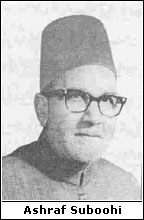 Having passed his matric exam in 1922 from Delhi’s Anglo-Arabic High School, Suboohi Sahib later on did his BA from Punjab University as a private candidate.
With the setting up of the Delhi Radio station, Ashraf Suboohi began broadcasting talks. He also wrote plays, features and women’s programmes for radio. In 1929, he joined the postal department, but kept on writing and launched ‘Armaghan’, a literary journal, from Delhi.
Another aspect that makes Ashraf Suboohi’s sketch-writing stand apart is his diction and the milieu he paints. He was not only brought up in Delhi but was also a keen observer of the culture and history that permeated through the city. As a child he would for hours listen to the elders, especially women, relishing the stories and historical events of a city that was the capital of the Mughal Empire. Their local idiom and regional accent enticed him so much that when he began creative writing his portrayal of the local patois and colloquialism of Delhi women was so perfect that many believed Ashraf Suboohi was a woman. Once he even received a letter addressed to ‘Madam Ashraf Suboohi’.
When Baba-i-Urdu Moulvi Abdul Haq moved the offices of Anjuman Taraqqi-i-Urdu from Aurangabad (Deccan) to Delhi in 1938, he began sending manuscripts to Ashraf Suboohi for pre-publication review. It was a sort of tribute to him as Baba-i-Urdu was very meticulous about Anjuman’s publications.
After partition, Ashraf Suboohi migrated to Pakistan and settled in Lahore. Hakim Mohammad Said befriended him and on his retirement from the postal department in 1962, Hakim Sahib asked Ashraf Suboohi to join Hamdard, Lahore, which he did. Later on he moved to Karachi. But he missed Lahore a lot and yearned for the city he loved most after Delhi.
‘Dilli ki chand ajeeb hastiyan’ and ‘Ghubaar-i-Karawan’ are collections of Ashraf Suboohi’s sketches. ‘Jharoke’ is a collection of his sketches and short stories. He translated a few novels from English. Ashraf Suboohi wrote many interesting episodes in a series ‘Kahawaton ki kahaniyan’ for children, which explained the meaning and background of proverbs and described the stories behind them. These stories and many of his sketches published in different magazines are in fact buried there and need to be collected in book form so that they are preserved for posterity.
Though Ashraf Suboohi deserved recognition, his contribution has not been properly acknowledged. In the late eighties, Mubeena Begum, a student of Delhi University’s Urdu department, did research on Ashraf Suboohi for her MPhil. The dissertation was later published in book form. Although scholars do not have a very high opinion of the dissertation, at least it paid long-overdue tribute to Suboohi Sahib. Other than that, not much has been written about him.
Hasan Askari, while eulogizing Ashraf Suboohi in his book ‘Jhaliyan’, wrote: “Writing ‘purple patches’ is not a great art. Even schoolboys can do that. But a good prose writer is one who writes good prose constantly. Ashraf Suboohi relishes writing good prose and you may relish reading it”.
Ashraf Suboohi died in Karachi on April 22, 1990.
The capital’s destitute
 POVERTY and homelessness are often associated with illiteracy and the lack of education, but two heartrending stories in Dawn last week opened our eyes to how harsh life can be even for people who are educated.
One story concerned a widow who is an M.A. graduate in English Literature, and the other a young man who was a matriculate. Financial pressures had made both their lives a living hell, they having found that their paper qualifications alone were insufficient to enable them to make a decent living and lead normal lives.
The widow, Fareha, with her two children, a boy aged 8 and a girl aged 5 (a third child aged 14 having died in an accident six months ago), were found sheltering in the stairways and corridors of the Pakistan Institute of Medical Sciences (Pims). The clothes that they were wearing and Rs20 were apparently all the possessions they had.
Calls poured into Dawn office offering to help the widow. But one-time charity is not what she really needs. What Fareha really needs is long-term multi-institutional help and support, including psychological counselling, to enable her to get back on her feet and ensure that she does not slip back into the dumps again.
The matriculate young man, Umar Deen, who was an ice-cream vendor in summer and a labourer in winter, and was under debt from a previous landlord, had committed suicide at Aapbara Chowk by shooting himself. The suicide note that he left behind, one part addressed to his family and another part to society, excerpts of which were published in Dawn, was an indictment of our system of governance.
In it, the despondent Umar Deen, who had indicated his intention to commit suicide in front of Parliament House but somehow landed up doing it at Aapbara Chowk, a popular venue for protests and demonstrations, blamed the rich, as well as the price hike, load-shedding and poor housing policies, for getting youths like him into the trap of usurers and thus, despair.
Umar Deen’s suicide was more than a personal suicide; it was also a form of political protest for a collective cause. The act was no doubt inherently individualistic, motivated by personal financial circumstances. But unlike most other suicides reported in the media, Umar Deen’s suicide represents an extreme form of public protest against our inability to reduce poverty, unemployment and load-shedding, as well as to control prices.
Not only was Umar Deen’s suicide performed in a public place in view of other people, it was also accompanied by a written letter addressed to the general public. At the end there was even an appeal to the new prime minister to find a solution to the price hike and load-shedding and to give special attention to the poor of the country who are being strangled by high rents and price hikes.
The suicide of Umar Deen, who hailed from Azad Kashmir, reminds us of a similar incident in Islamabad over one-and-a-half years ago in October 2006 in which a 38-year-old married man with three children from Sanghar in Sindh, Niaz Mohammad Khaskheli, self-immolated in front of the Supreme Court and died four days later in hospital.
Khaskheli, who was a matriculation dropout but had been working in Islamabad, was apparently driven to suicide by a combination of economic and social factors, although doctors had blamed it on personality disorder and the man’s inability to adjust to society.
The very fact that Khaskheli self-immolated in full public view in front of the apex court, on the same day that a group of women and children were also protesting at the same place against illegal detention of their male relatives, made his suicide attempt a political protest.
As for widow Fareha, whose late mother was reportedly a professor at a federal government college, for how long more can she tolerate living in this destitute manner before she loses her senses like Umar Deen and Niaz Khaskheli and decides to end it all, for herself and her children?
To prevent this from happening, Fareha needs help, not only economically and socially, but also psychologically in the form of counselling and life-coaching. Had such help been at hand for Umar Deen, he might be alive today.
There are no official statistics on suicide and attempted suicide rates here; the unofficial national suicide rate is 2,000 to 3,000 per year. Ours is one of the few societies in the world where suicide and attempted suicides are still considered as criminal acts and treated as moral crimes rather than social and psychological problems. The result is that despondent people with suicidal tendencies do not usually seek help for fear of being persecuted by the police.
Over the last few years, suggestive evidence from various non-governmental organisations have pointed to suicidal tendencies being a growing health problem in Pakistan blamed on unemployment and poverty, although the role of marital issues and mental illness cannot be totally ignored.
Thus, apart from the need to strengthen the institutions for advancing the social and economic welfare of citizens through providing them their basic rights of not only education but also of employment, housing and health facilities, and stability of prices, we also need to de-criminalise suicide and attempted suicide to allow people to seek help without fear of persecution.
Can Umar Deen’s supreme sacrifice and widow Fareha’s moving plight go beyond merely inciting sympathies and evoking emotions like guilt or shame, and provoke us into concrete action and credible policies to ameliorate the economic, social and psychological sufferings of people like them?
Nothing seems to have changed, neither govt nor the system
Comment
The approach to the National Assembly somehow presented a microcosm of what this country is going through. It was an odd contrast. Monday brought Islamabad’s most picturesque spring afternoon with clouds floating down the Margallas, flowers blooming in the windy afternoon drizzle. It was out of the world. Yet across parliament the spectacle of groups of protesters soaking in wet presented the stark realities between the life in Islamabad and Pakistan. There they stood -- women, children, young and old -- chanting slogans feverishly for an array of diverse causes. Some were protesting against the rise of rates for utilities; another group had placards bemoaning the flour prices; yet another group was crying itself hoarse about the employees’ right in the Ministry of Petroleum. There were so many of them that it was difficult to keep track of who was asking for what.
The romance about Islamabad’s weather being a constant, nothing else seemed to have changed. Neither the government, nor the system. The road to parliament remains barbed and barricaded. You have to pass through more pickets and searches than in, say, Adiala Jail. Much of this is obviously because of the security situation. But there seemed to be more to it. Everything in Islamabad -- the government, the courts, the parliament -- is still in a limbo. And everybody, it seems, is waiting for the final showdown to take place between the president and parliament to take place. Incidentally, a similar contrast was visible with the National Assembly as well. There was some realisation about the enormity of the tasks. A member took up the case of the woman who along with her two children committed suicide under the wheels of a train in Lahore just because “she had nothing to feed her children”. There was also an adjournment motion about the looming water and power crisis. There was some mentioning about people burning down electricity supply offices in Multan.
But somehow, the whole ambience of the house was laidback. Half of the cabinet was missing. The prime minister, who was supposed to entertain the question hour, came late and did not seem concerned even about the events in the city that brought him to this stage. It looked like a chat club with groups gossiping and socialising here and there. The PML-N was busy in Lahore. Perhaps they know power for them will flow through Lahore and not Islamabad. Even Pervaiz Elahi along with most of his compatriots was missing. Perhaps he too finds it easier to convey his message through ‘better-managed’ press conferences than in parliament. But the thrust of the whole argument is that everything is stalled till the inevitable showdown takes place. The issue is that when, how and, importantly, with what consequences with this Armageddon, if not a whimper, will take place.
Our pundits are convinced that it has to happen sooner than later. It simply cannot go on. It’s a topsy-turvy situation. The opposition is partially government because it is backed by the president and the government is partially opposition because it is fighting a war within the executive. It is supposed to be a parliamentary system but all the strategic powers -- from the dissolution of assemblies to the appointment and sacking of the army chief and Supreme Court judges -- lie with the president. The system cannot move on because of the legal, political and judicial lacunas involved. The government simply cannot take any major step. Governors nominated by the president are breathing down the neck of elected chief ministers. The prime minister announced in his first speech about the repealing the NAB courts. It turned out that he could not do that without the president. There are so many other areas where the prime minister’s advice is not mandatory on the president. Mr Musharraf may have announced that in the so-called third phase he would like to play golf. The fact is that it’s a virtual presidential system where his caddy holds more powers than our Seraiki simpleton. There are shackles all around.
Obviously, ordinary mortals cannot understand the intricacies of the problem. But then that might be the real strategy. Our cafeteria cynics smell a rat where the game plan is to fail the system. “Why else would all hell break loose over the Sher Afgan incident, not that it was the right thing to do,” asked a colleague. “Much bigger events have gone unnoticed, even forgotten.”
There was some truth in the assertion. It was not a coincidence that there was suddenly a barrage of doomsday scenario about the system collapsing. Political carcasses like Sheikh Rashid, Tariq Azeem and, the never-ending talking machine Mohammad Durrani, popped out overnight to paint deadly scenarios. Sheikh Rashid predicted another martial law; Pir Pagara too talked about the inevitable collapse of the system. Perhaps they realise that the only way they could survival is if the old system returns.
“Things may be bad,” said Afzal Sindhu, a veteran politician from Bahawalnagar. “But let me tell you the old system aint coming back”. His argument was that there would be even more hiccups.
He may not be wrong. Islamabad is bussing about mega scandals that may unfold in the coming weeks. Questions are already being asked about the Saab deal, the Boeing purchase and never mentioned defence deals.
For many it may not just be a political survival but business and personal one also. “It’s just a matter of time before you will see how much corruption has taken place during this phase,” said an insider. He thought the players of those shady deals were making a last-ditch effort to stop the winds of change.
The million dollar question revolves around, once again, Asif Zardari. Will he side with the Nawaz League and strike at the president?
Those in the know say that Asif Zardari, at the end of the day, will do what he has to do. He realises that his political survival, for the time being at least, lies with Nawaz Sharif and not the PML-Q and definitely not with their mentor whose China visit might be the last of those hundreds of lavish entertainments that he had relished in the last eight years.
The political logic is quite simple. The Nawaz camp is totally committed to the reinstatement of judges. Their present and future politics depends on staying the course on this issue. They will not budge on this issue no matter what the consequences.
The PPP may have a few problems, the biggest being the troika of lawyer advisers -- Babar Awan, Niaz Naik and Lateef Khosa -- surrounding him. They may have their personal reasons for opposing the Nawaz stance on the judiciary.
And if one goes by the pattern of Asif Zardari’s decisions, he likes to see an issue ballooning into a crisis where all eyes are set on him. Then the Caesar emerges from the palace and, amidst a suspenseful aura, cuts the crucial knot with a swash of his sword. This builds his image of a, God forbid, statesman. He has shown a similar pattern -- be it the case of announcing elections or the nomination of the prime minister, the Bhurban accord. He knows his political survival lies with the PML-N. He realises that he cannot afford to part ways with the PML-N. Not so early, that is.

























