0
0

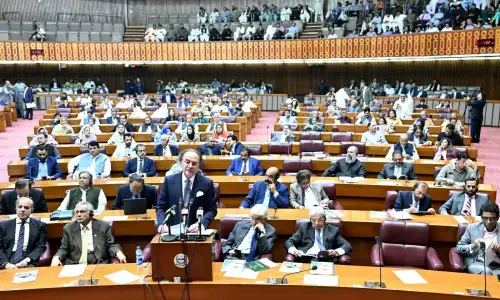
 ISLAMABAD, April 13: Some members are expected to raise the issue as to under which constitution the proceedings of the National Assembly are being run when the lower house will meet on Monday afternoon after a two-day recess.
The admittance by Federal Minister for Law and Parliamentary Affairs Senator Farooq Naek that the country is being run under a “disputed” constitution has come as a surprise for many of the newly-elected legislators who, unlike past parliamentary practice, were not provided a copy of the constitution when they took oath on March 17.
Some of the members may ask Deputy Speaker Faisal Karim Kundi, who has been presiding over the session in the absence of Speaker Dr Fehmida Mirza, to give a ruling whether the post- emergency amendments made by President Pervez Musharraf are part of the constitution or not.
The law minister’s admission has given a unique position to Pakistan as it is perhaps the only country in the world which is being run under a “disputed” constitution.
The law minister on Saturday told Dawn that he had directed the authorities to ensure that copies of the newly- published constitution containing amendments made by President Musharraf after proclamation of emergency last year reached nobody, including the legislators.
He said the amendments inserted in the constitution after proclamation of emergency on November 3 had not been validated by the parliament yet and therefore, the document was a “disputed one.” That was why, he said, he had not allowed its distribution.
The first regular session of the National Assembly is already underway and the members have even started legislation work but without knowing as to which constitution is applicable in the country.
It is also not clear as to which copy of the constitution is being used by the speaker and the deputy speaker to run the proceedings of the house.
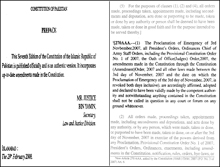
The latest seventh edition of the constitution, a preface of which has been written by Law Secretary Justice Bin Yamin, contains new articles — 270-AAA, 270-B and 270-C — providing indemnity to the acts of the president, including the sacking of about 60 judges of superior courts upon proclamation of emergency.
The cover of the latest seventh edition of the constitution, a copy of which is available with Dawn, says it was the version “as modified up to Feb 29, 2008,” published by the law and justice division.
Sources said the new edition of the constitution had already been published before the oath-taking of the newly-elected MNAs on March 17, but the caretaker regime decided not to distribute it among the members, fearing a 2002-like uproar in the house.
Before taking oath on March 17, the members of the ruling coalition announced that they would not accept any amendment to the constitution made by President Musharraf after proclamation of emergency on November 3 last year.
Later, when the legislators took oath, they made an addition on their own and said that they would only defend the constitution which was present on November 3, 2007.
When contacted, a senior member of the Pakistan People’s Party (PPP), the major ruling coalition partner, said the party was in a difficult situation on the constitution issue, particularly after tabling of the bill by Information Minister Sherry Rehman to amend the Pakistan Electronic Media Regulatory Authority (Pemra) Ordinance, which was promulgated by President Musharraf after proclamation of emergency and the Provisional Constitution Order (PCO).
Under the laws, an ordinance is automatically lapsed after a period of 120 days, if not laid before any house of the parliament. According to some legal experts, as the president had not re-promulgated the ordinance, the Pemra Ordinance had already been lapsed on March 3 and, therefore, there was no need for the government to table the bill.
“The information minister has in fact presented a bill to amend a law which even does not exist at all,” said an expert.
It may be recalled that in November 2002, the members of the PPP, Pakistan Muslim League-Nawaz (PML-N) and Muttahida Majlis-i- Amal (MMA), the then opposition parties — had refused to recognise the then-Legal Framework Order (LFO) containing amendments made by President Musharraf after seizing power in an October 1999 coup.
The opposition paralysed the proceedings of the parliament for one year when they lodged a strong protest against the LFO inside and outside the parliament. Later, the LFO became part of the constitution and was legitimised by the 17th Constitution Amendment in 2004 when the MMA alliance of religious parties helped the government get the required two-third majority in the parliament for the purpose.
The 17th amendment had introduced article 270-AA in the constitution validating the acts of President Musharraf, and now new articles 270-AAA, 270-B and 270-C have been added to the constitution to indemnify the acts of the president, including the sacking of judges of superior courts.