0
0

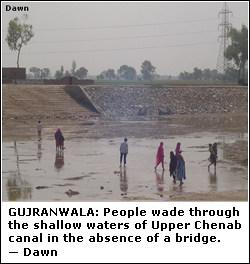 GUJRANWALA, April 10: The residents of Kotli Mughlan are living in the face of a ‘hate wall’ in the shape of Punjab's largest canal which denies them access to the other part of the world as there is no bridge on it.
The residents have to get across Upper Chenab Canal either on foot, when the water level is low, or on a boat, when the water level is high, thus risking their life to reach the developed part of the city.
Kotli Mughlan started developing in early 1960s on the eastern side of the Gujranwala city, and now houses 70,000 inhabitants.
The bridges constructed by the Raj on the canal still exist, but the Irrigation Department has not made any addition to them to meet the need of growing population.
Two bridges -- Ferozewala Bridge and Pipliwala Bridge – are two miles north and south of the locality, so the residents prefer a boat to get across the canal. The boatman charges Rs5 per head, and ends up earning a handsome amount every day.
As colonies on the eastern side of the canal have no sewerage system, so they drain their waste directly into the canal contaminating its water.
Majeedan Bibi, 65-year-old charwoman, has to cross the canal twice a day. After successive years of her physical contact with the polluted water of the canal, she has developed skin diseases.
"Life is but a struggle and crossing the canal for decades has become a routine,” says Majeedan.
Naveed, Bashir and Akmal, students of Workers’ Welfare School, say when they get across the canal on foot, water stains their school uniform, and when the water level is higher, their pocket money goes to boatman’s pocket.
Naseem, first-year student of Government Degree College, Gujranwala, said the non-availability of bridge had forced a number of girls to discontinue their schooling.
"In the 21st century, we are living in the age of 18th century,” she said.
Muhammad Ishaq, a labourer of Kotli, told Dawn that many patients had died on way to hospitals which were located on the other side of the canal due to a lapse of time.
"Two distinct civilizations exits on either banks of the canal and only a bridge can bridge the two sides,” said Ishaq.
Jamdad Khan, sub-division officer of the Irrigation Department, told Dawn his department had nothing to do with the development projects and residents of Kotli Mughlan had better contact the chief engineer of the Irrigation Department in Lahore or the Irrigation Development Circle, Mughalpura in Lahore, for a new bridge.