0
0

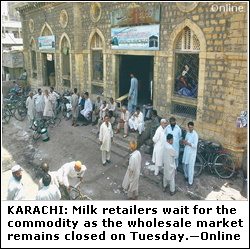 KARACHI, April 8: In a unilateral decision taken on Tuesday evening, dairy farmers decided to withdraw their strike call and announced that they would sell milk with five per cent fat content at the official rate of Rs34 per litre.
They claimed that the decision had been taken in consultation with the city government, which said no such understanding had been arrived at.
The dairy farmers said that milk with seven per cent fat content would be sold for Rs42 a litre.
Analysts said that the availability of two types of milk in the market – one with five per cent fat content and being sold at Rs34 a litre and the other with seven per cent fat content and being sold at Rs42 a litre – indicates that consumers will continue to suffer because they will in most cases opt for the better quality commodity.
They point out that the move would also sow confusion among the users of fresh milk especially because there is no readily available mechanism for the evaluation of milk’s fat content in the market.
Dairy farmers still use the traditional method of adding water or cow’s milk to buffalo milk to change its fat content percentage.
Shaukat Mukhtar of the Karachi Dairy Farmers’ Association said that a meeting of city government officials and representatives of the dairy farmers was held which decided that milk with five per cent fat content would be sold at the official rate of Rs34 per litre by the retailers.
“We have agreed to sell milk containing five per cent fat at Rs34 per litre. The decision is in line with the pure food laws,” he said, adding that the practice of selling milk on the basis of its fat content prevailed throughout the world and Karachi was the only city where this practice was not followed.
He was of the view that the decision was in the interest of consumers because now they would have the option of buying milk of their choice as the dairy farmers would provide the wholesalers with both types of milk.
“The good quality milk with seven per cent fat will be sold at between Rs40 and Rs42,” he maintained.
It is worth noting that the minimum limit of fat content of buffalo milk set by the pure food laws is five per cent.
Dairy farmers claim that many of them invest a good amount of money on cattle feed and their animals give milk having seven per cent fat. This was their major argument with the city government while presenting their case on the price issue. They argued that the increase in the prices of feed had severely affected the prices of milk.
When asked as to how the decision would be implemented on the supply of fresh milk, which was sold openly without any system to check or separate fat content, Mr Mukhtar said it this was primarily the responsibility of the city government, adding that there were some private labs operating in Cattle Colony which could facilitate dairy farmers in this respect.
Interestingly, the executive district officer of the city government’s Enterprise and Investment Promotion Department, Dr Shahab Imam, denied having any dialogue with the dairy farmers on the milk price issue. He said that city government officials would meet dairy farmers once they ended the strike.
“I have been informed that the dairy farmers have withdrawn the strike on their own, without attaching any conditions to it and agreeing to sell milk at the official rates. We welcome their gesture. Now, we could sit with them to solve their problems,” he said, adding that during the entire day the city government managed to ensure milk supplies to the former district central after persuading dairy farmers in Surjani, Baldia and Gadap towns to sell their produce there.
He said that in case the strike was not called off by the evening, the city government would conduct a raid on Cattle Colony and confiscate milk containers to supply the same to the city markets.
Commenting on the situation, the president of the All Milk Retailers’ Association, Hafiz Nisar Gaddi, said that while the association had many differences with the dairy farmers, the community was facing many genuine problems which needed to be addressed immediately.
“It’s a fact that successive governments have had made no investment in the dairy sector for decades. Financially crippled, the dairy farmers face a number of problems including rising feed costs and animal prices. I feel that if the government, in all honesty, starts taking an interest in dairy development today, it will take at least three years before we really come out of the food crisis that normally develops due to the fluctuating prices of meat and milk as both these sectors are interlinked,” he said. He also urged the government to provide a subsidy to dairy farmers on cattle feed so that consumers could get milk at affordable rates.
Mr Gaddi said that the use of force would not yield positive results. “The city government must sit with the dairy farmers to come up with a long-term and viable solution to this problem”, he said.