0
0

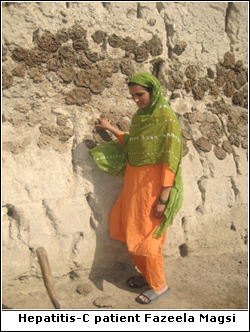 NAWABSHAH, April 7: Fazeela Magsi, 20, mother of four, is dying by degrees and each day that passes brings her closer to the premature death she is fated to face due to extreme poverty.
She, together with her husband, Subhan Ali Magsi who earns barely Rs70 to 100 at a car wash centre, is waiting for a miracle to save her from the silent killer disease of hepatitis-C.
“I hardly manage to make both ends meet. How can I even think of buying treatment for my wife that cost at least Rs50,000. I am between the devil and the Dead Sea. If I choose her life, my children will die of hunger.
“I wait for a miracle as I am tired of visiting Nawabshah Medical College Hospital for my wife’s vaccination whose health is deteriorating by each passing day,” he said.
He said that he had yet to pay back the money he had borrowed from his brothers and relatives for necessary tests, which declared her hepatitis-C positive months ago. A PCR test also found her hepatitis-C positive.
Fazeela is one of thousands of hepatitis-C patients in Sindh who are waiting for the therapy drug under the Prime Minster’s National Programme for Prevention and Control of Hepatitis.
Abdul Jabbar, 20, a tailor, who lives in a village near Sakrand is another victim who developed cirrhosis (a condition in which the liver of a hepatitis patient starts shrinking) as he could not afford to purchase the therapy drug.
The patients have lost their hopes in the Prime Minister’s Programme, which is on the verge of complete failure due to unavailability of therapy drugs (interferon injection supplies) in several hospitals of the province for more than eight months.
Thousands others have not yet been able to register themselves to obtain the therapy drug as they can not afford to go for PCR (Polymerade Chain Reaction) test, which is a must for registration and costs Rs4,000 plus. No hospital in the province except Liaquat University of Medical and Health Sciences provides free of cost PCR test facility.
Dr. Zulfiqar Ali Gurar, provincial coordinator of the national hepatitis programme, said that a team tasked with getting an average number of hepatitis patients in Pakistan in 2004 estimated that Sindh could have 1.8 million patients.
He said that 7,000 hepatitis-C patients were registered in the province and only 4,700 had been provided the therapy medicine. The money-strapped prime minister’s programme could not afford to provide the therapy medicine to all the patients so the district governments as well as hospitals were requested to allocate funds for the purchase drugs, he said.
Prof Anwar Ali Akhund at the Nawabshah Medical College for Girls said that they had to send the tests to the Centre of Applied Molecular Biology in Lahore through a courier for which it was almost impossible to maintain cold chain for the samples and secondly the centre returned the tests results in at least 3-4 months.
The NMC hospital have so far provided the therapy drugs to only 325 patients while hundreds others like Ms Fazeela have to wait in queue for months to lay hands on the drugs.
Dr Aijaz Ali Pirzado, in-charge of the PM’s programme at NMC hospital said that it appeared the programme had been discarded because they had not received even a single injection since June 2007.
A visit of NMC hospital revealed that more than 27 patients suffering from hepatitis B and C were admitted to all the three medicine wards.
Asst. Prof. Dr. Mohammed Saleem Faiz said that at least an average of 40-50 patients suffering from complications arising out of hepatitis-C died every month only in NMC hospital. The number of deaths at private hospitals was also high, he said.
He blamed reuse of syringes by quacks for the spread of virus and said that health officials should take action against quacks and blood banks selling unscreened blood and arrange workshops to create awareness.