



 0
0

A new Rahi returns to Karachi
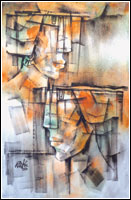 Mansoor Rahi has come back to Karachi. It’s after three years that we get to feast our eyes, exclusively on his works. The venue is Art Scene, the new kid on the art block. The three-level gallery on a lane off Khayaban-i-Mujahid, close to the old Gazebo, was inaugurated by Gulgee, a few days before he was murdered. His picture, very representative of him, is displayed prominently.
And as for the exhibition, most of Rahi’s 45 paintings and drawings were sold before the curtains were raised on the exhibition, the others will not last long it seems, but the city's art lovers have ten days to visit the gallery. The exhibition ends on the 27th.
Titled The Grey Genesis, the exhibition shows the emergence of grey in his colour paintings as also its various shades in black-and-white drawings and paintings. As a Rahi buff, who first saw his works in 1970 and has followed him with great interest I recall the time when he was inspired by Sadequain. The paintings were largely monochromatic and occasionally the figures were reminiscent of the senior artist's figures.
Came the mid-eighties and there was a burst of colours, which was also the time when he and his wife Hajra Mansoor, who is another accomplished artist, moved to Islamabad. When he came to what was then West Pakistan he fell in love with two things – Hajira, who I recall was the most good looking of all her siblings – and the hills of the Pothohar region, which is where Islamabad is nestled and where Rahi has what he calls his humble abode.
Back to his work: the appearance of grey is a recent phenomenon. His 2006 paintings are truly colourful (three of which are on display) but the ones that he did last year and early this year show the emergence of grey from out of a wide variety of colours.
His black-and-white sketches in graphite on paper are attractive – the texture of the paper lends an extra dimension to his work in this genre. But no less fascinating are his black-and-white drawings on canvas in oil. He calls them “open declaration of his calibre” and goes on to say, in an unguarded and for a change in an immodest moment, “these paintings show my command over drawing.” This he tells me when there is no one around, but he knows it will appear in print. But then there can be no two opinions about his highly developed drawing skills, which one doesn't fail to notice.
Michelangelo and Picasso are inspirations that have not forsaken him nor would he like to part with them. The strong contours of human body juxtaposed with semi-cubic figures continue to haunt him. But the distortions are his. Incidentally, he is less abstract now than he was in the past. He terms his new style as “neo-cubo precisionism”. A proof of his return to realism lies in the horse that makes occasional appearances in his paintings. Now you don’t have to make an effort to find out its outlines in his new works. All said, Rahi's new work needs to be seen to be fully appreciated.—Asif Noorani
Karachi’s roads
Sir,
 The condition of many roads in Karachi is deplorable even in the so-called posh areas like Defence and Clifton. On one hand the roads are broken, in a state of disrepair, have uncovered manholes, potholes and sewage overflowing all around. On the other hand many footpaths and islands in fairly good condition – which could have lasted for another few years – have been dug up to be replaced with material of questionable quality.
In this process I am sure that not only has the company supplying the material made millions, but a few people along the way must have made millions in kickbacks and commission also.
Who is responsible for this ruthless wastage of public money? Why is no one held accountable? Such matters need to be taken cognizance of by the higher authorities.
PARVEEN SHAH
Abdullah Haroon Road
Clarification
Sir,
This is with reference to a letter published in Metro Mailbag of March 10, 2008.
The area of Clifton mentioned by Mr Anwer Mooraj falling in the vicinity
of Bilawal House is not under the jurisdiction of the Clifton Cantonment Board (CCB).
It is clarified that only Block 8 and Block 9 of Clifton is under the CCB, in addition to the area of the DHA.
The CCB has no administrative jurisdiction in other parts of Clifton except the two blocks mentioned above. The writer of the letter may seek redress from the relevant quarters.
LT-COL (R) RAFAT NAQVI
Public Relations Officer
DHA, Karachi
Transport problems
Sir,
The transport system of Karachi is in a horrible state. About 80 per cent of Karachians have to undergo the agony of travelling in old and outdated buses and mini-buses daily. The illiterate bus conductors stuff people like cattle.
During Niamatullah Khan’s tenure as city nazim large-sized buses – particularly the Green Buses – were introduced and there was news that he was about to sign a contract to run overhead train services between Sohrab Goth and Tower. But ultimately, what happened to this project we do not know.
We have a lot of hope for our new City Nazim Syed Mustafa Kamal. We request him to please immediately revive the project of train services between Sohrab Goth and Tower and gradually start the work of three other corridors and circular railways.
The only solution to Karachi’s transport problem lies in the construction of underground trains, overhead trains and circular railways and not in big or small buses because these will further aggravate the traffic problem rather than easing it.
M.A. HASSAN
North Karachi
Utility Store
Sir,
There is only one Utility Store branch in Block 17, Gulistan-i-Jauhar. Flour, cooking oil and sugar are usually not available. The timing of the store is also not written and on the first and last Sunday of the month the store opens only for two hours (12-2pm). Sunday is a weekly holiday, so I request the concerned authority to kindly open the store from 9am-9pm daily, including Sunday.
Also, on the receipt the names of goods purchased should be written, while there should be close vigilance of the behaviour and activities of the staff.
DR ZIA UL HASAN
Karachi
Street barriers
Sir,
Many people have placed street barriers in DMCH, Al Hamra Society and other adjacent societies, which creates trouble for pedestrians and residents of the area and lots of parking problems.
We request, through your esteemed newspaper, for the removal of all such barriers from Karachi, especially from the following areas: Hyder Ali Road, Bahadurabad, and Shaheed-i-Millat Road, Bahadurabad.
NASIR ELLAHI, ABDUL SAMAD,
KAMRAN KHAN
Karachi
Phone woes
Sir,
The telephones of all Old Golimar residents have been out of order for the last nine months and have not been restored even after repeated calls to the complaint centre.
Old Golimar cabinet no 16 has been totally closed. We have complained to the SD Site and the divisional engineer. I request the telephone exchange concerned through these columns to look into the matter and redress it at the earliest.
M. SALEEM BALOCH
Old Golimar
Polluting generators
Sir,
The PTCL exchange at PECHS Block 6 has three large generators to cope with their needs during power outages due to the KESC’s inability to meet the demand.
We, the residents living near the exchange complex, in recent days have to bear the brunt of the exhaust fumes that spew out of the generators and choke our lungs, irritate our eyes and noses. This is now happening practically every second hour as the KESC cannot supply power for various reasons.
Will the ptcl/Ufone authorities concerned do something to stop the killer black smoke? It is getting from bad to worse, raising serious health concerns for residents living around the exchange complex. The acrid, poisonous diesel smoke is becoming unbearable, especially for children and the sick.
DR WEQUAR ALI KHAN
Karachi
Late holiday announcement
Sir,
The government announced Feb 18 as a holiday on account of the general elections, as well as two holidays for educational institutions. But Karachi University announced this on Feb 16 late night on a TV channel.
Many students were unaware of the late announcement. They came to the university as usual and were amazed to see the main gate was closed and security guards were stopping students from entering.
This situation was repeated on Feb 28 on the occasion of Hazrat Imam Hussain’s Chehlum.
We, the students, humbly request the authorities concerned to please announce any holiday well in advance or at least during study hours to avoid any confusion.
MEHMOOD
Karachi
city@dawn.com
Begging business
 Wrapped in profound thought during a red signal a loud rap on the window – which could waken the dead as the ring with which it was administered with had a big stone – brought me out of my reverie rudely. Annoyed at this encroachment of privacy and also the scratch on the glass, I wasn’t very polite in telling the persistent women to go away. Gratefully, as the signal turned green I escaped as fast as the car ahead would allow it, but my mood had turned foul by now.
This is an everyday occurrence for many commuters’ going on any road in any type of vehicle. The harassment, for that is what it is, by beggars of every shape, size and age, male or female, is not limited to any part of the day. You’ll be sprung on at 8 in the morning or 2 in the night depending on the area or place. Primetime is early afternoon till early evening – harassment at its peak – because rush hours promise lots of victims. This is the time when drivers have to be very careful because the beggars in their zeal to fleece motorists are not visible sometimes due to the cars ahead blocking the view. Braking or swerving in time has saved many potential accidents. But it taxes you physically and emotionally.
The most trying time is when you go out to eat. If you are ordering at a roadside eatery and plan to eat in the car you will be so guilty after a few mouthfuls that eating the rest of the meal becomes a daunting task.
The most heart wrenching is the sight of little children with jaundiced eyes and torn clothes, usually without slippers, and old people who should be at home being looked after by others.
Not too long ago one poor old lady, who had a bandaged hand and foot, would hobble about till midnight at a busy traffic intersection. One day, passing by just after 12 in the night, this poor old woman was seen taking off the bandages from her limbs and walking off into the moonlight with nary a care that passers-by were observing her. What confidence!
The other kind of beggars who are more persistent than the rest and bring some comic relief with their sentences and surprisingly are good natured too, are the transvestites more commonly known as hijrahs. Their stylish make-up and dresses can put many women to shame. If you pass late in the night, on a double road in a posh area you will find, sometimes, a beautiful young thing standing at the side of the road all alone and elegantly dressed up.
One wonders what a woman is doing there with the bad world ready to pounce. From close up front, the cute thing turned out to be …well a beautiful lass/ lad. Some can be outrageous flirts and provocative in their gestures, reaping the fruits of their labour when they get a positive response from lone male drivers. Karachi is seeing an increase in the number of beggars on the streets. Poverty drive beggars to greener pastures so that they can earn money the only way they know how.
There are no checks or rehabilitation of these people by the government, and as most are jobless and don’t know any other way of making a living, begging is the only means of keeping alive for them. It is also the easiest way of making a living. Sometimes half-hearted efforts are made by the local administration but they tend to fizzle out sooner rather than later. This is not a solution to an issue that needs to be addressed seriously.
—Khursheed Hyder
Selective cleanliness
Karachi Nazim Syed Mustafa Kamal insists that there should be a complete ban on graffiti. He recently exercised his powers under Section 144 of the criminal procedure code to enforce such a ban. He defended his decision when a group of religious leaders requested him to let the walls of the city remain inscribed with Rabiul Awwal messages till the 12th of the Islamic month.
To be fair, the nazim cannot be criticised for trying to keep the city clean. Surely graffiti-splattered walls do not add to Karachi’s beauty. And yet one cannot figure out why the nazim chose to remain silent when the city saw one of the most indecent graffiti on its walls in recent history.
Pakistan Tehrik-i-Insaf chief Imran Khan incurred the ire of the Muttahida Qaumi Movement when he initiated legal action against MQM chief Altaf Hussain in the United Kingdom shortly after the May 12 violence in Karachi. Anonymous graffiti writers hurled at Mr Khan all sorts of abuses – some literally filthy. The smear campaign came to a stop only when Mr Hussain advised his party activists to remove the indecent graffiti.
Why didn’t the nazim then feel the urge to keep the city walls clean?—Mir
Electronic hoardings
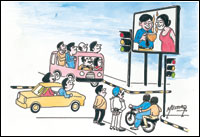 The latest monster to appear on the already messy streets of Karachi is the electronic screen, urging you to buy a brand of some sort as you weave your way past the many cars cutting into your lane. No matter that the city government has reinforced cats eyes on our newly-paved roads; motorists don’t give a hoot about their wheels as they cut across your lane when you least expect it.
With so many distracting hoardings already marring the face of the city, its latest scars are literally alive. The two that this motorist encounters each day are placed ‘conveniently’ on the busiest junctions and although they are bad enough during the day, it’s at night when their glare is most terrible. For a split second while you pass in front of it you are blinded by its brightness, even if you were not looking directly at it.
May I ask as an already agitated driver of this metropolis: why we are being urged to buy this, that, or the other product as we try and concentrate on the road?
There should be a stop to these ugly outcroppings in the name of marketing. The concept it seems is even worse than the TV screens in the cars these days, that are meant for the back seat passengers but, please, who are we kidding?
— Saima Salman
Seasonal blooms
With spring in full swing and summer round the corner there are lots of colourful and eye-catching, though not so fragment flowers blooming in the Bagh Ibne Qasim. There are few breathtakingly beautiful sites that you come across in Karachi and fewer where you don’t have to spend money in order to enjoy it. One such place is Bagh Ibne Qasim. It is special to people like me for reason that it sits on the beach and let me have the view of the sea without any major obstacles like skyscrapers blocking the view.
So, the park that is already a feast for the eyes at night with its marvellous lighting arrangement, which guides you to the enchanting stretch of the Arabian Sea, is now inviting in the evening as well, as soon as the scorching sun becomes somewhat mild.
Flower pots oozing with seasonal blooms are everywhere, even outside the park on Jahangir Kothari Parade these days. Apart from this, huge grassy figurines in pots placed near a recently renovated century-old structure and temple are quite interesting as well.
At night with pleasant weather, the place is visited by people from different walks of life. Some are there with families, while a few others with a group of friends to enjoy a brisk walk.
The combination of sea and this park with lush greenery is magnificent. One hopes, more projects like these will be taken up and more importantly, maintained like this one.
—Meera Jamal
Compiled by Syed Hassan Ali
Email: karachian@dawn.com
After the bomb blasts
 AMONG the hundreds of people whose lives have been turned upside down by injuries in bomb blasts in Islamabad and Rawalpindi since 2007 is a young, newly married medical doctor who is five months in the family way.
Despite losing one eye and one leg in the 4th February bomb blast in Rawalpindi which killed eight people and injured 25 others, she chose to bear the pain of her injuries without painkillers rather than lose or endanger her baby. On top of all this, her career, which she had worked hard for many years to get into, has been thrown into uncertainty.
If we are going to continue fighting the war on terror, this is likely to leave not only an increasing trail of ‘collateral damage’ from bomb blasts in our major cities, but also an even larger number of people like the young doctor above who survived the bomb blasts but live in a nightmare afterwards.
The escalating urban warfare has so far claimed over 100 lives in the twin cities alone since 2007, including Benazir Bhutto’s, besides mutilating, maiming and traumatising hundreds more. The latest target was a restaurant in the heart of Islamabad which was bombed during peak hours on Saturday evening injuring over 10 foreigners and killing one. A few days earlier, twin bomb blasts in Lahore had killed at least 30 and injured an estimated 200.
Previously such blast injuries usually occurred in war zones, i.e., in the tribal areas, and were the domain of military surgeons and military hospitals, but now that the scenario has shifted to civilian hospitals where civil surgeons have to deal with warlike casualties en masse, are our city hospitals adequately prepared to deal with such casualties?
Given the fact that trauma management has never quite been a forte of our civil hospitals, what to speak of military trauma management, are our civilian doctors and surgeons trained and experienced enough to manage effectively the complexities of bomb blast related injuries which usually involve a devastating combination of injuries?
Surviving a bomb blast is the easy part for many of the more fortunate at the scene of the blast. Much more difficult is the life afterwards for these survivors, who have to live with the scars - physical, medical, psychological and economical - for the rest of their lives.
Worse is the fact that the actual human toll and injuries from these blasts is believed to be much more than the count made of the dead and injured immediately following the blasts.
The body of research on non-fatal blast injuries in countries such as Iraq and Afghanistan is still thin. But initial studies do point to the fact that apart from being maimed by projectiles from the blasts and burned by post-blast flames, people in the vicinity of bomb blasts who may have no external signs of trauma or injury can suffer from internal injury, particularly to the ears, brain, lungs, stomach and intestines, caused by intense shockwaves of the blasts, the clinical manifestations of which could be delayed and may only surface days or weeks later.
Are the medical officers in our civilian hospitals experienced and trained enough to closely observe and continually reassess blast patients to detect such missed injuries before discharging them?
Beyond the initial crisis, there is a need for long-term planning by our hospitals as well. Many bomb blast patients need six weeks or more to recover before being transferred for rehabilitation. Multiple surgical procedures are also usually required, lasting over several months. Such surgeries are often accompanied by painful complications; it is not as easy as putting on a prosthetic or artificial limb and just walking off.
All this long-term treatment and rehabilitation are bound to have a major impact on routine activities in hospitals in the twin cities which not only have to cope with such blast patients en masse but also to the increasing number of routine patients. Not surprisingly thus, complaints have surfaced of the inadequacies of treatment in hospitals by recent blast survivors.
Most important of all, how can these bomb blast victims afford to pay for such long-term medical treatment and rehabilitation, especially those who are not in government service? At best, the injured victims are usually immediately compensated with some advance compensation money from the government but the balance and chunk of the promised compensation money is usually not forthcoming.
Apart from physical and medical rehabilitation, what about mental or psychological rehabilitation? Bomb blast victims who have suffered neurotrauma pose particular challenges as a result of their cognitive, behavioural and physical injuries. Internal, initially-undetected brain injury from bomb blasts may cause victims to suffer from neurological disorders, headaches, seizures, pain, coordination problems, sleep disturbances and problems with speech, vision and learning.
Equally important for many bomb blast victims is economic rehabilitation, since many of them are no longer able to work as they used to or hold the same-paying job as they did before.
Thus while the importance of improving the preparedness at our hospitals to deal with mass bomb blast casualties cannot be overemphasised, we need to do much more to help rehabilitate the survivors of bomb blasts and their families.
The establishment of a high-tech special rehabilitation centre in the twin cities, whether government-run or NGO-run, is one such measure that could help bomb blast victims after their discharge from hospitals to recover their basic physical skills and to provide special counselling for those mentally affected by their injuries.
If such bomb blasts persist and become a longer term feature of life in our cities, we might eventually have to set up some kind of a bomb blast victims’ rehabilitation authority, and even a resettlement and relief services ministry (as some countries - like Sri Lanka - have done) to regularise the provision of immediate and long-term medical treatment and rehabilitation, as well as the provision of monetary compensation, job resettlement and job skills training for bomb blast victims and their families.
While we continue to hunt for those responsible for bomb blasts in our cities, equally important is helping those who have been injured and their families to cope with life thereafter.
| © DAWN Media Group , 2008 |



























