0
0

Balochistan politics
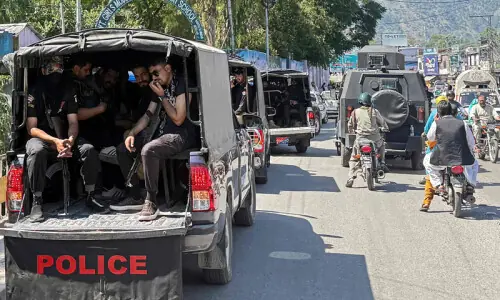
WHILE Balochistan Governor Zulfiqar Magsi’s stated intentions of ending hostilities among various feuding elements in the province are welcome, it would be useful to recall that the heady, post-election phase is not yet over. True, in the days following the Feb 18 poll, a reconciliatory approach by the main political parties has brought former rivals together. In Balochistan’s case, the PPP’s apology to the people of the province for state-sponsored excesses perpetrated on them has been particularly poignant. But it would be a mistake to presume that Balochistan’s troubles will disappear overnight with the induction of a new political dispensation, however well intentioned it may be. For one, Governor Magsi’s ceremonial position may impede his reconciliatory measures as it is the assembly that will have legislative powers. Here, friction cannot be ruled out as it is unclear how far the two largest parties — the pro-establishment PML-Q and the PPP — will cooperate with each other in the assembly, given their mutual distrust.
A bigger consideration is the role of the army. Even if the legislators are united in their resolve to improve conditions in the province, can we assume that the military, that has so far called the shots in Balochistan, will take a back seat? Propelled into action by the belief that Balochistan’s nationalist ferment is the work of foreign elements, the army has carried out indiscriminate attacks on the province’s population. Hundreds of activists have simply ‘disappeared’, political leaders have been killed or arrested, and armed action has uprooted thousands of families. These and the army’s expanding presence as witnessed in the building of military cantonments and check posts, and its possession of land for commercial purposes, have fuelled resentment. Will the army submit to a new political order that may want to limit its presence in the province? Doubts on this score are justified. After all, the army failed to take its cue from the recommendations of a parliamentary committee on Balochistan in 2005 during the tenure of a pro-military government. One can only hope that army chief Gen Kayani’s apparent resolve to transform his institution into an apolitical and professional force will bear fruit and that the military intelligence will not be allowed a free hand in the province.
For the next government in Balochistan, the task ahead is clear — and gargantuan. Apart from anti-army feelings, there are problems ranging from grinding poverty and the absence of an adequate socio-economic infrastructure to feelings of alienation among the Baloch population. Lack of provincial autonomy has given them little say in the distribution of the wealth that their land generates, while projects like Gwadar Port have created uneasiness. Many Baloch see outside labour being given precedence over local recruits and view such projects as a means of altering the province’s demographic composition. Clearly, words alone will not douse the flames of separatism that still burn. For that, more concrete action is needed. In this regard, sending the army back to the barracks and taking measures to promote provincial autonomy might prove a good starting point.
The people are waiting
THE nation is waiting impatiently for the newly elected National Assembly to meet and go ahead with the task of government formation. Perhaps the people’s mood can be understood — they want a perpetuation of the euphoria in the wake of the Feb 18 general election. Their leaders have so far not disappointed them, for instead of confrontation and mudslinging one finds a spirit of accommodation and harmony. Since that fateful Monday, the winning parties — and even the losers — have got together on several occasions and pledged cooperation, even if this meant sitting on the opposition benches. The differences between the PPP and the PML-N on the judiciary are well known but the two parties appear to be making efforts to bridge them. A bigger issue seems to be the PML-N’s insistence that it will support a PPP-led government in Islamabad without sharing power. We also know that the new government will be called upon to take some unpopular decisions, including possibly raising oil prices and power rates. This will mean that the next government will have to combat a new inflationary spiral. This is a challenge the people’s representatives have to accept, for a party which has a people’s mandate cannot afford to shirk responsibility.
The PML-N has to form a government in Punjab in any case, for it has emerged as the single biggest party in the province. But its reported reluctance to be part of the federal government will have two negative consequences. One, it may not ensure the harmonious relationship that should exist between the federal government and a Sharif-led Punjab. Two, the PML-N will have an image problem, and the party runs the risk of being marginalised nationally. As a party that has gained the number two position in the National Assembly, the PML-N has no choice but to be part of the federal government to work within the ambit of the Constitution to advance national goals. Government formation talks should not be allowed to drag on. We hope the Election Commission will notify the final results at the earliest so that the assemblies meet and the governments are formed to end the prevailing uncertainty. It is not wise to put pressing problems on hold indefinitely.
Chemists’ strike
ALMOST all the chemist shops in Lahore and other cities of Punjab observed a complete strike on Wednesday to protest against the newly promulgated Punjab Drug Rules 2007. These require chemist shops to employ a pharmacist to handle the sale of medicines. The closure, as expected, put patients in distress and also created difficulties for doctors and the nursing staff in hospitals. The chemists’ association, which had so far been organising partial strikes for the last several months, intends to hold more shutter-downs if the government does not withdraw or amend the new rules which supersede Drug Rules 1988 and are seen as a major threat to the retail drug trade. In Punjab there are more than 50,000 medical stores (wholesalers and retailers) described as B category pharmacies and over 500 category A pharmacies, mainly attached with government, semi-government and private hospitals.
The new rules prohibit medical stores from selling a number of essential drugs because most of these shops, officials say, lack proper storage facilities and hygienic conditions. The objective is to develop pharmacies on scientific lines. It is felt that this is possible only if pharmacies are run by individuals who hold a pharmacy degree and have completed a one-year apprenticeship in a hospital. The Pakistan Chemists and Retailers Association has also asked for an end to discrimination between pharmacies and medical stores. It fails to see why there should be two categories of pharmacists, especially when the Lahore High Court had accepted that a dispenser with four years of experience was qualified to run a medical store. While the government’s good intentions can hardly be disputed, strict implementation of the new rules would amount to rocking the boat. Obviously, most medical stores cannot afford to employ qualified pharmacists who in any case are not available in sufficient numbers to man every drug store. Hence there is need to find a via media — such as running courses to train pharmacists — until there are enough qualified people to run every medical store.
Give Pakistan a chance
CREATED by one man’s will and unfailing support of his loyal lieutenants, this country has traversed undulating decades of political uncertainties, cyclical progress, poverty and dictatorships.
It now seems that some persons’ whims helped by weak and negligent institutions may push it into turmoil and disintegration. Sixty years after our independence we are still searching for the goals which compelled us to seek a separate Muslim state in the Indian subcontinent.
Denied a continued leadership combining integrity and authority we were early prey in the first decade to machinations of civil-military bureaucracy and the political feudal. The turbulence of nascent nationhood, weak economic infrastructure and divisionary socio-political forces did not help matters and institutions were not allowed to develop and securely entrench themselves.
The next decade of authoritarian rule saw considerable economic growth but without the promised trickle down effect. Years of insensitive bureaucratic control resulted in the tragedy of 1971, followed by half a decade of promises for the common man but soon the political process was derailed by military adventurism.
Dampening the future of democracy, encouraging a pervasively pernicious dogmatic obscurantism, the 1980s saw a chequered fractionalisation of the social fabric, creating ethnic, religious and sectarian divides. Benefits of economic development remained safely in the grip of selected elitist hands and the common man fed on promises not kept.
The decade of the 1990s, now remembered as the lost decade, saw a revival of some political process but was kept strangulated by the long arm of the establishment. It was the decade of engineered political polarisation, factionalism, corruption, palace intrigues and sheer neglect of the common man. Since 2003 governance was a slogan in the hands of amoral corporate gurus. The country suffered at the hands of extremism insensitively used for political purposes —most significantly in the Lal Masjid episode.
The imported prime minister made selfish use of the economic space available post 9/11 and the shortchanged common man expected to feed on cell phones rather than food. Institutions were damaged with disdain and the hyperbole of promises of 1999 deflated with the cussedness of an enemy.
So Pakistan has been ruled since 1947 by juntas securing the interests of the few; the voices of the impoverished masses continually suppressed with impunity by tyrants, succumbing thought under the choking weight of dogma.
But 2007 was a watershed. Suddenly, like a Shakespearian tragedy, the tragic flaw of misgovernance triggered a release of emotions unknown in our political history. Unexpected by the rulers, the civil society discovered its potential as a sentinel of citizenship. A popular movement of dissent was dexterously initiated and sustained by Aitzaz Ahsan and his tribe, at considerable personal costs to themselves.
Posterity may recognise 2007 as the year of defiance by a hitherto subservient populace. And, this in turn, accentuated the tragic flaw of the rulers, pushing them into a cascade of avoidable mistakes.
Elections were unavoidable and could only be stage managed. But tragedy can befall the designers of the meanest deviousness. The process, due to a variety of now well analysed reasons, did not produce the desired diagram of a hung parliament, with a couple of parties with interchanged positions. So by sundown of Feb 18 the clouds of despair gave way to the sunshine of euphoria. Hopefully this euphoria cannot now be crushed under the heavy boots of the establishment’s authoritarianism.
Suddenly there is hope, nay a window of opportunity. This opportunity, if lost, may not present itself again .Therefore, let us seize it and give Pakistan a chance, something we have not done before. For decades we have pursued narrow, sectional interests only.
We really cannot blame a single person, or a single institution for the morass we are in. Be it the executive, the legislature or the judiciary: there are no closets without skeletons. In direct proportion to opportunity each state institution has faltered at the altar of its ego. Historically, the establishment and the politicians are equally self righteous, conveniently forgetful of their past misdeeds.
Is there a wind of change? Realising that the nation is at the edge of an abyss, some politicians seem poised to cross the threshold and enter the hallowed halls of statesmanship; subordinating selfish and temporary interests to larger national goals of supremacy of institutions over individuals. Both major parties claim to have realised the urgency to mend the fences within this fracturing federation and cobble together a partnership of cooperation, a retreat from their past relationship of mutual intolerance. Formerly irreproachable and sacrosanct, some retired generals have come clean admitting their past adventurism bordering on illegalities — one retired general has even admitted interference in 2002 elections. Winds of change indeed!
For far too long the fragile egos of our masters have prevented unison amongst the people, the state and its institutions. Today the civil society struggle of 2007 has provided us space and opportunity to shed our petty prejudices, rise above ourselves and give a chance to this country to realise its potential of great nationhood. This country has been a land of opportunity for all of us and brought us innumerable personal benefits and we, this writer included, owe it a debt of gratitude. Most of us, barring the civil society of 2007, have failed to repay that debt. Now is the time to retrieve our IOUs.
This is the time for the establishment to emerge from behind their sinister sinews and resign to their designed roles. Governance must be left to governments, without tutelage. The people are the best check over irresponsible exercise of power and authority. A piracy of people’s sovereignty must be buried for ever.
Also it may be the last opportunity for the politicians of earlier vintages to recognise the sanctity of public service, respect the verdict of the voters and understand that hold over peoples’ lives is more gratifying than holding huge wealth. Let them be elated by the authority reposed in them, but let that be exercised with care, integrity, generosity and tolerance. It is no more time to settle old scores. Let fanaticism of all shades — ethnic, linguistic, religious or regional — be barred from politics. Let different approaches to public good alone distinguish between different political parties.
It is time also for the bureaucracy to regain their lost confidence and reputation and serve the state with integrity. Over the years it has been encouraged by politicians to serve them as courtiers, rather than government servants. Many have given in to the temptations of extra privileges and extensions at the cost of integrity. It can now redeem its esteem by reviving the pride in neutrality and a high moral ground.
The judiciary today can see a sea change in the public’s adulation of this institution, as a provider of succour and relief. To sustain this respect judiciary will need to ride clear of prejudice, vendetta and opportunism.
The greatest obstacle in giving Pakistan a chance is the intransigence and personal egos of the major players. It is time for all to candidly express their remorse over their past follies. Penitence is not a sign of weakness; it is the endowment of the great. Therefore, gentlemen in power, please rise above yourselves and just do it.
jha45@yahoo.co.uk
OTHER VOICES - Bangladesh Press
Disciplining rogue VIPs
Sangbad
It is sad that some VIP prisoners ended up clashing with each other in jail. It was unbecoming of those who had been elected by the people to run the country at some point in time. Political leaders influence society with their manners, so they must be careful about how they behave in jail or in public places. They should know that their behaviour has a significant impact on their followers.
Erosion of morality has a terrible effect on the young generation. According to media reports, two former members of parliament — elected from Comilla and Demra — scuffled in jail. Another MP was accused of breaching jail discipline by not complying with the instructions of jailors. The three have been branded as rogue prisoners, collectively known as ‘B-class’ among inmates. In the past, politicians were often blamed for breach of discipline in social life. Now, such reports are coming from jails as many of them are behind bars.
We emphasise that the politicians who are at the forefront of society have higher moral responsibilities than others. The government is pledge-bound to hold elections by year-end and transfer power to an elected government. Those who are now in prison could prove innocent in court and return to power through the ballot. We desire to see people with a greater sense of morality and discipline in office. — (Feb 29)
Ensure fiscal transparency
Samokal
The government is not expected to borrow loans from banks to finance the budget deficit, as it has a major source of finance — revenue collections that is. Every year, the government announces the revenue target and budget spending. Sometimes the government depends partly on foreign loans and assistance.
Short of funds, the government looks to banks for loans or sells treasury bonds, a debt instrument. Domestic bank loans, like foreign funds, are not free from interests. The government spends a hefty amount of money on paying back loans and interests. In fiscal 2006-07, the government has spent Tk6,298 crores in interest payments on domestic loans and Tk1,339 crores in interest payments on foreign loans.
Transparent spending is significant and more so in a country where a broader anticorruption crackdown is going on. Moreover, people have the right to know how and where the government spends the money borrowed from banks or earned from the sales of treasury bonds.
An issue such as transparency was absent in past governments. Loans were easy. No administration was answerable to people.
We hope that the caretaker government will buck the trend and ensure transparency in spending to make reforms meaningful. — (Feb 29)
— Selected and translated by Arun Devnath
| © DAWN Media Group , 2008 |