



 0
0

Was Manto Pakistani?
 Saadat Hasan Manto, one of Urdu’s greatest short story writers – if not the greatest – became a literary colossus, a legend in his own lifetime. Those who rejected him on grounds either moral or ideological (and that included writers and intellectuals with progressive leanings), watched him grow in stature after his death.
His fiftieth death anniversary was commemorated last January and despite all the sinister ideas propagated against him through these years, Manto was remembered as a great writer of our language and a good many books were published on both sides of the border in the run-up to the occasion. To coincide with his fiftieth death anniversary, the Pakistan Academy of Letters has published the book Saadat Hasan Manto: Shakhsiyat Aur Fan in its series ‘Pakistan Adab Ke Meamaar’ on the founders of Pakistani literature.
Written by Mubeen Mirza, a poet, short story writer, critic and editor of Karachi-based literary journal ‘Mukalma’, the book not only assesses Manto’s literary merits but also thrashes out the various popular albeit incorrect beliefs about Manto, his life and his art. The author has sincerely tried to see Manto and his works as they were and not as some critics would have us believe. Some Manto-philes, including bigwigs such as Hasan Askari, Mumtaz Shirin and Waris Alvi, when overwhelmed by Manto’s greatness, tend to be less objective and emotionalism gets the better of them. Mubeen Mirza is a great admirer of Manto but does not get carried away and coolly announces that although Manto is Urdu’s greatest practitioner of the craft, yet not every one of his short stories is a masterpiece and he has penned, alongside great stories, some mediocre and even lesser stories.
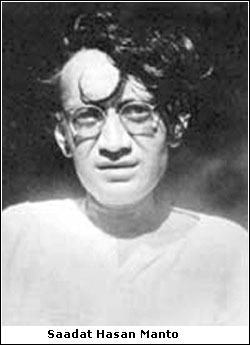 Aside from the objectivity and the emotional detachment of its author with which it casts a fresh look at Manto, the book carries a very engaging debate as to what was Manto’s nationality.
The question of Manto’s nationality was raised in India against the backdrop of his political commitment and ideology. Mubeen Mirza has skilfully captured the essence of the debate and tells the reader why the question was raised and how Prof Fateh Muhammad’s new interpretation of Manto’s famous short story ‘Toba Tek Singh’ holds the answer to the question.
Some time ago, India’s Sahitya Academy published an anthology of Pakistani short stories by Intezar Hussain and Asif Farrukhi, titled Pakistani Kahaniyan. It began with Manto’s short story ‘Khol Do’. According to Mubeen Mirza, Indian writer Musharraf Alam Zauqi objected to the inclusion of Manto’s story in the anthology as Zauqi thought that Manto was not a Pakistani writer. According to Zauqi, since Manto lived merely the last seven years of his life in Pakistan and since he was against Partition (as is evident in his story ‘Toba Tek Singh’), he could not be stamped Pakistani. Khem Chand, another Indian, supported Zauqi’s argument and in doing so attacked Pakistan, the two-nation theory and Islam, criticising even Manto for opting to migrate to Pakistan. In this book, Mubeen Mirza has taken Zauqi to task and proved him wrong. Mubeen Mirza is of the opinion that Manto migrated to Pakistan of his own free will and his sketches such as ‘Mera Sahib’ (which portrays Quaid-i-Azam quite emotionally and with reverence), ‘Murli Ki Dhun’ and ‘Ashok Kumar’, as well as short stories such as ‘Khol Do’ and ‘Toba Tek Singh’ reveal Manto’s inner self; and that it was his innate mental state that forced him to migrate to Pakistan.
Mirza Sahib has very rightly remarked that one can interpret fiction any way one likes but in sketches and articles Manto has expressed his thoughts on his migration in unambiguous terms. To drive his point home, Mirza refers to the arguments of Mohammad Shahid Hameed and Amjad Tufail. He especially quotes Prof Fateh Muhammad Malik’s new book Saadat Hasan Manto: Aik Nai Taabeer that interprets Manto and his ideological stances quite differently. According to Prof Malik, the theme of ‘Toba Tek Singh’ is neither partition nor the ensuing massacre but the loss of memory and the death of imagination.
Perhaps when people such as Zauqi hear about the publication of a book on Manto in the series on the greats of Pakistani literature, they question Manto’s inclusion. But while one agrees to Mubeen Mirza’s argument that Manto was an ideologically-committed Pakistani to the core, it may be added that the question of Manto’s nationality simply makes no difference because a great writer such as him is a shared and treasured legacy of all humanity, just like any other great writer of any other language.
Putting our heads, and resources, together
 WITH the post-election decision of PPP and PML-N to form a coalition federal government, this makes the twin cities the complete stronghold of the next government, as all nine National Assembly seats from Islamabad and Rawalpindi were won by the PML- N and PPP, the former eight seats and the latter one seat.
Hopefully, this overwhelming sweep of National Assembly seats from the twin cities - two from Islamabad and seven from Rawalpindi - by parties in the to-be-formed government would help to bring about not only a more even pace of development between the urban and rural areas within each city but also, a more integrated and coordinated approach to development policies in the twin cities in general.
In the previous National Assembly elections in 2002, the nine seats from the twin cities were won by four different political parties, with the opposition parties capturing seven seats, viz., PML-N one seat, MMA two seats and PPP four seats, while the ruling PML-Q won two seats. In the case of Islamabad, its two seats were won by two different opposition parties, viz., PPP from the rural area and MMA from the urban area.
Islamabad and Rawalpindi may be very different in character and history, one administered under the federal government and the other under a provincial government. But their proximity to each other makes them interdependent and inseparable in many ways, so much so that close cooperation by them in some policy areas, e.g., public transport, water supply systems, sanitation, etc., is crucial to the development and progress of both cities as a whole.
This cooperation presumably can be more easily achieved if the MNAs from the twin cities belong mostly to one political party or to parties in a coalition government rather than if the MNAs were from a hotch-potch of opposition and ruling parties having interests and holding views and ideas that might be poles apart.
Public transport policy is one area whose development in the twin cities in the past five years has been stunted in large part by a lack of coordination and cooperation between Islamabad and Rawalpindi.
Despite a longstanding public demand for a more efficient and reliable bus-based public transport system, not only between Islamabad and Rawalpindi but also between rural and urban areas within each city, such a service has yet to materialise.
An efficient transport system between the twin cities is also crucial for keeping congestion in both cities in check and protecting the environment.
A new CNG bus service within Islamabad was finally launched two weeks ago, the reported result of long overdue cooperation between CDA and the Islamabad administration. However, it remains to be seen whether this service will become a hit among residents.
To make public transport in the twin cities as competitive as the car, or to achieve a target of making say at least 50 per cent of all morning peak hour trips in the twin cities on public transport, the transport policy or service must have the commuter at heart, i.e., commuters should be spared from the chronic problems of the existing transport system such as long waiting times, overcrowding, irregular routes, inconsistent fares, and as recently reported in Dawn, forceful boarding of passengers on particular vehicles regardless of their destination.
Close cooperation between the twin cities is particularly necessary if the planned mass transit rail system project is to be effectively executed and implemented. The stakeholders in this project are not only Islamabad and Rawalpindi but the ministry of railways also.
More so in a train-cum-bus transport service, the transport policy must be planned and built through the eyes of the commuter from the time he steps out of his house to the time he gets to his destination. Unless there is smooth and seamless connectivity from bus-to-train or train-to-bus or bus-to-bus, people would prefer the convenience of their own car and only those without cars will use public transport.
Another policy area that requires but lacks close cooperation between the twin cities is water supply.
Both cities share water supply from Khanpur Dam which is facing a chronic seepage problem that is depriving many residents in the twin cities of their regular water supply. Already current water extraction from Khanpur, estimated to be about nine MGD for Islamabad and 14.5 MGD for Rawalpindi according to a recent Dawn report, is half of the expected output of the project, which is 51 MGD in total.
Unless both cities work together to optimise use of water from the Khanpur source, particularly with reference to maintenance of the Rs7 billion Khanpur Metropolitan Water Supply Project launched a decade ago, both will gradually lose this as an important source of water supply.
Groundwater, extracted through tubewells, is another major source of water supply in both cities but the groundwater table in the area is falling rapidly at an estimated rate of one to two metres annually.
Again here unless Islamabad and Rawalpindi work collectively to regulate the extraction of groundwater from various uses and promote rainwater harvesting at household and community level through enforcement of the necessary building by-laws to augment the municipal water supply and for groundwater recharge, this source of water supply for the twin cities will also face fast depletion.
Another important source of water supply for Rawalpindi is Rawal Lake, which is located within Islamabad, as also is its catchment area. Cooperation on the part of Islamabad is necessary to ensure that recreational, housing and farming development activities around the vicinity of the lake and its catchment area are accompanied by pollution and sedimentation mitigation measures.
Furthermore, since 80 per cent of the catchment of Rawalpindi’s Leh River falls in Islamabad, proper management of the perennial and rainwater flow from the capital’s springs on Margalla Hills - which is stored in Simly Dam - not only provides Islamabad a crucial source of water supply but is also important for helping to prevent disastrous flooding in Rawalpindi during the monsoon season.
Yet another problem which the twin cities should put their heads, and resources, together and solve is the power shortage. Cooperative investment by the twin cities in the energy industry, especially renewable energy industry such as wind, solar and biogas energy, could not only help solve the twin cities’ electricity problems but also provide cleaner energy sources beneficial to the environment.
| © DAWN Media Group , 2008 |



























