0
0

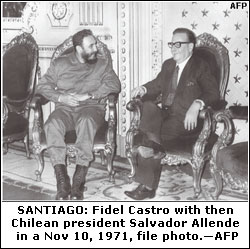 HAVANA, Feb 19: Ailing Cuban leader Fidel Castro said on Tuesday that he would not return to lead the communist country, retiring as president 49 years after he seized power in a revolution.
Mr Castro, 81, who has not appeared in public since undergoing stomach surgery almost 19 months ago, said he would not seek a new term as president or leader of Cuba’s armed forces when the National Assembly meets on Sunday.
“To my dear compatriots, who gave me the immense honour in recent days of electing me a member of parliament — I communicate to you that I will not aspire to or accept — I repeat not aspire to or accept — the positions of president of the Council of State and commander-in-chief,” Mr Castro said in a statement published in the Communist Party’s Granma newspaper.
US President George W. Bush, who has tightened a decades-old economic embargo against the Cuban government, said he hoped Castro’s retirement would mark a new era in Cuba.
“I believe that the change from Fidel Castro ought to begin a period of a democratic transition,” Mr Bush said in Rwanda during a tour to Africa. “Eventually this transition ought to lead to free and fair elections. And I mean free and I mean fair.”
Cuba’s National Assembly is expected to nominate Mr Castro’s brother and designated successor Raul Castro as president. The 76-year-old defence minister has been running the country since emergency intestinal surgery forced his brother to delegate power on July 31, 2006.
Raul Castro has raised hopes of economic reforms but he is unlikely to make bold political changes to the one-party state.
Fidel Castro will remain influential as first secretary of the ruling Communist Party.
Cubans on the empty streets of Havana were not surprised by Castro’s retirement, first announced on Granma’s website in the middle of the night.
“Everyone knew for a while that he would not come back. The people got used to his absence,” said Roberto, a self-employed Cuban who did not want to be fully named.
In a deserted Revolution Square, the site of many hours-long speeches by Castro to massive crowds, a lone soldier stood guard at the government headquarters. The city was calm.
The charismatic Castro led the bearded and cigar-chomping guerillas who swept down from the mountains of eastern Cuba to overthrow US-backed dictator Fulgencio Batista in 1959.
He then turned Cuba into a communist state on the doorstep of the United States and became the world’s longest-serving head of state, barring monarchs.
Castro survived a CIA-backed invasion of Cuban exiles at the Bay of Pigs in 1961, as well as assassination attempts, the continuing US trade embargo, and an economic crisis in the 1990s after the collapse of Soviet bloc communism.
He played a key role in taking the world to the brink of nuclear war in 1962 when he allowed Moscow to put ballistic missiles in Cuba, leading to a 13-day stand-off between US President John F. Kennedy and Soviet premier Nikita Khrushchev.
Famous for his long speeches delivered in his green military fatigues, Castro is admired in the Third World for standing up to the United States but considered by his opponents a tyrant who suppressed freedom. —Reuters