



 0
0

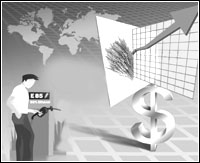 The US programme of using ethanol as automobile fuel is cited in the western press as the basic reason behind the abrupt rise in international wheat prices. The US government not only subsidises the programme but also protects their maize ethanol from competition by slapping duty on Brazilian (sugar cane) ethanol.
This is as a part of the protectionist policy of tariffs and subsidies that the industrialised states give to their farmers.
While apparently the rich world’s fixation is on ‘free market’ principles, they do not refrain from taking steps that militate against these principles. Ricardo’s idea that countries would gain the most if they concentrated on products in which they had a ‘comparative advantage,’ and obtained other products from states that had a comparative advantage in producing those products, is good for the textbooks but constrained in practice. This is especially true of international trade in essential items. The demand for self-reliance in times of war or shortages or risks of fluctuations in transportation costs or delays, can make nations continue to produce essential items at high costs.
The policies of rich capitalist states continue to impinge on prices of essentials in unforeseen ways. However, it is a dangerous for a developing state to casually handle matters relating to essentials. First,, the government over-estimated the wheat crop, our staple food, and then permitted its export. To add to our bad luck, the prices obtained through wheat export ($200 per ton) were much less than the price paid to import it later, when the ill-advised policy led to shortages! This is what one gets when planners are either complacent and too easy going to analyse deeper, or prefer to go along with vested interests, or seek to religiously apply policies based on the advice of international institutions that work essentially in the interests of the developed states.
According to The Economist, the price of wheat rose from $200 per ton in May 2007 to $400 in September 2007. In real terms, this price is far below the peak it attained in 1974, but is still twice the average of past 25 years. The price of maize at $150 a ton is 50 per cent above the average for 2006, while the year’s peak was $175 a ton. American government’s policy of producing ethanol from maize is responsible for increase in the price of maize and sympathetic price increases in other food grain crops.
According to The Economist, something fundamental is affecting the world’s demand for cereals, partly due to increasing prosperity in the developing countries, particularly in China and India. But it admits that this is a gradual process and does not explain the abrupt dramatic rise in price last year which is due to “the rampant demand for ethanol as fuel for American cars.” This year the quantity of maize turned into ethanol in the US is likely to be 85m tons, as against 15 million tons in 2000. This translates into a rise in price of maize; and converting a lot of land, formerly used for cultivation of wheat and soybean, into cultivating maize. Consequently, there has been an overall decline in all cereals this year of 53 million tons, partly also due to decreased production in some countries such as Australia due to drought.
Subsidies in rich countries are already one major reason why agriculture of many poor countries is suffering or even being destroyed. If this continues, there may be a shortfall in supply in the next decade and the price may go higher as a result. But officials in Pakistan should not use increase in international prices as a justification to permit export of part of the wheat crop, since doing so enriches a few at the expense of the majority and is liable to disrupt the entire local price structure and cause an inflationary price spiral, besides depriving the people of essential food items.
The under-nourished population suffers further malnutrition and its productivity is liable to decrease. In any case, are we to maintain international prices at the cost of our people, or maintain our local price structure and protect it against external shocks? The government’s economic managers have already surrendered to the unscrupulous smugglers and hoarders of grain by suggesting that the price be brought to the international level to ‘discourage smuggling!’
On the other hand, according to International Grain Council, there is no shortage per se, of grain in the world. The total world cereals crop this year will be 1.66 billion tons, the largest on record and 89 million tons more than last year’s, itself a bumper crop.
The real problem is that of equity. Problems lie in distribution and in lack of purchasing power of the users—the same reason that accounts for some people going hungry in countries that happen to be large grain producers. The neo-liberals, of course, would tell the usual tale, that the increase in price is good because it would spur greater cultivation of wheat, and act as a stimulus for use of modern technologies. Our own brands of neo-liberals claim that wheat price is still low as compared to other countries! But they tell only part of the story.
They do not tell about the low wages, and that wages and prices are interlinked. Higher prices would perforce translate into need for higher wages, failing which the disposable incomes of the poor would decrease further. And if wages rise, a wave of inflation follows. This is not going to be ‘cured’ by cosmetic measures of slight increase in discount rates.
The immediate problem here is the adverse impact on the poor for whom food forms a large proportion of the household budget. Landowners and the agents that monopolise grain trade would of course claim the lion’s share of the booty. As far as harnessing new technologies, bringing new lands under cultivation and building the necessary infrastructure is concerned, the process is painfully slow.
The neo-liberals still cling to the notion that government intervention in the form of slapping price controls, even if it is on staple foods, is bad. Shortages are created not as much by imposition of price controls as by hoarding and smuggling for profit by the private sector. The current rapid upsurge in the prices of staple grains like wheat and rice in the local market is viewed with indifference or even approval by neo-liberal advisors, ostensibly under the notion that this would discourage smuggling.
This approach fails to see the other side of the picture, which clearly points to social and economic chaos, besides economic stagnation and dislocation if this continues without a corresponding rise in wages. When they compare price in isolation from wages, they hide not only the illegitimate profiteering that lies behind grain smuggling but also skewed distribution of income and assets that such price increases reinforce. They also hide their failure to steer the economy towards production and export of value-added industrial products instead of consigning the economy merely to export of agricultural commodities like grain and fruit.
John Stuart Mill, a classical economist who considered the rise in workers’ wages in monetary terms a blessing in that such increase would make the people pay more attention to higher pursuits in intellectual and cultural realms, also advanced the idea that while the production of wealth could follow classic economic principles, the distribution of wealth was a political rather than an economic choice that depended on societal laws and customs. This political choice needs to be people-friendly! In fact, taxation of income and assets and budgeting, are used as parts of the procedure to distribute incomes and allocate resources by governments.
The implication is obvious: political action is needed to weld efficiency with equity, and everything cannot be left to the vagaries of the market. The current regime’s priorities and political choices are exacerbating the people’s problems in almost every sphere, and now impinging on their very survival through making essential food items exorbitantly costly and scarce. Misplaced application of laissez faire policies is responsible for many tragedies.
The modern capitalist states, including the US, EU and Japan, give subsidies to their farmers so that their own farming sectors remain viable and they do not have to depend excessively on foreign, even though cheaper, food.
In Pakistan, the ruling clique is totally sold to the neo-liberal agenda, and egalitarianism is not a policy preference. Just as excessive land prices and rentals retard business in urban areas, excessive appropriation of land rent as the first claim on agricultural produce ensures that the tillers remain where they are. Thus the increase in grain price is hardly likely to improve the lot even of the rural poor.
We ought to focus on making and exporting value-added products, industrial manufactures and skilled services rather than try to subsist on exporting primary produce, unless we have a clear surfeit of it. But that would necessitate changing our priorities, too tall an order for those currently directing our economic destiny.




























