Power crisis
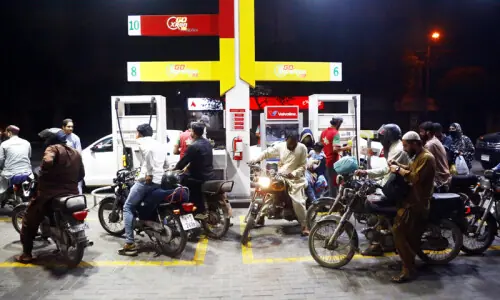
IT was a sad but apt commentary on President Pervez Musharraf’s eight years of rule that most parts of the country had plunged into darkness when he began his televised address on Wednesday. The nation had been facing frequent power cuts for several weeks but the situation worsened towards the end of December when Wapda enforced a daily four-hour shutdown to bridge the 2,000MW gap in demand and supply. The authorities blamed low water releases from dams and suspension of gas supplies to thermal units for the reduced generation. The situation deteriorated further this week when the duration of the blackouts was doubled as the power deficit peaked at 35 per cent of total demand due to the disruption of oil supplies to producers in the wake of the recent violence. The damage done in a subversive attack on HubCo’s 600MW transmission lines on Jan 1 also added to the growing power woes.
The authorities have sought public cooperation to overcome the crisis. PepCo has promised to halve the blackout duration by the third week of this month as thermal power producers start operating at their full capacity and additional water becomes available for generation. Yet the crisis has underscored the fact that not a single megawatt has been added to the country’s generation capacity in ten years. That brings us to the real source of the persistent power crisis — lack of political will, planning and foresight on the part of the Musharraf government that has presided over what is described as an ‘economic boom’. The demand for electricity grew by an average of 1,500MW per annum during the last five years but nothing was done to meet the additional requirement. What was added to the national power grid during these years was 286MW of rental generation. Hydel generation was made a source of inter-provincial discord in the early 1980s and the only project undertaken since 1994, Bhasha Dam, is scheduled to be completed in 2016.
The government’s thermal energy policy fell flat and failed to attract the required private investment. Now we hear that the government is formulating a new policy. The new document is unlikely to woo private investment unless a heavy price and guaranteed return is assured. The crisis has the potential to threaten the country’s food security, force industrial closure and cause economic recession. The enormity of the crisis demands that the government must take both short- and long-term decisions to overcome the power shortage. Short-term measures would entail the diversion of development resources to thermal generation. Replacement of existing boilers at sugar mills with high-speed technology can also make an additional 3,000MW of electricity available to the country. The long-term solution — hydel generation and foreign investment in thermal power — requires that the country move peacefully to democratic politics as early as possible.
Health-care blues
THE promulgation of the Sindh Health Institutions (Establishment and Management) Ordinance by the provincial governor, making room for the government to put in place a board of governors to run the affairs of any public-sector hospital, has indeed come as bolt from the blue. Similar steps that were taken earlier in respect of the Civil Hospitals in Karachi and Hyderabad failed to produce any tangible improvement in the services offered by these two health institutions. If anything, the move has taken the unfortunate path that seems to have been the fate of government decisions in several other spheres of our national life: from bad to worse. Similar experiments done in the province of Punjab since 2003 have proved to be no different either. In fact, so disappointing was the outcome that a major reshuffle had to be incorporated in certain public-sector facilities, like for instance Mayo and Lady Wellington hospitals. Once they reverted to the old system, these hospitals have shown improvement in all areas, and that has been acknowledged by the Punjab government itself. Seen in this context, the ordinance now promulgated in Sindh has the potential to raise eyebrows, and may we say not without reason.
Having said that, experience also shows that the concept of having a board of governors running a public-sector health facility is not inherently flawed. In fact a watch-dog body that honestly monitors the working of an institution should, technically, streamline its operations and inject transparency in the organisation as a whole. What is actually worrying is more the manner in which this concept is executed on the ground. It has proved to be a big failure. More often than not, retired personnel from the civil and military bureaucracy have been hired to head the board which has members drawn from various fields. With such a composition, the board is often in no position to stand up to pressures from several quarters as well as government interference. Also missing from the equation is a professional, long-term vision about the nature of the overall health-care delivery system. Sitting on huge budgets — as huge as Rs3m per day excluding staff salaries — demands vision, professional exposure, managerial competence and commitment in equal measure to make the right choices. Past experience has certainly left a lot to be desired on some of these counts.
Disaster management
MANY cities in other countries have a disaster management cell and, in some cases like India, also an overall disaster management authority. In the case of the federal capital, however, despite two
major disasters in recent years — namely the collapse of Margalla Towers in the October 2005 earthquake and the fire at the Shaheed-i-Millat Secretariat in January 2002 — such a cell has yet to be established to provide an integrated approach to disaster management in the city. Although an attempt was made to create such a cell after the Margalla Towers incident, with the Capital Development Authority making budgetary allocations for this in 2006-07, the plan has apparently been put on hold with no new provisions being made for financing it in 2007-08.
No doubt there already exist several disaster response agencies like the Emergency Relief Cell, the Pakistan Red Crescent Society, the National Crisis Management Cell and the more recently established National Volunteer Movement. But these are not agencies specifically tasked to coordinate and handle emergencies in Islamabad. The capital needs its very own disaster management cell that can coordinate the usage of resources and manpower between the city’s various agencies during emergencies. This cell should be responsible for working out ways in which different government agencies, hospitals and people can coordinate in handling disasters. It should be responsible for systematically tackling bottlenecks by involving as many departments and people in the task, coordinating with the fire department, the city police, the electricity department, the water department, the health department, the Pakistan Red Crescent Society, etc, and specifying tasks to be carried out by each of these agencies. For instance, in a fire disaster, the fire department will be involved in putting out the fire, Iesco will be told to cut off electricity supply to the site of the blaze, the CDA will help in providing access to buildings, and the police will be asked to maintain law and order by diverting traffic from the emergency site to avoid piling up of vehicles. To brace itself for the task of managing emergencies resulting from earthquakes, major fires, floods or nuclear and biological threats, Islamabad needs a disaster management cell not only to coordinate operations but also to provide training of staff.
Two contrasting requiems
THE tragic demise of Benazir Bhutto coincides with the dying days of the praetorian military rule headed by Gen Musharraf whose days seem numbered by every reckoning. The defining characteristic of that era was the deliberate attempt of the regime to establish the supremacy of the military over civilian institutions.
The pervasiveness with which this project was implemented was unprecedented. Both the Ayub and Zia regimes, which lasted much longer than Musharraf’s, were far less prone to establishing such overarching hegemony.
The civil-military face-off reached a climax with the dismissal of the Chief Justice in March 2007 on the basis of an untenable reference against him by the president, which sparked a lawyers-led struggle by civil society against the military regime and opened the possibility of democratic change. Despite the turn in the tide of domestic and international public opinion against him, General Musharraf succeeded in getting himself sworn in as president for a new five-year term. A series of Machiavellian moves beginning with the imposition of the emergency on November 3 by the COAS and ending in its lifting on December 15 by the president after his retirement from the army, with General Musharraf playing his favourite double role of Dr Jekyll and Mr Hyde, helped him achieve this bizarre feat.
However, even before Benazir’s tragic death, which has all but sealed the fate of the Musharraf regime, two events — both tragic and unfortunate— served as the silver lining in the dark clouds that have pervaded since the regime came to power. The first event was the October 2005 earthquake which brought forth a groundswell of sympathy and material support from the people of Pakistan, and resulted in a relief and rescue effort in which the entire nation participated on a scale and with a commitment unparalleled in the country’s history.
For a few months towards the end of 2005, Pakistan stood united and focused as never before, creating opportunities capable of transforming the country from a security-oriented state on the verge of being declared a failed state into a welfare state. But the military never yielded the commanding heights and turned the earthquake-affected areas into a large camp of refugees living on handouts.
The second event that captured the imagination, hearts and minds of a significant and important section of Pakistani society, and raised hopes for its intellectual and moral emancipation, was Chief Justice Iftikhar Chaudhry’s firm stance against his illegitimate suspension by General Musharraf in March 2007. Instead of meekly giving in to the president’s demand that he resign from his post or face a lengthy process of litigation and humiliation on trumped-up charges, the Chief Justice decided to challenge the legality of the reference against him and his suspension from office, which was itself unlawful. He refused to yield to the intimidation of the intelligence chiefs who were on hand when General Musharraf called him into his military camp office in Rawalpindi.
The general, who had become accustomed to trampling the Constitution at will to suit his needs, seemed to have no idea of the disaster he was going to bring upon himself and the nation by this wanton act motivated by his desire to stay in power. If left unchallenged, it would have permanently damaged a basic edifice of the Constitution, viz. the independence of the judiciary. Pakistan’s superior judiciary, in its 60-year history epitomised by the ‘doctrine of necessity’, had seldom shown such courage before.
Justice Chaudhry’s firm stance, despite the outrageous treatment meted out to him and his family during his trial, inspired the legal fraternity and civil society to rally behind him in almost daily and countrywide demonstrations with the chanting of ‘Go Musharraf, Go’ and other anti-government slogans. This gave the nine-member Supreme Court bench hearing Justice Chaudhry’s petition enough courage to quash the illegal reference and reinstate the Chief Justice. But for the determined efforts of the lawyers, led by Aitzaz Ahsan, both inside and outside the court, it would not have been possible to achieve this near miracle.
Since November 3, with the imposition of the emergency, the country was in a state of suspended animation, notwithstanding the formal lifting of the emergency on December 15. With the independent electronic media banished or put under tight control, the non-PCO judiciary deposed, the political parties half-heartedly participating in elections, Musharraf could hardly have wished for more. He and his minions had felt comfortable enough to rig the elections and install a parliament whose composition would ensure their continued hegemony for the next five years. It would, in due course, have received the imprimatur of his patrons abroad, ensuring the continued flow of the foreign aid which has been the regime’s lifeline.
However, the forces unleashed by the lawyers’ successful struggle to have the Chief Justice reinstated began gathering momentum and thwarted the possibility of this bleak scenario becoming a reality. The lawyers were joined by a broad section of civil society, including the media, educationists, students, civil rights and development and women’s activists, as well as common citizens. Although the numbers of the latter were small, they were bound to grow by leaps and bounds once people become convinced of the correctness of the cause of uprightness, fairness and defiance of unlawful authority which Chief Justice Iftikhar Chaudhry and his colleagues have come to symbolise.
A few years ago, a poor peasant woman from southern Punjab, Mukhtaran Mai, had shown similar courage to defy her feudal lords who had made her a victim of gang rape, inspiring the nation by raising her voice against tyranny.These values, to which Benazir’s killing has added reduced fear of death and personal harm, had till now faced the danger of becoming extinct, while hypocrisy, cowardice and lack of integrity were fast becoming the operational norms of society. The March 9 dismissal of the Chief Justice proved a blessing in disguise for the besieged nation. Similarly the December 27 killing of Benazir, which has completely changed the political landscape, may well pave the way for roads not taken and the realisation of dreams which had been turned into nightmares.
The civilian-military confrontation has now reached a new peak with the controversy over Benazir’s assassination and the likelihood of Musharraf’s political supporters being swept out in the coming elections. This has put the regime doubly on the defensive. The general and his legal team have already used up every weapon in their arsenal to contain the public wrath against their diversionary tactics and every red herring to justify their illegal acts. Should the election results fail to follow the intended script, the regime would certainly not be averse to undertaking some more desperate unconstitutional acts to keep itself in the saddle.
But its game is up and the dismissal of the Chief Justice and Benazir’s assassination provide the final acts of the macabre drama staged during the Musharraf era. Its requiem will go largely unsung while the whole nation mourns the death of Benazir Bhutto.
syed.naseem@aya.yale.edu
OTHER VOICES - US Press
Saudi Arabia’s reforms
KING Abdullah of Saudi Arabia did the right thing when he pardoned the ‘Qatif girl’. The perfect injustice of the case, in which a young woman was gang raped and then sentenced to 200 lashes for being alone in a car with a man to whom she was not married, left him no choice. Now another ugly face of Saudi justice has been revealed, one that cannot be explained by religion, ancient tradition or culture. The detention last month of an outspoken blogger, Fouad al-Farhan — only confirmed by the interior ministry this week — is an act of thoroughly modern despotism and one the king should immediately overrule.
Mr Farhan’s website, www.alfarhan.org, has posted a letter from him in which he said he was being investigated because of his writings about political prisoners…. King Abdullah’s announced reforms include the creation of a Supreme Court as well as specialised courts for criminal, commercial, labour and family matters, and the training of legal staff. These plans have been especially welcomed by foreigners doing business in Saudi Arabia …
The case of the woman from the eastern town of Qatif should make clear to the king that his reforms cannot stop at making life easier for businessmen. They must also make life far better for women, who are denied basic legal and social rights, and they must give more legal protection to those who criticise the government.
Defenders of the existing Saudi system argue that change in this traditional society must come slowly. Many Saudis are clearly eager for more and faster change. A Gallup poll conducted last year showed that a majority want more freedoms for women. King Abdullah has demonstrated a laudable desire for reform. He must understand that cruelty, sex discrimination and censorship cannot be part of a modern legal system or a country that wants to participate in the modern world. — (Jan 4)
A health-care emergency
TODAY the Ninth Circuit Court of Appeals will hold a hearing to determine whether the city of San Francisco can fully implement its universal health-care programme while it appeals a federal judge’s ruling that would limit it. The court should grant this emergency order. The health and well-being of the 26,000 residents who could remain uninsured outweighs the hardship employers will face on having to pay extra fees.
US District Judge Jeffrey White’s ruling against the city last week was a serious setback — but it may not be a fatal one. White ruled that by creating an employer mandate to either provide health coverage or to pay fees in order to support a city-run programme, San Francisco violated a 1974 federal law. — (Jan 3)
| © DAWN Group of Newspapers, 2008 |