0
0

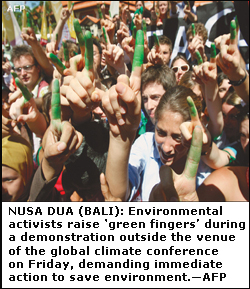 NUSA DUA (Indonesia), Dec 14: Developing nations said they would resist ‘pressure and even threats’ from some rich countries to step up the fight against climate change, as talks on a global climate pact went to the wire on Friday.
About 190 nations are meeting in Bali, Indonesia, in talks that are set to run well into Saturday, when the UN secretary-general will make an unscheduled return to the conference.
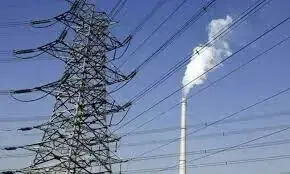
The main negotiating bloc of developing countries, called the G-77, said they were not ready to make new efforts to fight climate change by cutting emissions from fossil fuels. They fear curbs would cramp economic growth aimed at lifting millions out of poverty.
But the UN climate change chief was optimistic about the Bali talks, which aim to launch two years of negotiations to agree on a pact to succeed the Kyoto Protocol from 2013.
“We’re on the brink of an agreement. We’re absolutely not deadlocked,” Yvo de Boer told reporters.
“It’s slower that I had expected but people feel this is a very important journey that they have embarked on,” said de Boer, head of the UN Climate Change Secretariat.
The G-77 comprises about 150 developing countries, including China and India, among the world’s top greenhouse gas emitters.
Developing countries had come under ‘strong pressure’ to curb their emissions of greenhouse gases, said the chairman of the group, Munir Akram.
“The developing countries so far have successfully resisted the kinds of pressures and even threats which we have faced to undertake commitments,” he said, referring to threats of trade sanctions from unnamed developed nations.
“Developed countries want developing countries to have a commitment. I don’t think it’s possible,” said Komi Tomyeba, a member of the delegation from the African nation of Togo.
TAKE THE LEAD:The United Nations wants countries to agree by 2009 on a global climate pact. This would involve all nations, led by the United States, and include big developing countries such as China, India and Brazil.
Kyoto binds all industrial nations except the United States to cut greenhouse gas emissions by an average of 5 per cent below 1990 levels by 2008-12, a first step towards combating the trend to ever more heat-waves, desertification, and rising seas.Rich countries should continue to take the lead, Akram said, identifying the United States as the most reluctant among developed nations to do their fair share under a new pact.
The talks had earlier on Friday received new impetus as the European Union toned down a clash with the United States over 2020 emissions goals for rich countries, raising hopes of a deal to start negotiations on a new treaty.
Indonesia suggested dropping an EU-backed ambition for rich nations to cut emissions by between 25 and 40 per cent by 2020 in a bid to overcome Washington’s opposition.
De Boer said the new draft was the basis for a compromise because it retained a guideline, consistent with the EU’s 2020 target that world emissions should peak within 10 to 15 years and be cut by to well below half of 2000 levels by 2050.
But it was still not clear if the United States and Europe would agree to the text.
“I know that there are some concerns particularly among several countries about this quantifiable target,” UN Secretary-General Ban Ki-moon said on Friday.
“Somewhere down the road we must agree on that but our goal is to launch this negotiation,” he said on a visit to East Timor.
FORESTS AGREED: On other issues, the Bali talks took steps on Friday on a number of issues, including a pay-and-preserve scheme to help developing countries protect their tropical forests.
The agreement would launch pilot projects to tackle deforestation and forest degradation, and contribute to harder proposals in a broader climate pact in 2009, European Environment Commissioner Stavros Dimas told reporters.
Activists danced conga-style around the main hall where negotiators met, singing ‘hot, hot, hot’, after awarding their ‘fossil of the year award’ to the United States and Canada for contributing least to the talks.—Reuters