0
0

Of missing persons and the state’s missing conscience
You may be lost in the eyes of the world, but how can I set you free; When there’s a whole empty world in my aching heart, You’re the missing part of me.
— Susan Musgrave
SEASONS come and go but for the families of the missing persons — as those picked up by the ubiquitous intelligence agencies have come to be labelled — autumn is the one permanent fixture.
They know not when the wait will end and life resume. For months and years, it has been on hold, much like inmates sinking every minute on death row.
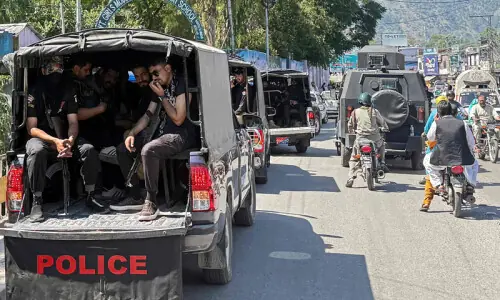
So visible is the strife on their forlorn faces when they assemble almost every other week in Islamabad that one cannot but be shamed by the sheer helplessness at the state-wrought agony.
The only time General Pervez Musharraf tried to explain the “disappearances” was in the wake of the Lal Masjid operation when he plainly dismissed any case (for relief to the missing persons) with acid suggestions that while many (amongst the “disappeared”) had gone astray, still others simply left their own families without informing them.
What does this tell about Pakistan to the outside world — we, of course, are accustomed to how the state has failed the citizens again and again?
With those endless wire images — all pictures of pain — and stories about human spirit flailing precariously between hope and despair, our once-promised land only looks like a remnant of lost civilization.
To be sure, no-one condones any act against the state. But surely, none can be denied the right to defence for any manner of crime. In the case of the missing persons, more than four hundred according to some reports, few if any, have had recourse to a proper trial. Forget trial, the families haven’t even seen their loved ones in the autumn avatar.
They have been crying, not for any favour, but recourse to law — still others only straining for a fleeting glimpse of the missing loved ones, only to breathe in the knowledge that they live. Such is the stuff desperation is made of.
Indifference to their plight at the official level is so acute that it appears the state has lost its soul. In fact, had it not been for the single-minded and undying resolve of Chief Justice Iftikhar Muhammad Chaudhry, probably the sun would have set in the lives of many of these tormented souls, a long time ago.
His mere presence, while being a symbolic harbinger of hope for them, continues to be a major thorn in the side of the powers-that-be, who have been questioned about their role with any degree of authenticity for the first time in the state’s deplorable ‘pick up’ history.
The Constitution Avenue is a familiar rendezvous for the missing people’s families, who gather there at every hearing, emotionally drained and tired of living on the edge.
The hearing itself has turned into a delicate battle between the chief justice-led bench and those ‘invisible’ forces, who are provocatively engaged in finding new ways to keep the ‘recovered’ flock from rising although the word in currency is ‘traced’.
Such description, were it not tragic, would have been comical. After all, how else would one explain the gymnastics of the authorities in ‘tracing’ one missing person or the other that it previously stated it had no information about.
A New York Times dispatch a few months ago on the issue with the chief justice still locked in a legal challenge over his dismissal by Musharraf made for poignant reading.
Recalling the top adjudicator’s resolve to help her like, Amina Janjua, who is leading the fight for the families of the missing under the aegis of Defence of Human Rights, said of a hearing on March 8:
“He was very fatherly. I was in tears. He said: Be comforted. We are using every channel, and every person is going to be released, and we are going to continue the hearings until the last person is released. On March 8, he was speaking like this. The very next day, he was not in his chair.”
Some pundits attribute one of the reasons that invoked the failed presidential action against the chief justice to the judge’s bold and consistent stand on the missing persons.
Whatever be the motive for the General’s indiscretion, it is difficult to find a similar parallel in Pakistan’s judicial history where a chief justice has taken on the powers-that-be, ‘invisible’ ones included, in an attempt to provide justice to a distraught citizenry.
In a hearing last month, he spoke of “irrefutable proof” of missing persons being in the detention of secret agencies and hence warned that if the government did not release them, the court would be compelled to adopt a more standard framework — as in cases of abduction.
For now, the indomitable Amina, whose husband is among the missing, and many like her are in danger of becoming as representative a landmark of the federal capital as any — so profound has been their impact on a city, whose power purveyors caused them the pain for which they seek relief in the same city. No-one should ever have to endure such agony where your eyes remain glued to the door as if asking in mournful numbers... Ghar Wapis Kab Aao Gey? (When will you return home?)
The writer is News Editor at Dawn News. He may be contacted at kaamyabi@gmail.com
Flesh is weak
She lurks in shadows; on dark street corners, in damp, squalid rooms and sometimes in shimmering mansions, smug in borrowed majesty. But whatever her avatar, she is always the crime. Meena is 16 years of age and a sex worker who frequents Karachi’s squalid Napier Road where hard-eyed men throng tiny lanes still awash with decaying pools of monsoon water. She was brought here from Bangladesh at 13, when her widowed mother died of tuberculosis and Meena became a burden on her uncles. “It is silly to even think about my country and home. I don’t know what that means. Besides, I am in pain but am scared to leave as I will be completely on my own,” she says.
But she is fighting hard to survive. Just like Nasreen, whose fondest memories are of the time when her home rang with the children’s laughter and her husband was a hero in the locality. Orphaned in childhood, Nasreen could not have asked for more. But today, as the sun dies, she prepares for yet another night on the sullied streets of Orangi. These streets have kept her alive since her husband, an office- bearer of Muttahida Qaumi Movement (MQM), died in a police encounter. “I was abandoned by everybody I knew and this was the only way out. I couldn’t let my children die and wanted to educate them,” she says. Nasreen, however, is certain that there will be a time when, in another town, life will limp back to dignity. “My son will become an engineer and we will be respectable again. Then I will settle my daughter as well.”
Similar wounds fester across the border but few would dare to call it a crime of faith. Yellawa’s became one of the more famous cases of a renowned Indian NGO Saheli, one of the first in India to fight HIV in red light areas. She was an eight-year old who became a Devadasi or a temple virgin —girl slaves to the gods. Her parents gave her away in exchange for a prayer for a son. When Devadasis come of age, they become the property of the priests and can be hired out. Although this practice is now illegal, it is still prevalent in many districts of Karnataka. Reportedly, Yellawa’s journey began in a sleepy village in Karnataka and ended in a seedy Mumbai brothel, where at 32, she continues to help an NGO battle AIDS. She has been quoted in many social development journals as saying that she is still in the business because she cannot get a job with this stigma.
Cut to swankier environs in Lahore where glossy surfaces belie higher stakes. “If I leave, my keepers will hunt me down,” says Nadia, (name changed) who is an actress but continues to work as an escort. “If I get lucky, someone will marry me but I have to work to save as I don’t want to return to where I came from. I am rich and used to material comfort,” she explains.
From circumstance to sanctified prostitution such as Yellawa’s, these women have known betrayal intimately. They also know the hazards of the flesh trade well but their fear of the unknown is far stronger than a desire for security. International NGOs may have fought long and hard to enforce health measures in these localities, but if such initiatives are armed with large-scale counseling, it may enable these workers to muster up more confidence for newer challenges. Surveys declare that up to 80 per cent of sex workers are victims of either abuse or disease and that prostitution rises in times of displacement and is more rampant in areas affected by terrorism and war. Experts maintain that women are the hardest hit in times of turmoil and economic crises as they have neither occupation nor resources. However, the West cashes in on these tragedies by using these dispossessed women for sex tourism in places such as Amsterdam and Bangkok. Activists say that such conditions create refugees and women turn to prostitution for food and shelter.
It is also the duty of the civil society to give them a fighting chance at life by making employment available. Also, literacy drives and small handicraft centres in these localities may provide them with choices they never had. These are lives without context and all they are likely to leave behind, is more fear and despair.
| © DAWN Group of Newspapers, 2007 |