0
0

The quest for freedom
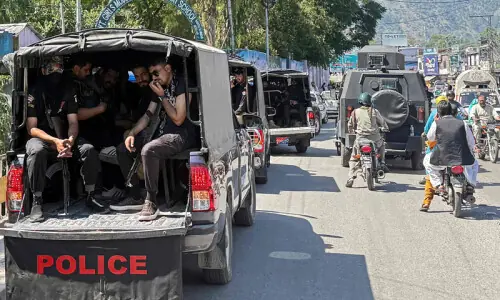
 A villager, Razzaq, from the interior of Sindh received an SOS call from his younger brother, Haji, employed by a milk trader in Karachi, asking for refuge from the police as he had knocked over a girl in an accident recently.
Razzaq rushed to the dairy farm in Cattle Colony where Haji used to work, despite the fact that he was not very familiar with the City of Lights. He could not find him there and was told that Haji might be with the milk trader at his shop at Ranchore Lane, off M.A. Jinnah Road.
He got on a truck taking milk from the farm to the shop and upon reaching the shop the employer told him that since the police and the deceased girl’s family were after his brother, he had not only provided him a safe hideout but had also given Rs30,000 as compensation to the family and Rs5,000 to hush up the police.
Forbidding Razzaq and Haji to meet the aggrieved family, the employer bound them to pay off the debt within two weeks or work for him for seven months without salary. However, Razzaq sensed something fishy in the trader’s narration. He could not believe that the trader could give such a big amount without prior consultation with any of them.
Haji, meanwhile, told his brother that he was not sure if the girl had really died as he was riding a bicycle when he had hit her. Razzaq managed to get the matter checked out from the duty officer at the police station concerned, who confirmed that there was no accident of such a nature.
Now the two brothers were sure that the trader had made a mountain out of a molehill to cheat them and get bonded labour. Instead of confronting the trader, the poor villagers quietly left for their hometown without any fear of arrest.
Though the trader failed in his evil designs and the two brothers were fortunate enough to find their way back, luck does not favour everyone every time and many do fall prey to such traps. This incident is just the tip of the iceberg as over 1.7 million haris remain in bondage across Sindh, according to a study of the Human Rights Commission of Pakistan.
With growing poverty and joblessness bonded labour is taking roots in the multinational companies and the booming media industry as well, though there the bonds are not life-long. Such bondage is more common among the haris of Sindh, where the poverty and illiteracy of workers is exploited. The landlords are too willing to advance loans to their workers, albeit on phenomenal rates of interest. The loans as such never get repaid and the indebted workers, as well as their families, are bonded for life.
Sometimes the bond is passed on from one generation to the next and from one landlord to the other. Women and children have to share the burden of the credit and are obliged to work without remuneration. It is psychologically crippling for them to know that they have been robbed of their freedom. Worse still they are subjected to abuse of all kinds — sexual, verbal and physical.
This is the price they have to pay for their poverty and ignorance. They do not have NICs and very little recourse to legal intervention. Local police turn a blind eye to such practices due to their strong ties with the landlords, while the politicians are lax about implementing the relevant laws.
After all, getting a bonded worker’s vote is easier than a freeman’s.—H.A.
Exempt the exempted!
I am among the millions of practising Muslims who could not observe the Ramazan fast for health reasons. I fully adhere to the Islamic values and norms pertaining to the sanctity of Ramazan and respect the feelings of the fellow fast-observing faithful.
However, despite complying with all the religious and legal obligations, I am often confronted with a situation where I am ruthlessly dealt with by some rozedars, who are supposed to demonstrate the highest degree of tolerance in the holy month.
It may be many people’s experience that the rozedars’ attitude towards others turns crude during the fasting period, i.e. from dawn to dusk, especially in harsh summers. There may be a lot of reasons for this but one thing is quite clear: our society has become increasingly fanatical.
Until 1977, when there was a political upheaval involving the liberal-minded PPP at one side and the crusaders of so-called Islamization on the other, things like prosecution for committing blasphemy and legal action for breaching the sanctity of Ramazan did not exist. Even fast-observing Muslims used to operate eating houses during the daytime, though behind a curtain.
Now, nobody is allowed to eat, drink or smoke in public. Although different quarters have constantly been opposing the curb, all moves to get it annulled have so far met with failure owing to stiff resistance from fanatics. Karachi, unlike most other cities, towns and villages of the country, gives a look of a partial strike during the day in Ramazan. It seems as if only Karachians are supposed to comply with the religious obligations.
Those who can observe the fast face no problem, but what about those who have been exempted from fasting by the Almighty? One must consider that the number of the exempted is not meagre. There are millions of minors, sick people, the weak, the elderly and, of course, travellers and non-Muslims.
The state, however, recognises only non-Muslims and travellers as fit cases for exemption and allows them to benefit from the relaxation. Food outlets are thus kept open at railway stations and airports. But in many cases airline passengers are denied the relaxation and non-Muslims are forced to hide themselves while eating or drinking. Interestingly, some ‘influential’ Muslims are often seen breaching the rules without let or hindrance.
What should the sick, the weak and the elderly do if they have to eat or drink something while they are away from home? This question has never been answered by the fanatics, who think the curb cannot be relaxed come what may.
However, some youths who defy the obligation of fasting have many options open. They find places within their educational institutions, offices, shops etc where they can smoke or have a meal. And if possible, they can also sneak into a hospital where canteens remain open and food is served to patients and their attendants. Also, there are some localities inhabited by non-Muslims where one may have meals in public without fear of being penalised.
This gives one the understanding that the denial of the exemption allowed by the religion is as impracticable and ridiculous as the law of jungle, where the sick, the weak and the elderly creatures cannot survive.—Awam
Compiled by Syed Hassan Ali
Email: karachian@dawn.com
The panacea is solid waste management
 Bureaucracy is said to be a method for transforming energy into solid waste. But unfortunately Pakistan, where the phenomenon is most pronounced, lacks solid waste management. So the solid waste our bureaucracy produces continues to pile up, making life more miserable.
Our men of power and influence sitting in Islamabad hardly debate issues and their solutions. Since most of them operate in overlapping spaces, spending much time barricaded in offices that only few leave before dark. So engrossing are the movements on the chessboard they hardly find time to think of other things than promotions, postings, plots and salary packages. Who is worth how much in cash and kind is not very often discussed as their estimates about each other are more or less correct to the last thousand. Who is retiring and who is going to get an extension, whose services will be rehired at fat packages and who is and who is not getting close to the President or the Prime Minister are pet topics of hushed whisperings.
Their pet occupation is ‘meetings’, to form committees, stack up fresh files on old files and yet deliver little. For them it is said “a committee is a group that keeps minutes and loses hours”. They are public servants by definition only, in reality they rule. The extinct class of public servants to which at one time super-bureaucrats like Qudrattullah Shahab, Ghulam Ishaq Khan and Roedad Khan belonged has now been replaced by the likes of Tariq Aziz and Dr Ashfaq Hassan Khan. Of totally different species both have acquired the position from where they can manipulate governance and policy making.
Mr Aziz draws his influence from the President and has a role in almost everything. He is secretary National Security Council in name only; his powers stretch from internal security to secret talks with India on Kashmir and negotiations on power sharing between the military and the Pakistan Peoples Party. Originally, believed to be a man of Chaudhrys of Gujrat, Tariq Aziz successfully made it to the Musharraf camp after the 1999 military coup for being his classmate at the F.C. College, Lahore. Since then, he has emerged as the key aide of the President and has maintained this role even in turbulent times. This is, perhaps, for the reason that despite enjoying so much power, he keeps a low profile away from public view. He is known as a real king maker.
Dr Ashfaq Hasan Khan on the other hand is close to the Prime Minister and has played his chips smartly to gather sufficient power and sway through his economic and financial policy work. He officially wears three caps — one more than the incumbent President of Pakistan. Unofficially, he has assumed or has been given three more responsibilities and is nicknamed ‘Maimar-i- Maeeshat’ (Builder of the Economy). Hardwork could be one — not the only one — of his qualifications but he is the only exception (President Musharraf being the other) among three million government servants whose triple role in office is protected through a constitutional trick.
A grade-21 officer of the economic group, Dr Ashfaq is basically an Economic Adviser to the Ministry of Finance. Half a decade ago many still remember him complaining about how he was being ignored by the then finance minister (now prime minister). But things changed dramatically, courtesy some friends in the ‘anti-Pakistan lobby’ — a term he now uses for the journalists. A new post was created and he was appointed as director-general of Debt Coordination Office, in MP-1 scale. Overnight, he graduated from Rs32,000 per month to an open ended package worth Rs0.3 million, without retirement, resignation or re-hiring. Nothing, however, changed in his office, not even the files and chairs that he used to have before. This is perhaps a unique arrangement never enjoyed by any government official. Of late, he has also been appointed as Special Secretary Finance, without any summary from the concerned ministry. The package now stands inflated to about half a million.
“I draw only one salary and work a lot”, he volunteers saying “some people think I am getting three salaries which is not true”. However, his role as DG Debt attracts criticism from other finance ministry officials because that allows him to have a package at least three times higher than his batch-mates. The critics seem justified to some extent. At a post-budget press conference a couple of years ago he was unable to respond to simple questions about the debt Pakistan had, creating an embarrassing position for the government.
His posting as DG Debt and the package it carries has now intelligently been protected through Finance Bill 2007. The catch is that his salary would fall down to Rs50,000 or so per month like his batch-mates if this parliamentary protection is withdrawn. Many say that he has not been able to deliver what he was required to as DG Debt and his only achievement has been the publication of an annual debt policy statement. His colleagues also feel jealous when he travels abroad to attend quarterly board meetings of various banks and companies with government shareholding and is paid attendance fee at the rate of $4000- 4,500 per meeting. Many officials say the Higher Education Commission (HEC) has now embarked upon a drive against plagiarism but nobody took notice when his article on the first 365 days of Prime Minister Shaukat Aziz was published on the finance ministry’s website and the same article appeared in newspapers in the name of one of his subordinates. It was unclear who the real author was.
Those who attend economic meetings say he has the guts to prevail upon federal secretaries and even ministers to reach conclusions and decisions. He is the only public servant of any cadre outside Information who formally attends daily meetings with the prime minister in the morning to review media reports and make coverage strategy for the day.
He is the official spokesman for the ministry of finance. In addition to all these duties, he has taken upon himself to declare those journalists as ‘anti-Pakistan elements’, ‘negative and cynical’ who take the liberty to question the government on any social or economic matter. His spin of economic realities is often reflected in the speeches of President Gen Pervez Musharraf. When asked how much input he gives for the President’s lectures, he smiles and answers the question with a question “have you really noticed that?” “Had I been so close to the President, I would have been governor of the State Bank of Pakistan”, he adds. This was his dream that has so far not been fulfilled.
TAILPIECE: The Governor of the State Bank of Pakistan, Dr Shamshad Akhtar, felt very upset last month when she received a call from adviser to the prime minister on finance Dr Salman Shah in the midst of a board meeting. She excused herself to leave the meeting and when she returned she told the board that the government wanted no change in the monetary policy. But she had to exercise her independence as governor central bank. She took the board into confidence and decided to further tighten the monetary policy, instead of toeing the government line. The board gave full support. She herself is on leave of absence from the Asian Development Bank — many believe an example of conflict of interest. Others think it was a question of conscience and everybody was free to take own decisions in this regard.
Revised master plan devoid of transport planning
THE capital’s revised master plan, the layout of which was published in Dawn last week, envisions transforming Islamabad from the scenic city of bureaucrats and diplomats into a culturally vibrant city bustling with commerce, industry and tourism by the year 2030.
Residents are already beginning to get a feel of the new Islamabad with the completion of several major road improvement projects in the city, the most notable of which is the signal- free Seventh Avenue with five underpasses, inaugurated last month.
The other ongoing and upcoming road improvement projects — including flyovers at Zero Point and at the intersection of Jinnah Avenue and Faisal Avenue, and a new 34-km-Margalla bypass which, as evident in the revised master plan, runs along the foothills of the Margalla Hills and serves the new GHQ and an expanded Diplomatic Enclave — will hopefully give Islamabad one of the most efficient road networks in any Pakistani city.
However, one important aspect that seems to be missing in the revised master plan is transport planning within the city of 1.2 million people. Land use planning, particularly in road network, ought to go hand in hand with transport planning since the two are closely related. But the revised master plan is apparently devoid of any material proposals for the development of the transport/transit sector to meet the commuting needs of the population in Islamabad, in particular, and that of the twin cities, in general, (Terms of Reference for the Feasibility Study of a Rapid Mass Transit System for the Twin Cities, July 2007).
However, outside of the revised master plan, and without apparently first carrying out a general transportation study or formulating a general urban transport plan and policy, CDA and the railways ministry have both announced plans for a rail-based Rapid Mass Transit System (RMTS) for the twin cities.
In fact, CDA has recently invited bids from international consultants for a feasibility study and reference design for an RMTS for the twin cities.
Although the twin cities are characteristically very different from each other in history and identity, they have nevertheless developed into a common labour market. Their combined population totals 2.78 million, and is expected to increase to 7 million in 25 years’ time, according to the Terms of Reference for the Feasibility Study on the RMTS for the Twin Cities. It is also estimated that 525,000 people commute daily between the twin cities with an estimated public transport demand of at least 158,000 people.
Although roads and highways have been growing with the traffic in the twin cities, traffic volume is growing faster than the progress needed to widen them. Moreover, public transportation has not developed commensurate with the population and road network.
Since the gradual deregulation of the state-run urban buses from the 1970s to the 1990s, the consistent lack of a visionary plan for an urban public transport infrastructure has resulted in the emergence of a system of fragmented services in the twin cities carried out by a large number of individually operated small vehicles that include mini-buses, coaches and taxis. That this system is not well coordinated and not efficient from an overall perspective has been documented in the print media.
Not surprisingly, the RMTS Terms of Reference document cited the ‘totally missing bus services,’ ‘increasing congestion and environmental pollution due to rapidly increasingly vehicle numbers and the use of old vehicles particularly for the minibus fleet’ and ‘overcrowding on mini-buses’ as justifications for a rail system for the twin cities.
But judging by urban public transport policies in many other cities abroad, any efficient and constructive transport model is usually based on a combination of rail and bus rapid transit rather than a rail only transit system. Most mass transit rail systems in other cities elsewhere are complemented by dozens of bus routes timed to connect with the trains making it easy for people to get to work, school, shopping or wherever they need to go.
In fact, a study twelve years ago conducted by the now defunct National Transport Research Centre of the ministry of communications in conjunction with foreign consultants had looked at two mass transit solutions for the twin cities, viz., a bus only system and a mixed light rail-cum-bus system (Greater Islamabad-Rawalpindi Area Transportation Study, September 1995).
But since then, several attempts to launch and run some sort of a bus rapid transit system in the twin cities (e.g., the Varan bus, the Green bus, etc.) have persistently run into problems, although successful bus services are being run in other cities in the country. In the latest attempt, reported in an English daily last week, recent bidding for launching a bus service in the twin cities, in which some 11 companies apparently applied, was mysteriously cancelled.
The actual reason behind the failure so far to establish a simple bus system in the twin cities is not clear, although reasons like loss of employment for thousands of small transporters (mini-buses and taxis) and thus, pressure from the existing transporters and their influential supporters against a bus system, have been cited in the press. Another reason could be competition between the authorities in Islamabad and Rawalpindi in launching a bus system for the twin cities.
Whatever the reason, addressing the issue as soon as possible and coming up with a solution is necessary because the efficiency and success of the proposed rail-based mass transit system for the twin cities depends in large part on the simultaneous establishment of a coordinated bus system to provide crucial supporting services to the rail network.
| © DAWN Group of Newspapers, 2007 |