



 0
0

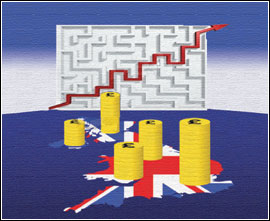 Assets under management of the UK fund management industry increased for the fourth year running in 2006 to a record £3,836 billion according to International Financial Services London’s (IFSL) Fund Management 2007 report.
The 9.7 per cent growth in 2006 was due to strong economic growth and rising equity markets. The UK is the second largest fund management market after the US. It is by far the biggest centre in Europe.
London continues to be the leading international centre for fund management with around 30 per cent of its funds under management from overseas.
UK institutional funds (pension funds, insurance companies, local authority), were the source of two-thirds of funds under management. Around 17 per cent came from retail funds (unit and investment trusts), 11 per cent from alternative funds (hedge funds, property funds and private equity funds) and the remaining 10 per cent from private clients.
Fund management makes a significant contribution to the UK economy, accounting for 0.69 per cent of GDP, generating revenue of £12 billion and employing over 50,000 people in 2006. Net exports of fund managers’ services rose by 17 per cent in 2006 to a record £2.47 billion.
Worldwide conventional fund management assets (pension, insurance and mutual funds), reached $61.8 trillion at the end of 2006, up 15 per cent on the previous year and 72 per cent on 2002. Pension assets totalled $22.6 trillion, with a further $17.4 trillion invested in insurance funds and $21.8 trillion in mutual funds.
Assets under management of the global fund management industry nearly doubled between 2002 and 2006 as a result of rising equity markets and strong economic growth.
The UK market is relatively concentrated at the top end with the top 10 fund managers accounting for around a half of UK funds. There are however many medium and small players on the market. Barclays Global Investment Managers was by far the largest UK registered investment manager at end-2006 with $1,623 billion under management. Substantial restructuring in the UK industry in recent years has reflected global developments.
Recent consolidation activity included the merger of Black Rock and Merill Lynch Investment Management, buyouts of Jupiter from Commerzbank and of Gartmore from Nationwide Mutual. Some of the mergers have not only been between asset management firms but have also included related industries such as banking and insurance as firms seek to diversify.
Fund managers have an array of investment choices available to them at home and overseas including equities, bonds, property, and cash. In recent years fund managers have increased their allocation to non-traditional asset classes such as commodities, hedge funds and property.
Around 75-80 per cent of UK institutional assets are managed actively. Third-party insurance and in-house insurance have the largest proportion of active management (around 95 per cent), while corporate pension funds (65 per cent) have the smallest proportion.
Around a half of UK institutional funds are invested in equities although this proportion has been falling over the past decade. As some pension funds are facing a deficit, there is a heightened awareness of risk. In 2006, for the first time, UK pension funds allocated more funds to overseas securities than domestic equities.
UK government bonds accounted for around a fifth of UK pension funds’ investments in 2006 and around seven per cent was held in property. The use of derivatives as a means of facilitating the transfer of risk and implementing tactical asset allocation decisions has become a common feature of many fund managers.
While there is no official figure for the contribution of fund management to the UK’s GDP, IFSL has made an estimate by applying cost margins indicators to total funds under management in the UK. According to this measure, fund management generated around 0.69 per cent of GDP or £8.0 billion in 2006. It is therefore an important component of the financial sector’s overall contribution of around 9.4 per cent.
Fund management’s wider contribution to the economy stems from its promotion of the UK’s capital market and from the many links fund managers have with other financial services providers, particularly banks, securities dealers and information providers.
IFSL estimates that fund management margins (profit /revenue) increased to around 30 per cent in 2006, extending the recovery of the previous four years. The increase in margins in recent years was largely due to a reduction in costs, an inflow of new money and an increase in prices. The recovery was more evident in the retail sector. Prior to this, for most of the 1990s profit margins were relatively stable, fluctuating between 29 and 33 per cent before falling sharply in 2001 due to equity market declines.
In an effort to reduce costs, a number of firms have consolidated fragmented back-office operations into centralised infrastructures. Some firms have outsourced back-office processes while others have moved services such as transactions processing, IT services and call centres to offshore locations.
Offshore transactions have been more common amongst firms based in the US, UK and Asia, while firms in France, Italy and Germany have been reluctant, partly due to the language barrier.
The annual World Wealth Report published by Merrill Lynch and Cap Gemini (MLCG) estimates that the number of people with financial assets in excess of $1 million increased 8.3 per cent in 2006 to 9.5 million. Their combined financial holdings totalled $37.2 trillion, up 11.4 per cent on the previous year. This means that the private wealth industry is larger than the global insurance industry, pensions industry or mutual funds industry.
However, these categories overlap since the private wealth industry is also an investor in ‘conventional assets’.
The growth in private wealth assets in 2006 was due to a steady increase in real GDP and stock market capitalisation, the two primary drivers of wealth creation. Growth was particularly strong in Latin America, Eastern Europe, Asia-Pacific, Africa and the Middle East. Based on MLCG’s report, Europe and North America were the major sources of private wealth with 57 per cent of the total wealth at end-2006 and 64 per cent of the number of HNWI (High Net Worth Individuals).
HNWI from Asia held 23 per cent of wealth and those from Latin America 14 per cent. The Middle East and Africa together accounted for the remainder. A report by The Boston Consulting Group, estimates that the total value of assets managed on behalf of all investors totalled $88.3 trillion in 2005.




























