Are we having fun yet?
CONTRIVED fervour and August 14 go together. Maximum mileage is extracted from patriotic songs composed in the seventies, a time when there was still hope, with a bit of jhankaar thrown in to give the exercise a veneer of currency. People who defraud the exchequer on a daily basis fly the flag proudly, and children who have been taught that our history began with the Arab invasion march up and down schoolyards in scenes right out of Monty Python.
And yes, PTCL lets you call anywhere in Pakistan free of charge. Azadi mubarak! Haanji, aap ko bhi azadi mubarak! People feel so free they can barely contain their passion, and who can blame them. The human brain can tolerate only so much excitement.
Throughout the day it is reasserted that Pakistan was created in the name of Islam, when in actual fact the idea was to carve out a separate homeland for Muslims. Easily conflated, the two notions may share commonalities but are strikingly different nonetheless. One is a religion and the other a cultural identity, an altogether more complex notion that does not lend itself to ready definition. The tenets of faith though are relatively clear-cut.
One school of thought has it that tolerance and reason only pollute the soul and lead you astray from the true path. This view, tragically, is catching on in Pakistan.
The identity crisis is understandable. We do, after all, sing or mime a national anthem written almost entirely in Persian, a foreign language that few adults, let alone children, can even begin to understand. Day after day, we must suffer the falsehood perpetuated by our self-appointed guardians that the roots of Pakistani identity lie westward — not in Europe, perish the thought, but the Arab world. Nothing could be further from the truth.
Other than the religion of the majority, we have little in common with the Arabs — not language (save some nouns, proper and otherwise), not dress, not food, not music. If there is at all a need to look further than the Indus for our origins, the eye ought to be cast towards the east, not west.
But I digress. The topic of the day is choreographed, colour-by-numbers ‘fun’ and our national obsession with the purely ritualistic.
Take Eid, for instance. Non-human animals are slaughtered as a matter of course and men touch shoulders — one, two, three, I am free — like dinky toys powered by battery cells until everyone resigns themselves to desultory chit-chat and unmitigated boredom. A few do clasp you to their bosom with genuine relish but then their motives are not always above board.
And so the long day wears on, year after year, without a spark of spontaneity. It is much the same on the other Eid, save the blood and gore.
Our barely literate mullahs, even some of the ulema, take pride of place among those concerned only with ritual. Instead of focusing on genuine problems — poverty, lack of health care, the destruction of the environment — they remain obsessed with the right or wrong distance between paincha and foot, and whether or not taking a leak while standing upright is Islamic. That is the level of our ‘religious’ discourse, for the most part at least.
Noise features prominently in our celebrations. On August 14 this year and the days preceding it (until the rain bunged a massive spanner in the works), the city government blasted songs from loudspeakers all evening, whether you liked it or not. Boating trips on the Bagh-turned-Jheel Ibne Qasim would have been more captivating.
On New Year’s Eve, we all know, motorcycles are stripped of mufflers for maximum effect. Assault rifles are fired in celebration at midnight — really, I wasn’t expecting that, how imaginative can you get? No one tires of this, apparently, like the attention-deficit-order boy downstairs who keeps exploding patakhas through Shab-i-Baraat and the next three weeks.
Subjecting neighbours to night-long torture is now part and parcel of our wedding rituals. Why should you be asleep when I’m not, and to hell with the fact that your babies are crying from the full-bore jhankaar assault.
I wonder how much of this ‘joy’ is genuinely felt and how much is mere proclamation. Who knows. Some things are never fully explained.
My personal take is that the citizens of the concrete jungle, particularly the unempowered, find ruckus cathartic. I make noise, therefore I am. Never mind if it’s fleeting. Tomorrow I’ll be running errands on my bike but today, world, hear me roar. You have to listen to me; for once you have no choice in the matter.
That’s all very good, if not excellent. It would perhaps be more meaningful though if the occasion were not sanctioned by the system and the mode of behaviour ordained in advance. What you’ve got down pat, brother, is the role of the performing monkey which by definition is a sad and unnatural state of affairs.
Having fun need not follow a formula. Maybe that’s the privileged person in me thinking out loud, but then I know a lot of people who can’t make ends meet and yet shun the madding crowd as much as I do. Make of that what you will.
The thing is, most people like manufactured ronak. Line up here, ticket katao. It’s all very brightly lit, folks, don’t be scared. Enter here, stick to the footpath, enjoy the stunted bushes and paan-smeared flower beds, have a Pepsi plus fries and exit at the designated point. Loads of fun for everyone. Or take the muffler off and make a lot of noise with your motorcycle. You’re allowed to, after all, for a day.
The crime situation probably has something to do with this pre-programmed toeing the line, there being no shortage of thugs and loonies in the concrete jungle. People feel more comfortable in a crowd, and that is truly tragic.
Enough said, for now.
imalik@dawn.com
Urdu, Baba-i-Urdu & Pakistan Movement
 IN the first chapter of his book 'Pakistan: the formative phase’, Khalid Bin Sayeed has given an interesting account of the conflicting views about the origin of Pakistan. The learned author has given many diverse views, citing, for example, British policy of divide and rule, Muslim anxiety and the Quaid-i-Azam’s determination, but in the conclusion he writes:
“Each view taken by itself is a highly exaggerated account of the origin of Pakistan. Each, perhaps, played its role and Pakistan was brought about by a multiplicity of the factors. But perhaps a dominant or decisive cause of Pakistan is that there has never taken place a confluence of the two civilizations in India – the Hindu and the Muslim. They may have meandered towards each other here and there, but on the whole the two have followed their separate courses – sometimes parallel and sometimes contrary to each other.”
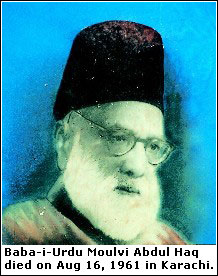
Historians concur that it was the zeal of the writers, poets, journalists, scholars and intellectuals that created awareness in the Muslims. They agree that Altaf Hussain Hali, Maulana Muhammad Ali Jauhar, Akbar Allahabdi, Allama Iqbal, Maulana Zafar Ali Khan and many others brought about the cultural awakening of the masses. But Baba-i-Urdu Moulvi Abdul Haq’s role is downplayed, though inadvertently, perhaps under the misconception that he was merely a scholar of the Urdu language and secretary of Anjuman Taraqqi-i-Urdu. But it was he who fought on the linguistic and cultural front, countering the efforts of the Hindu revivalist movements to make the Hindi language an icon of Hindu culture and religion. Emphasising the cultural importance of Urdu for Muslims, Abdul Haq worked with a nationalistic spirit. It is a well-established fact that after religion, the most important role in the Independence Movement was played by the Urdu language. The emergence of Muslim nationalism owed much to the Hindi-Urdu controversy. Baba-i-Urdu’s part, as any student of Indo-Pakistan history would tell you, in strengthening Urdu’s case at a historical juncture was pivotal. It would not be wrong to say that he had devoted his entire life to Urdu’s cause.
Baba-i-Urdu Moulvi Abdul Haq was born in Sarawah, a village near Hapur (District Meerut), on Aug 20, 1870. He got his early education in Ferozepur, Punjab, where his father Shaikh Ali Hussain had settled. Graduating from Aligarh in 1895, Moulvi Abdul Haq had the fortune of meeting there luminaries such as Sir Syed Ahmed Khan, Prof Arnold, Shibli Naumani and Altaf Hussain Hali. The would-be stars of the Indo-Pakistan sub-continent such as Maulana Zafar Ali Khan and Dr Ziauddin Ahmed were his classmates.
A few years later, Abdul Haq went to Deccan, the princely state in South India, and worked there on different posts including headmaster, translator, assistant to director of education, inspector of schools, director of the bureau of compilation and translation and principal of Usmania College.
Abdul Haq was made secretary of Anjuman Taraqqi-i-Urdu in 1912. The Anjuman was created in 1903 in Aligarh with Prof Arnold as president and Shibli Naumani as secretary. It was in fact an offshoot of Muhammadan Educational Conference, established by Sir Syed Ahmed Khan in 1886. Abdul Haq established the Anjuman’s office at Aurangabad (Deccan) as he was settled there in those days and it was much later, in 1938 to be precise, that the office of the Anjuman was shifted to Delhi.
It is often said that when Baba-i-Urdu took charge of the ‘offices’ and the ‘assets’ of the Anjuman, they consisted of an old metallic box (tied with a piece of rope) which contained a few worn-out registers, a few unedited manuscripts, an inkpot and a pen. This oft-quoted incident is not a myth. It was all the Anjuman consisted of. Building it from scratch, Moulvi Abdul Haq made the Anjuman one of the most dynamic and prolific institutions working for the development and progress of Urdu.
In the establishment of Usmania University, Abdul Haq played a very vital role. After retirement from the post of principal in1929, he was made professor of Urdu at Usmania University in 1930.
In 1936, after a meeting of Bhartia Sahitya Prishad (Indian Literary Society), where Gandhi declared that ‘Hindi Hindustani’ would be India’s national language, the Urdu-Hindi controversy started to rage and anti-Urdu forces were unleashed to crush and wipe out Urdu from the face of the earth. Baba-i-Urdu convened an All-India Conference in Aligarh, resigned from the university, brought the offices of the Anjuman to Delhi and set out to counter the attacks on Urdu. His famous skirmishes with Gandhi on the language issue made him all the more prominent and his fight for the cause of Urdu got a boost, supported by Muslim political as well as religious leaders and Ulema.
After the independence, Moulvi Sahib wanted to work for Urdu on both sides of the border but Anjuman’s Delhi office was ransacked by the rioters and Abul-Kalam Azad told him that in India suspicion and distrust on him was on the rise. Moulvi Sahib migrated to Pakistan in January 1949. He established Anjuman’s office in Karachi.
In Pakistan, his primary task was to re-establish the Anjuman and do what he had been doing all his life: researching and editing the rare manuscripts, publishing reference books in Urdu and promoting higher education through Urdu. His dream was a college and a university where all the medium of instruction till the highest level would be Urdu. Both of his dreams came true but the first one after a long and fierce battle with the establishment and the second about 40 years after his death.
What anguish he had to go through during his last years of life and what treatment he received at the hands of the office-bearers of the Anjuman and Urdu college is a long and sorrowful story. In brief, Field Marshal Muhammad Ayub Khan had to come to his rescue and through a martial law ordinance Urdu college was handed over back to him with full powers restored. Qudrat-ullah Shahab, Ayub Khan’s secretary and a writer in his own right, helped Baba-i-Urdu in his twilight years, perhaps a lone example of co-operation from the bureaucracy for someone working for the cause of our national language, be it a legend like Moulvi Sahib.
In addition to editing Anjuman’s literary magazines and a large number of published articles, Moulvi Sahib has a long list of books to his credit, mostly rare texts edited and annotated, but more prominent among his great feats are: Qavaid-i-Urdu (A grammar of Urdu) and Lughat-i-Kabeer (Greater Urdu dictionary).
Revolutionary of a rare breed
LET me put it this way. Though a great teacher of enlightenment and progressive values, Prof Khwaja Masud whose 85th birthday we all celebrated on the 11th of this month, hasn’t been that good a teacher of maths, which is a pity. I was in his class for three years out of the eight I spent in Gordon College Rawalpindi struggling to find out what was best for me if differential calculus or trigonometry was not my cup of tea.
Khwaja Sahib could not explain how the lines of the parabola met at infinity when they never met at all. Abdul Sattar, my class fellow, also did not understand that mystery but he did a double masters and a doctorate in maths, retiring as a big science boss and doing his country proud. But when I was trying to sort out a problem in a maths test Khwaja Sahib tiptoed to my seat, took away the helpful documents, without which, unable to move to the next step, I decided to call it a day. But Khwaja Sahib called me back. He had made a point but wanted to prove the corollary too. Please take your material, he said, handing me the notes. After that, as they say in success stories, there was no looking back. Had he allowed me to pass the test I may have stayed in his class and discovered where the parabolic lines met. As it is I regard it as a signal failing of his as a teacher letting space science stuff drift to pen pushing.
Prof Masud has a number of other failings also. Being the unrepentant revolutionary that he is he never gave company to his comrades during their periods of incarceration. He always managed to stay on this side of the law which in a mathematician is an absolute requirement. You have the freedom to assume anything but if you wish to work out a correct solution the boundaries of the quadratic equation may not be trespassed. As a rebel though he has stood up to the system and said no but unlike lesser minds he has always been able to give a satisfactory rationale of his conduct. And not often but always the dumb powers that be have left it to the lines of the parabola if they wish or not to meet at infinity. Always impeccably dressed with hair parted on the left cranium and combed back in the manner of proper sons of meticulous mothers he has made the task of sleuths tailing him often quite challenging.
Now the Gordon College where Khwaja Sahib taught for nearly a half century was a co-educational institution and the maths class always had its share of bespectacled Marie Curies, but there never was a whisper of an affair in which his name might have been rumoured. Not that his compactness stood in his way. Ladies indeed are partial to size. But he possessed that intensity of being that gives exceptional men their gravitational bulk. I think he had gotten over his adolescent romanticism earlier than most other men who continue to experience its hang over to their middle age. He was engaged in more serious matters and saw things in their larger social perspective. And then what was your worth as a man if you were twenty something in the fiery forties and yet were not a Comrade. Khwaja Sahib, who to this day preaches the pursuit of new ideas and novel things, was very much a man of his time. He respected the past but on the pages of history books. The living he thought needed to create their own reality and write their own history. His young pupils, boys and girls alike, were his social laboratory. They surrounded him all the time. His romance consisted in awakening their passion for change and enlisting them to work for the Red dawn. This was something teachers of mathematics were not supposed to do. Establishment moles wasted precious hours of their life chasing him but he always followed traffic rules and kept to the left.
I said he was a man of his time. He still is. The fall of the Soviet Union and the wounded state of socialism under its debris has not weakened his faith. The conditions that gave rise to that system have indeed worsened. The unipolar global tyranny has no ear for the squeals under its heel. The desperate are on their own. With nothing to look up to they are blowing themselves up. These are signals of a great change that the unwashed and the barefoot of the world will bring about. Khwaja Sahib, whose focus has since narrowed from the workers of the world to the confused mass of ignorant Muslims, wants them to become a part of the change that science and technology is bringing about and over which now no one has any control, neither politicians, nor priests or even generals in battle fatigues. On his wrinkle free face hope shines like faith on some. By all accounts he has a good digestion. I have never seen him at a doctor’s or a pharmacist. He doesn’t smoke and probably doesn’t drink. A very special breed of revolutionaries he has been all through his Spartan life. Who at 85 would tell the young to discard the old?
| © DAWN Group of Newspapers, 2007 |