



 0
0

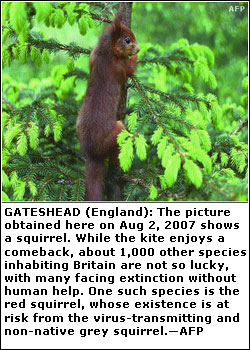 GATESHEAD (England): Its broad wings outstretched, the red kite glides down to bring food to its nesting chicks, hidden behind a thick green curtain of foliage. In this corner of north-eastern England, it is a sight some thought they might never see.
Thanks to one of Britain’s most successful conservation projects, the russet-bodied bird of prey is once more sweeping over the town of Gateshead, where kites are also breeding for the first time in more than 170 years.
But while the kite enjoys a comeback, about one thousand other species inhabiting Britain are not so lucky, with many facing extinction without human help, according to recently-published government figures.
One such species is the red squirrel — a shy rodent whose existence is at risk from the virus-transmitting and non-native grey squirrel.
Save our Squirrels — the largest single-species conservation project in Britain — is helping to reverse the massive decline in England’s red squirrel population, which has shrunk to just 30,000 from 3.5 million in the late 1800s.“We’re trying to get back what’s native to the country,” Mark Wilkinson, the conservation leader at SoS, told the news agency.
Red squirrels have been in England since the last Ice Age, which ended about 10,000 years ago, but are declining as a result of the bolder greys which the Victorians first brought over from North America in 1876.
Since last year, SoS has established 16 red squirrel reserves across northern England, which in combination with grey control financed by the government, is helping to preserve the slender creature.
At a wildlife hide in the county of Northumberland, north-eastern England, people patiently sit to catch a glimpse of a red squirrel.
“That was well worth waiting for,” beamed an elderly visitor after a 45-minute stay to see the creature descend from its drey.
Meanwhile, over at the Derwent Walk Country Park in Gateshead’s Derwent Valley, members of the public armed with binoculars and telescopes zoom in on a circling red kite.
“I am very lucky to be here,” said Mark O’Keefe, assistant information officer for Northern Kites — a five-year project began in 2004 to reintroduce the red kite to north-eastern England.
“This is my office,” added a delighted O’Keefe, as he stood atop the one-time coal heap turned green landscape.In 1989, the Joint Nature Conservation Committee (JNCC) — the statutory adviser to Britain’s government on world nature conservation — decided to reintroduce red kites to England and Scotland.
This preceded the Convention of Biological Diversity, signed by 159 governments at the Earth Summit in Rio de Janeiro in 1992, and which was the first treaty to provide a legal framework for biodiversity conservation.
The UK Biodiversity Action Plan is an umbrella organisation for government bodies, wildlife agencies such as the JNCC, and NGOs involved in shaping British conservation projects.
However, it is not obliged to preserve the red kite or red squirrel as they are also found outside Britain, unlike some endangered butterflies.
“If there is a species that occurs in the UK that doesn’t occur anywhere else and it’s declining then we have an obligation to look after it,” Ant Maddock, Secretariat of the JNCC, told the news agency.—AFP



























