



 0
0

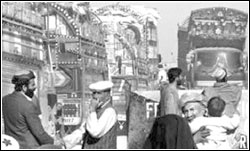 TRADE Policy 2007-08 has little to offer to enlarge exports to Afghanistan, which will certainly make the job of country’s economic managers tougher to achieve the ambitious target of $19.2 billion for this fiscal year.
Pakistan emerged as a major trading partner of Afghanistan following major reconstruction work started there because it has geographical, ethnic and cultural advantages over competitors in trade with its neighbour..
More than 3.5 million Afghans lived in rural and urban parts of Pakistan for three decades that has made them familiar with Pakistani consumer goods.
The situation offers opportunity for more exports to the war-ravaged country which lacks enough manufacturing base to cater to its domestic demands. This is evident from export growth after 9/11. The bilateral trade climbed up from $492 million in FY 2003-04 to $1.63 billion in financial year 2005-06 mainly because of exports.
NWFP’s businessmen engaged in bilateral trade argue that the country’s exports can be increased manifold from the existing level, if the government removes what they called ‘irritants’ in exports.
Owing to these impediments they argue that exports have witnessed a decline of almost $400 million in financial year 2006-07 as compared to 2005-06. The local manufacturers are losing huge market mainly to Iranian and Indian competitors.
Liaqat Ahmad Khan, President Sarhad Chamber of Commerce and Industry (SCCI), says the government claims that Pakistan is located at the doorstep of Central Asia, but in reality it has never focused on the benefits of geographical proximity to these emerging markets.
The exports to Afghanistan are on the decline mainly because of the discriminatory policies for the region.
Under the trade policy 2005-06, the federal government made abrupt procedural change to settle claims of rebate on taxes on export to Afghanistan, making it obligatory on exporters to produce imports clearance by Afghan Custom authorities across the border.
This, in Mr Khan’s view, is the major factor behind the decline in exports.
In the past exporters claiming rebate on taxes were required to produce export documents verified by the embassy/consulate of Pakistan in Afghanistan, a mode still intact for other countries.
Mr Khan says: “The new procedure has created a lot of problems for the exporters because most of the Afghan importers are reluctant to provide copies of requisite documents to Afghan Custom authorities across the border. In a number of cases relating to different exporters, where there is one importer in Afghanistan only one certificate of receipt of goods is issued by the Afghan customs, which is difficult for different exporters to claim rebate on their exports. Also, Afghan customs documents are mostly in Persian and are not verifiable, whereas in some cases the Afghan customs documents do not contain even the vehicle number.”
“We proposed to the federal government to restore the previous system in the new trade policy. But no heed was paid to our demand ,” says Mr Khan.
At present export is allowed only via land route of Torkham and Chaman border. The growing volume of trade needs better infrastructure. A part of the goods are cleared by Ghullam Khan custom station in North Waziristan.
The Federal Board of Revenue (FBR) on December 30, 2004 notified opening of customs stations at nine different routes to facilitate trade. These include one each at Nawa Pass (Bajur Agency), Khapakh (Mohamand Agency), Terimengal (Kurram Agency), Kharlachi (Kurram Agency), Sheedano Dand (Kurram Agency), Lawara Boya Datta Khel Road (North Waziristan Agency), Angoor Ada (South Waziristan Agency), Khand Naral (South Waziristan Agency) and Arandu Pass at Chitral district.
So far, the custom authorities are unable to formalise trade on such routes because lack of facilities, poor road infrastructure and above all security concerns in the tribal belt, although informal trade is still taking place from such routes.
The commercial exporters are also unhappy over the rebate issue. They say Peshawar-based Regional Tax Office (RTO) is using delaying tactics in disposing of refund claims one way or the other, which is causing liquidity problem for them. They also complain of harassment by the tax officials through unnecessary investigative audits.
Officials in RTO, however, have a different story to tell, saying it was unusual growth in claiming rebate on taxes on export to Afghanistan that prompted them to investigate.
A senior official at RTO informed that a number of commercial exporters with the help of some tax-officials had inflicted loses worth millions of rupees to the national kitty by producing fake documents.
The RTO has recently registered FIRs against two exporters in fraud cases for collectively receiving Rs591 million as refund on bogus invoices.
The official did not agree to the contention that delays in refund claims is hindering export , saying during the first six months of the last financial year 2006-07 the value of pending refund claims was Rs700 million, which stood the same in June this year.
“This means there is no increase in the size of pending amount,” the official remarked.
In his trade policy speech, Commerce Minister Humyun Akhtar attributed the decrease of almost $400 million in export to Afghanistan to petroleum, leather and rice as flow of other consumer goods is normal. The Commerce Minister has put things under carpet for the time being.
The government has no long-term policy to develop its trade with Afghanistan and Central Asian Republics, says exporters.
Numan Wazir, President Industrialists Association Peshawar, says NWFP trade and industry is mostly focused on the consumer markets in Afghanistan, while opening of huge Central Asian markets will stimulate investment opportunities here.
The federal government should have announced a special package for the NWFP under new trade policy for promoting industrial sector by focusing on trade with Afghanistan and beyond, in various fields including marble, granite, gemstone, match , furniture, cement, pharmaceuticals and food products, Mr Wazir pleads..
In his view, freight subsidy, exemption from import duties on raw materials and machinery and tax holiday can be the lasting remedies for developing local industry and to maintaining a strong hold over Afghanistan’s markets.




























