Finding the way forward
AS the dust settles on the Lal Masjid operation, the direct link between madressahs and militancy becomes apparent. The country is at a crossroads and decisive action against militant madressahs and preachers calling for ‘jihad’ within Pakistan can be delayed no longer. If clerics running a mosque in Islamabad can stockpile weapons, turn their madressahs into hideouts for hard-core militants and engage the security forces in a fight to the finish, the activities of their counterparts in more remote areas can only be imagined. In his address to the nation on Thursday, President Pervez Musharraf declared that establishing the government’s writ had become “inevitable”. Here it can be asked why this was not the priority from day one. Allowing the Lal Masjid brigade so much leeway during the last six months only emboldened the clerics and furthered the delusion that militants wrapped in the garb of religiosity are above the law. It was in January that they first challenged the writ of the state, when the Hafsa students took over a children’s library. If the whip had been cracked then — and if there had been fewer intelligence ‘lapses’ — the bloody final showdown in July may have possibly been averted. Still, no one should lose sight of the fact that the Lal Masjid militants brought their fate on themselves. It was they who created the conditions for a violent showdown, and the responsibility for the loss of innocent lives also rests on their shoulders.
The need now is to press ahead with efforts, earlier tarried with by the government, to regulate each and every madressah in Pakistan. The relevant laws already exist on paper and no madressah should be allowed to function if it refuses to register with the authorities. No quarter must be given and no exceptions made. Registration has to be mandatory irrespective of whether or not a madressah receives monetary support from the government. The thorny issue of revealing sources of funding must also be settled once and for all, with every seminary obliged to submit itemised accounts of cash inflows, including the names of donors, as well as expenditure. A monitoring system needs to be put in place to ensure that no texts are taught that promote militancy, sectarianism and religious hatred. This can be achieved in part through surprise visits, which can also help prevent physical abuse of students. To widen the scope of job opportunities available to seminary graduates, curriculum reform must also include the teaching of mainstream subjects such as science, mathematics and English.
Acknowledging the link between the Lal Masjid brigade and militants operating in the NWFP and the tribal areas, President Musharraf announced on Thursday that the security forces in the Frontier would be strengthened considerably so that they can take on the militants on their own. This is of critical importance because large pockets of the tribal areas are a breeding ground for militancy where pro-Taliban elements have created a virtual state within a state — making medieval laws and handing out equally primitive punishment, blowing up businesses and schools, thwarting and even killing those engaged in the anti-polio campaign. Their influence has spread to the settled areas of the NWFP and there is no telling where it will stop. Here, too, as in Islamabad, the writ of the state must be upheld and established.
Why this price hike?
ATTEMPTS are being made by hoarders and profiteers to create an artificial shortage of wheat flour in the market despite a bumper crop this year. The imposition of a ban on wheat exports is reportedly causing unscrupulous elements to hoard up and create a shortage of the staple grain. Wheat prices have soared to Rs1,280 per 100kg, up from Rs1,190 in the span of a week. If the trend is not checked a major crisis may be in the making, causing wheat flour price to spiral out of control. If that happens, lower income groups will be the worst sufferers. Prices of baked bread and bakery products have already registered an increase in the corresponding period. The price-hike is patently artificial because the country this year has two million tons of surplus wheat, most of which is stored in government godowns. The hoarders are reportedly purchasing more wheat stocks than needed by the flour mills and thus creating a shortage. This has to be stopped immediately. It is equally important to plug the borders and the ports to avoid the slipping of wheat out of the country.
Another disturbing trend was reported by the Federal Bureau of Statistics, which has revealed an increase over the previous week’s prices of 53 daily-use food items, ranging from under one per cent to over 22 per cent. The commodities include everyday kitchen items like ghee, pulses, vegetables, flour, rice and eggs. The overall economy might be sustaining a healthy five-plus per cent growth rate, but the corresponding increase in daily-use kitchen items is certainly not sustainable for the lower-income groups eking out a living on limited monthly incomes. Until the benefits of a growing economy start trickling down to reach the most vulnerable sections of society, the government should come up with a mechanism whereby subsidies are provided on everyday items to avert a further squeeze on the pockets of the very poor. Not doing so will not help the cause of stabilising the overall economy in a country where the poor are seen to have become poorer and the rich richer in recent years.
Crimes against women
WHY are crimes against women, particularly of a horrific nature, so widespread in Pakistan? They are often ordered to be gang-raped, supposedly to humiliate their husbands or families; they can have their heads shaved and hands, feet or even nose chopped off as a “punishment”. To restore the family honour, a woman is also killed. Such cruel acts are committed against women almost every day which begs the question: what will it take to contain them? Take the case reported on Thursday from Tando Mohammad Khan (Sindh) where a man shaved his wife’s head because he thought she was having an affair. The wife reported the matter to the police who arrested the man. This is no less than a victory, for far too often men committing crimes against women are not held answerable: either they are not apprehended, or through bribe or influence, they go scot-free. The government needs to ensure justice in all such cases regardless of the power and influence of the offender. For that to happen, the police need to register a woman’s complaint without fail and pursue each case through the investigation and prosecution stages with unabated interest. It is the government’s inability to successfully prosecute criminals that has seen women being denied justice. Mukhtaran Mai’s story is a case in point.
Apart from the legal aspect, there is a social aspect that also needs to be addressed, for laws alone cannot bring about the much needed change in attitude. It will be a positive development if enlightened members of a community come out to voice their opinion on crimes against women. Such an initiative must be matched by an on-going dialogue aimed at creating awareness on these and other important problems. Here, the NGOs can play a valuable role in educating people about the evils of primitive customs and in spreading tolerance and respect.
Resisting the inevitable
MUSHARRAF’s military regime fails to grasp or deliberately ignores the significance of the current movement sweeping the country. Clearly, if triumphant, which it is likely to be, it could turn out to be a defining struggle for the rule of law and the independence of institutions, especially the judiciary.
There is today a genuine belief among perceptive observers that there is across the board an intense desire and appeal for democracy in Pakistan and the military’s long dominance of the power structure has undermined nation-building with long-term effects.
Judging the way this movement is picking momentum and the government’s increasing nervousness it is obvious that it has a broad grass-roots support and will not peter out despite the regime’s manipulations. Even if the government were successful in suppressing it through coercion and usual draconian measures, it will either go underground which would be much worse and more difficult to manage or return with violent ferocity, layered with religious overtones sooner than later. Moreover, suppressive tactics could further widen the civil-military divide, which is already under great strain.
It is unfortunate that driven by his ambitions to cling to power, Gen Musharraf is not seeing the significance of this movement. After years of authoritarian rule by both the military and civilian leadership, civil society has matured and is now in the forefront in the struggle for rule of law, strengthening of institutions and return of genuine democracy. People are supporting the lawyers’ protest as evident from their large participation in it. In a way it is an expression of the common citizen’s desire for the creation of a just and equitable society.
What more would a genuine leader wish for a nation whose people aspire for the ideals that promote the rule of law and the sanctity of the constitution and the independence of the judiciary. Moreover, the army does not have to worry, as this movement would not jeopardises the military’s core interests.
In fact, it strengthens it because a country set on a democratic course can defend itself more effectively from both external aggression and internal insurgencies. In the longer term, a just and equitable society is the best guarantee for the professional and corporate interests of the military.
But swimming against the tide, President Musharraf seems in no mood to relinquish power or be sidelined. This is expected because for any military ruler abandoning power does not come easy. Initially there was the mistaken belief among some liberals that he belonged to a different category of authoritarian rulers whose decisions and actions were in tune with the wishes of the people. But he has so far been no different from any other military ruler that we have had so far, the reason being that Musharraf and some among the military elite perceive themselves as the saviours of the nation and therefore entitled to exercise total political authority.
However, as chances of President Musharraf retaining his position as army chief and getting elected again as president by the present assemblies gets slimmer, a new political configuration is being sought by reaching an understanding with the PPP. But in view of the contradictions in such an alliance, it is unlikely to materialise and even if it did, it will remain tenuous. The PPP’s electoral fortunes too could seriously suffer if Benazir is seen siding with Musharraf in a future coalition.Besides, the PML leadership and its coalition partners who ride on the wings of the military will be lost in the wilderness by this move and their loyalties will change, placing President Musharraf in a quandary.For a military regime to try to act as an agent of change by indulging in political and social engineering is unrealistic and full of contradictions, as we have witnessed in the 60 years of national life. Acquiring cosmetic legitimacy by meddling with the Constitution is not what the people are prepared to accept any more. What many of us fail to realise is that a state’s power to be effective has to be truly legitimate.
President Musharraf has been seeking legitimacy through his performance and, fortunately for him, his position was strengthened after 9/11 by a highly supportive international environment and full backing of the US and the western world. It resulted in the lifting of sanctions against Pakistan and was followed by substantial economic assistance and an increased flow of remittances and investments. Credit should also go to Prime Minister Shaukat Aziz for better macro-management of the economy.
All this gave President Musharraf an illusory feeling that it compensated for his lack of political legitimacy. The regime used other methods of legitimising itself by consistently demeaning the politicians through government sponsored propaganda. Meanwhile, President Musharraf tried to play the role of a “statesman” by engaging on issues facing the Muslim world, especially the intractable Palestinian- Israeli conflict, but with little success.
During the last seven and a half years the world has moved on and so has Pakistan, and the people are not prepared to accept these expedient measures as a substitute for legitimacy. Moreover, during the last two years the performance of the government has been on the decline. Pakistan today is threatened with creeping Talibanisation, a deteriorating law and order situation, insurgency in Balochistan, poor governance and rising sectarianism and ethnicity.
The ruling PML-Q’s performance too has been tardy as President Musharraf keeps bemoaning that he has to fight major political battles all alone. Although to observers watching from outside it is obvious why the situation is so. The PML-Q, despite its years of association with the president, has still not gelled as a cohesive political entity. It is more of a cobbled-together party whereas genuine political parties rely less on patronage and more on grassroots support. Basically it is a conglomerate of individuals who are fairly powerful at the local level because of their feudal, tribal or ethnic links and have grouped together to protect their narrow interests by retying on support of a president in uniform.
It is another matter that many among them do not even share the “vision” or policies of the president. What has further weakened the effectiveness of the party is that President Musharraf’s government is a one-man dispensation. Feeling powerless, most of its members show scant interest in the affairs of the state and frequently remain absent from parliament and its important committees.
Currently, their first priority is self-preservation and for this reason many prefer staying in the background rather than support the government during the judicial or media crisis fearing that it would lower their standing with the electorate, especially in an election year.
The American factor has also been pivotal for giving President Musharraf longevity. For nothing suited Washington more than to deal with one individual in their post-9/11 engagements with Pakistan. But in the rapidly changing scenario in Pakistan Washington is looking for alternatives to protect its interests. A clear indication of the US concern was highlighted by a series of high-level visits by its officials to Pakistan in June.
There is also a better appreciation in both Congress and the administration that a country of 160 million cannot be governed without proper institutional support in both policy formulation and execution. Irrespective of the outcome of the current movement, the US will try to remain closely associated with Pakistan in its fight against terror, building its capacity against counter-terrorism and for combating extremism and militancy.
Pentagon will retain its traditional ties with the armed forces and continue to develop institutional and operational linkages. Nonetheless, the fate of Pakistan is likely to be decided more by internal dynamics and the determination of its people and less by manipulations by foreign powers.
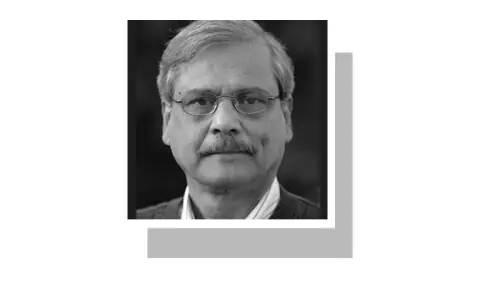
The writer is a retired lieutenant-general.
Brown’s choice of motto
COD may be in short supply, but sadly not cod philosophy. So much was clear recently as Gordon Brown, claiming the prize he had worked towards his entire adulthood, chose his school motto to sum up his approach to government.
Hovering diffidently at the meeting-place between ideology and homily, mottos too often succumb to triteness. Kirkcaldy High's "I will try my utmost" (the teenage Gordon would almost certainly have learned the Latin original "Usque conabor") does as little to get the heart beating as the former chancellor's reforms to capital allowances on industrial plants and machinery.
It is admittedly better than the opposition leader's old school motto of "Let Eton flourish", which serves merely as a reminder that, whatever their brand of trainers, the Tories remain unpalatably posh.
Imagine, however, if Mr Brown had shaken off the dead hand of nostalgia and chosen his own bold slogan? He could have borrowed from another language, thus showing he believes in a nation of all the cultures.
A man standing on the threshold of his new home with his cherished wife might have uttered the Urdu romance of "Sitaroon se aagay jahan aur bhi hain" (There are more worlds beyond the stars). Or, if we must use a dead language, how about Sanskrit's "shottom shivam sundaram"?
Its assertion that truth is supremely beautiful surely rings true for any newly unspun politician. He could even have coined his own; to this newspaper, "no more unjustified wars" has a certain ring.
––The Guardian, London
| © DAWN Group of Newspapers, 2007 |