



 0
0

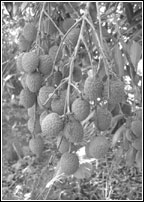 LICHEE (Litchi sinensis, sonn) belongs to the family Sapindaceae, which also includes soap-nut tree. The earliest Chinese monograph written by Ts’ai Hsiang in 1059 A.D, deals with the varieties, areas of cultivation, methods of preservation and popularity of the fruit during that period, which indicates that lichee was native to the lower elevations of southern China.
He mentions of 40 varieties of lichee in China and that the fruit grew there for centuries and was favourite of all.
Lichee tree is ever-green and grows to a height of 30 to 60 feet with bright green compound leaves forming a beautiful canopy. The lichee tree is monoecious, that its male and female flowers exist on the same tree. The fruit is small of the size of a walnut varying from one inch to 1-1/2 inches in diameter. It is globular, sweetish-to-slightly tart in taste, white–pulped with a brown smooth seed.
Outer skin of the fruit is papery and brown covered with pimply protuberances, which is easily removed by hand while the fruit is eaten. The fruits are borne in loose cluster, and each cluster has three to 29 fruits. The lichee plant is mainly grown for its aromatic and luscious fruits in the tropical and sub-tropical areas of the world. The fruit is liked both by young and old. It is eaten not only as a fresh fruit, but is also preserved in syrup, and served both at homes and hotels for dessert. Food and beverage industries make drink from it, which is sipped for quenching thirst.
Distribution: In recent years lichee trees have been introduced in the tropical and sub-tropical areas. It grows abundantly in India, Bangladesh, and Thailand. In India; it is under cultivation for the last 200 years and specific varieties have been evolved for cultivation in Uttar Pradesh, Bihar and west Bengal. In Pakistan, it is mainly grown in the districts of Sialkot, Sahiwal, Okara, Raiwind etc. of Punjab. According to official sources lichee is not grown in Balochistan, Sindh and NWFP, although, according to unconfirmed sources, lichee is grown in some parts of NWFP. Lower and Upper Sindh are also believed to have good prospects for lichee cultivation.
The late M.H. Panwar, an eminent scholar, intellectual and an agricultural scientist, took keen interest in Sindh’s horticultural crops as well. He had a few lichee varieties imported and tried them at his farm, located near ‘Kissano Mori” some 16 or 20 km from Hyderabad on way to Tando Allah Yar. His trials indicated that lichee could be grown in the soil and climate of lower Sindh. He ultimately suggested that Hyderabad, Tando Allah Yar and Mirpur Khas in lower Sindh, Nawabshah, Naushero, and Ghotki in Upper Sindh, were equally suitable for lichee cultivation. Sadly, no enterprising grower of the afore-said districts ever tried to benefit from his research and findings.
Climate and soil: Lichee is well-adapted to the tropical and sub-tropical areas of the world. But frost and extreme temperature are not tolerated by young plants and also when the plants are in fruiting stage. Sandy deep loamy soils not deficient in lime, organic matter, and adequate water are essential for is cultivation. The young trees can be protected, when there is a spell of hot and dry winds by providing wind-breaks.
Propagation and season: Lichee is propagated from seed. But air-layering, grafting on ‘khirol or khirai’ stocks, and budding give better results. Crop sown in February–March and August–September in Punjab starts bearing fruits in May. The fruit is picked by hand and sold between Rs200 and Rs100 per kg in big cities. Lichee is generally sold in loose bunches and also nicely packed in cartons. The fruit has a good keeping quality and can stay well for three weeks or more.
Local production: Officially the total area under lichee cultivation is limited to Punjab only. The latest five years figures are as follows:
Year Area in Production
hectare in tones
1999-00 420 2,957
2000-01 428 2,879
2001-02 435 2,671
2002-03 426 2,671
2003-04 416 2,627
Source: Ministry of Food, Agriculture
and Livestock, Islamabad.
From the above figure it will be observed that both area and production of lichee during the last five years have not shown any increase. Yet the country exported small quantity of the fruit to Gulf countries.
Nutritive value: Lichee like most of the fruits has got good nutritive value to maintain our health. According to information available, the total sugar content in lichee averages to 13 per cent and 15 per cent. It also contains various minerals and is a rich source of potassium and vitamins. It is also a good source of Vitamins B and C and fair amount of Vitamins E and D.
Chemical composition: The chemical composition of lichee, according to a recent study in the US, is as follows:
“100 grams, edible portion, raw, water 81.9 per cent; food energy 64 calories; protein 0.9 grams; fat 0.3 g, fat 0.3 g; potassium 170 mg; Vitamin A (no data); thiamine (no data); riboflavin 0.05 mg, fiber 0.3 mg; iron 0.4 mg; sodium 3 mg ascorbic acid 42 mg.”
Production prospects: It has been observed that research on individual fruits or vegetable in the country by official agencies is hit by financial constraints and lack of trained, experienced and qualified staff. Trials conducted by the late Panwar, at his farm, have indicated that lichee could grow well in lower Sindh. The efforts made by him need to be reviewed by official agencies in Sindh and reconfirm his findings for recommendation. The districts in lower and upper Sindh have a favourable climate for lichee cultivation, as opined by the late Panwar. The extension staff of the provincial agriculture departments can pass on the production technology to the enterprising growers, if lichee cultivation is feasible as commonly believed.
Suitable varieties could be imported from neighboring countries to make lichee successful in prospective areas. The research staff should be trained in lichee growing by a lichee expert invited from abroad.




























