KARACHI, June 9: The federal budget announced on Saturday aims at sustaining the country’s robust economic growth that sidesteps reforms, such as clipping the quantum of subsidies as desired by development partners, the World Bank and sister organisations.
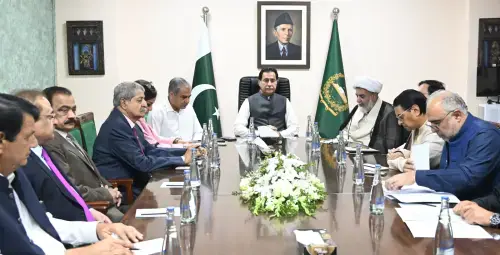
The Rs1,874 billion budget presented by Minister of State for Finance Omer Ayub Khan along with impressive growth numbers, reveals an economy that is buzzing even without a synchronised economic policy aimed at addressing disparities, increasing industrial and agricultural productivity and achieving millennium development goals.
This budget is clearly an attempt by the government to lure the voting community that they have alienated over the past five years by pursuing policies that were more rewarding for the privileged. The economic survey released on Friday acknowledges the fact that the wedge between the rich and the poor has widened over the past few years.
One may call it populist, but the election-year budget is an appeal for votes, offering something to everyone from business to farming to middle to lower classes, seeking to disarm the opposition on the economic front.The common man’s too simple to understand the long-term cost of short-term one off gains.The budget offers immediate respite to the toiling masses, both urban workers and rural farmers to cope with the rising cost of living.
A multi-billion rupee subsidy package was announced to ensure availability of essentials such as lintels, ghee, tea, sugar, etc. at utility stores at cheaper rates.
The minister also announced the decision to open 5,000 more utility stores that will also deal in essential medicines. The government will run utility trains to reach people living in the far-flung areas.
The rise in minimum wages, inclusion of contract workers in the welfare cover, provision of subsidy on seed and DAP, 25 per cent reduction in electricity rates for tubewells, etc are some other such measures.
An effort has also been made to woo the middle class that appears to have been influenced by the ongoing anti-government movement spearheaded by the legal fraternity and journalists. A number of measures have been announced to provide immediate relief and concessions such as 15 per cent increase in salaries of government employees and 15-20 per cent increase in pensions.
An interesting aspect of the budget is the fact that though the size of the outlay has been increased but no new taxes have been imposed to cover the extra expenses. Amazingly, there are winners and winners and no losers. This translates into the reality that no attempt has been made to carry out fiscal corrections.
The tax regime is regressive where people are not taxed according to their ability to pay. The ratio of direct to indirect taxes remains unchanged.
The budget highlights the inability and lack of vision and willingness of the ruling PML, to re-orient the policies to make them equitable, open and transparent, while aligning with the military that thrives on the status quo.
Whether the government will be able to honour the fiscal responsibility and debt limitation law is anybody’s guess.
All in all it’s a clever election-year budget but it’s a budget that fails a future test, and it fails the test in some key areas. It doesn’t deal in an effective way with infrastructural bottlenecks (acute shortages of water and power), speculative activity that is diverting precious resources to non-productive areas (real estate and stocks), provision of social security net and lifting and boosting productivity by investing appropriately in human capital.
Despite the massive spending spree, unless the supply side constraints especially in food items are removed, the trend of price rise cannot be arrested.