0
0

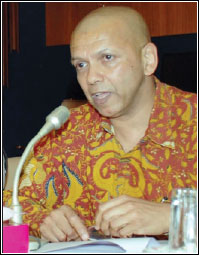 ISLAMABAD, June 9: A noted South African scholar on Islam from Harvard has said that instead of trying to shield itself from “western moral corruption”, the Muslim world needs to hold dialogue with “the liberation social movements spawned by modernity”.
“Ours is not an Islamic universe but a plurality of liberation discourses, in cross-cultural conversation with each other, forming alliances that fight oppression anywhere,” Prof Farid Esack said in a lecture titled “Towards a Theology of Liberation” at the International Islamic University (IIU) here on Saturday.
“We live in a dangerous time, a time of profound crisis. Ecologically it is an apocalyptic time defined by the sixth mass extinction of Earth’s species, the destruction of the last wilderness areas and the forced assimilation of the planet’s few remaining earth-centred cultures,” he said.
Prof Esack traced these ills to the stranglehold of what he called the imperialism of corporate sector, globalisation and mass culture.
He said cultural imperialism had the goals of capturing markets, dominating popular consciousness on the economic side and of alienating people from traditional class and community bonds.
“Cultural imperialism is global in scope and homogenising in its impact. It proceeds to paralyse collective responses and seeks to destroy national identities or empty them of substantive socio-economic content,” explained the professor.
But speaking truth to powerful is both the path and objective for a Muslim. “Like all individuals and societies Muslims are never powerless in the absolute sense. In relation to the Empire we may be having less power but others have less in relation to us in other ways,” he said.
In the situation he advocated “finding common ground with other religions’ potential for emancipation.”
Prof Esack used to be Prof William Henry at Harvard Divinity School before he converted to Islam and received education in the madressahs of Karachi.
His various publications include “Quran, Liberation and Pluralism: An Islamic Perspective of Inter-religious Solidarity Against Oppression”. He had fought Apartheid in South Africa and President Nelson Mandela appointed national commissioner on gender equality.