0
0

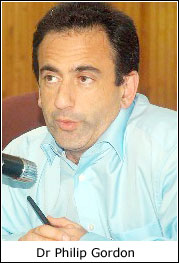 PESHAWAR, May 18: A scholar from a Washington-based think-tank said on Friday that Pakistan should have used the $10 billion aid it received from the United States after 9/11 for the socio-economic development of its people.
“The US should help Pakistan, but it will be also legitimate for Washington to criticise Islamabad for not using a major share of the money for economic development of its people,” said Dr Philip Gordon, a senior fellow in the Foreign Policy Studies Programme at the Brookings Institute.
Speaking at a lecture programme on ‘US-Pakistan relations’ at the Lincoln’s Corner in the central library of University of Peshawar, he said: “I wish relations between the United States and Pakistan are built on the social basis as we need more social interaction and need to replace negative images.”
Dr Gordon said that Washington-Islamabad relations were shaped by the US ties with India and Afghanistan and democracy.
“India is worthy of attention as it is a democracy, a rich market and has no nuclear proliferation issues; but it’s not an anti-Pakistan move. Pakistan is an important strategic ally in war on terror,” he said.
He said the US had realised that it was not possible to stabilise Afghanistan and strike terrorists without full cooperation of Pakistan.
“Questions are arising whether Pakistan is fully committed,” Dr Gordon said, adding that Pakistan was important in war on terror as a ‘stable, cooperative friend’.
Students of the university raised many questions on how much ‘reliable and steadfast’ friend US was to Pakistan.
A number of questions were raised on ‘war on terror’ and its negative implications on Pakistan.
Dr Gordon said that countries had their interest and accepted that there had been ups and downs in the relations between the US and Pakistan due to changed interests.
“The US had not been a steadfast friend for Pakistan because it has strategic interests and they change,” Dr Gordon said.
He said that the nuclear proliferations issue and support for Taliban in the past had driven both countries apart.
Students during the discussion commented that the US was responsible for all the mess in the region, especially Afghanistan and North West Frontier Province.
Refuting that impression, Dr Gordon said the US would not have invaded if Osama bin Laden was turned over.
After 9/11, the US intervened in Afghanistan to defeat terrorists, he said and added that the US had a strong record of using power for Muslims in Bosnia and Kuwait.
“The US has used its resources to stabilise Afghanistan and the role of Pakistan is very important in bringing stability,” he said.
Replying to a question on why the US supported Mujahideen in war against the Soviet forces and now those same people are called ‘terrorists’, Dr Gordon said that these were not the same ‘Jehadis’ and it was not the same thing.“It was a mistake and US-Pakistan both were involved in creating the mess,” he said.
Later, Dr Gordon also held a briefing at the Peshawar Press Club, adds app.