0
0

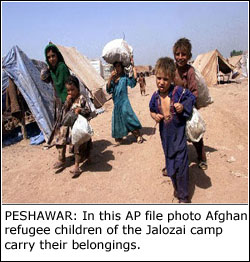 ISLAMABAD, May 3: A vast majority of the two million-plus Afghan refugees in Pakistan do not intend to return home, mostly because of security fears, but the government still plans to repatriate them all within three years, officials said on Thursday.
The government is pushing for the refugees to go back to Afghanistan largely in response to international criticism over cross-border attacks by Taliban militants who Pakistan says often shelter in refugee camps.
But the escalating conflict in Afghanistan, where about 1,300 people have died in violence this year, and the lack of land and services for returnees, has raised doubts about whether the plans are feasible.
A report issued on Thursday on a recent UN-supported registration of Afghan refugees found that 84 per cent do not intend to return. Of those, 41 per cent cited insecurity as the primary reason, double the figure recorded during a refugee census in 2005.
Three-quarters of the registered refugees arrived in Pakistan during the Soviet occupation of Afghanistan in the 1980s. Most are ethnic Pashtuns originating from Afghan border provinces, and 90 per cent of the refugees say they have no land there.
Nevertheless, Sajid Hussain Chattha, a top official at the Ministry of States and Frontier Regions, said the government was sticking to its target for all the refugees to be repatriated on a voluntary basis by 2009.
''We have no reasons to believe that we will shift our policy,'' Chattha told a news conference after the report's release. ''We hope the situation in Afghanistan will improve.''
He said 200,000 had already gone back during 2007 and it was planned 600,000 more will return by year's end, although those plans were still being discussed with officials of the UN High Commissioner for Refugees.
Four camps, housing more than 220,000 refugees, would close by September, he said.
One of the first camps slated to close, Pir Alizai in Balochistan, houses about 36,000 people, many of them holding Pakistani ID cards. Officials have described it as a hub for militants and drug traffickers.
Some 2.1 million refugees joined the 15-week registration process, which entitles them to stay in Pakistan until December 2009. Of the 300,000 who did not sign up, 200,000 have since gone back to Afghanistan. Those remaining face deportation.
Guenet Guebre-Christos, the UNCHR representative in Pakistan, said repatriation should be gradual and take into account the “'absorption capacity”' of Afghanistan.
“'It has to be voluntary. The people have to decide for themselves if the situation is conducive for them to return,”' she said.
According to the report, 300,000 Afghans have special needs, including the need for special legal and physical protection, as well as female-headed households, serious medical conditions with many children/youth at risk. At least 74 per cent of the Afghans are under 28 years of age. Also, 71 per cent of the registered Afghans have no formal education, and only 20 per cent are active in Pakistan's labour market. Of the latter, almost half of them worked as unskilled or daily wage labourers. Moreover, 83 per cent of working Afghans earned less than Pakistan's minimum wage of US $67 per month. Of those registered, 41.6 per cent cited security as their foremost concern, followed by shelter at almost 31 per cent, and livelihoods at 24.4 per cent. The report added that 64 per cent of those registered live in North West Frontier Province, while 21 per cent live in Balochistan.—AP/PPI