



 0
0

Afghan violence putting pressure on aid workers
KABUL: Amid kidnappings, assassinations, bombings and all-out battles, aid groups say Afghanistan’s violence is forcing them to cut back on efforts to help the destitute country’s neediest people.
Worryingly, the security threat is growing in areas outside the southern stomping grounds of insurgents and the drugs mafia, where the non-governmental organisations which are sticking it out are already taking precautions, one analyst said.
The Taliban’s demand for France to pull out its troops or for Kabul to free prisoners in return for the release of one French and three Afghan aid workers has raised concerns about a trend in kidnappings for political reasons rather than financial gain.
A French woman being held with them was freed on Saturday.
The government’s release in March of five Taliban prisoners in exchange for an Italian hostage has had an “encouraging effect on these kinds of problems,” said Handicap International country director Arnaud Quemin.
“We observe a global warming of the situation in the country so we are more careful about how we manage our movements,” said Quemin, who has 250 workers — 10 of them expatriates — working with people with disabilities.
“The risk is statistically becoming higher, either to be taken in fire between different forces or because of bombing in the cities. So we try to decrease the risk of exposure to such things by limiting our movements.” The group does not keep its expatriate staff in the southern province of Qandhar for security reasons, he said.
Last month it suspended work in parts of adjoining Helmand province when Nato-led and Afghan forces launched Operation Achilles, intended to wrest back control from the Taliban and drugs lords.
“There was a risk of being in the wrong place at the wrong time,” he said.
However the Agency Coordinating Body for Afghan Relief (ACBAR), an umbrella body of nearly 100 Afghan and international non-governmental organisations, is not seeing NGOs pulling out of the volatile south.
Rather, “people are very much tuned into what is happening and adjusting their operations,” said director Anja de Beer.
“Their area of operations has shrunk considerably and people keep a watchful eye on where to go and when.” They also keep international staff down to a minimum, and foreigners rarely move outside the comparative safety of Qandhar city, which was struck by a rash of suicide bombings last year.
The paucity of expatriate personnel “makes it difficult sometimes to comply with the monitoring and evaluation demands of donors,” De Beer said.
The general situation means “you cannot serve the community as well as you would like,” she said, commenting on a recent surge in attacks in the once-calm north.
Mercy Corps copes in Qandhar by staffing the office only with Afghans who wear local dress and travel in ordinary cars or taxis when they visit projects.
Some districts are even a no-go for certain Afghans, with only staff from those areas allowed there “because they are part of the community,” agriculture advisor Atiqullah said.
The Afghan Development Association, an NGO involved in reconstruction and development projects in the south and southeast for 15 years, relies largely on its community links to keep its staff safe.
“Security is one of our biggest concerns — it affects travelling from one location to another, the movement of our staff, logistics,” director Esmatullah Haidary told the news agency.
“We take careful measures. Sometimes we delay projects. We are all the time approaching community structures, the beneficiaries. They travel with us,” said Haidary, whose group employs about 890 staff, all Afghans.
Organisations still in the south “have been there a long time and know how to operate down there,” a Western security analyst said.
He does not expect many kidnappings in that area as most foreigners avoid the roads, travelling by plane from hub to hub.
“Generally in the south, no one is getting out — they are all stuck in the centres,” he said.
Problems were likely to arise in other regions “where they get out and do what they want, where they don’t adhere to security procedures,” he said.
There was also a certain degree of naivety among people who “think they are invulnerable because they are aid workers and here to save the world.” “Attacks are increasing countrywide.... We are picking up more static of threats to NGOs and aid workers.” The analyst expected security to plummet in the relatively calm north in the coming months, with the Taliban’s release of Italian journalist Daniele Mastrogiacomo in exchange for prisoners sending a bad message.
The reporter’s Afghan driver and translator were beheaded.
“It has just opened the door for everyone (to be kidnapped) — Afghans and foreigners,” he said.—AFP
Mothers abandoned in their twilight years
 KARACHI: Lives soured by neglect, shunned by relatives, given scant attention by the government, a growing number of mentally challenged women and children have found a safe haven in Edhi Centre for the Mentally Ill Women in North Karachi. Theirs is a tale of shame, remorse, human neglect and abandonment.
Bent double, octogenarian Khatoon Begum is a victim of physical violence and the perpetrators are none other than her own family.
Defending her son, she says: “It’s my daughter-in-law who hits me with whatever she can lay her hands on. It can be a rolling pin, a broom or even a pair of tongs. If not that then she will kick me.”
The indignity of living a life where she’s an unwanted person in her own son’s house brings tears to her eyes and she cries uncontrollably. “For the last 22 years, since my husband died, I’ve not seen a day’s peace. I’m not even dependent on them for money as I get my husband’s pension all of which I give to them, then why can’t they treat me like a human being? I’m probably the most unfortunate mother. I do try to keep myself busy in prayer, but even that does not bring me solace. Sometimes I just feel like dying. I am sure that will bring me peace.”
What should have been the responsibility of the state, is taken over by people like the Edhis. “Our leaders cannot look after the youth, what to talk of the aged,” rues Anwar Kazmi, secretary to Abdul Sattar Edhi and his companion for the last 40 years.
Their North Karachi centre, built over 10 acres, was set up in 1986 with just 50-60 mentally ill women. Over a span of 21 years, the number has swelled to accommodate 1,540 of which 600 are above 40. Around 40 died this year mainly due to old age. “Relatives of only four came after they were informed, to pay their last respects, not to take the bodies. It was left to us to prepare their last rites and bury them,” says Anwar Kazmi,.
In just five months, this year, 370 women were admitted to the Edhi Centre, of whom, he says, 30-40 were young and healthy, both physically and mentally, and thus sent to the Sohrab Goth centre for destitute women.
“For the life of me, I never thought I’d be spending the latter part of my life here,” says Rashida Anees, 57. For Anees, once a teacher at schools like Mama Parsi and Habib Girls, this centre is her salvation where she has been living since 1999. According to her, her two brothers and their wives didn’t want to keep her or her younger sister, 55-year old Shakira, after the death of their parents.
Extended family system which meant three, and in some cases four, generations living together, is fast diminishing in this cosmopolitan town of Karachi. “It’s time to face the bitter reality. Ours is a society at crossroads. In this age of the internet and cable TV, through which we imbibe the western cultural values coupled with increased economic difficulties is taking a toll on the joint family system,” explains Kazmi.
At times, he says, families do take care of the mentally challenged woman for as long as they economically can. “But when it becomes impossible, many let their aged parents adrift.”
While they may be kept under lock and key (which the Edhi authorities say is done for their own security) but here they are not beaten up or ignored. Their daily needs, including their health needs, are met; they get three square meals a day, are kept clean, given clothes to wear and are taken care of.
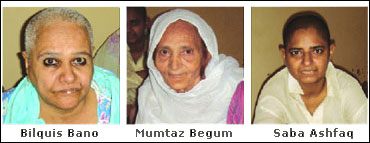
Bilquis Bano, 52, may have three “happily married” sons but she’s been living at the Edhi home now for 21 years, since the North Karachi centre opened.
“I had dishonoured my family because my husband slapped me with a divorce. My brother brought me here in 1986,” she says, adjusting her dupatta on her bald head. The last time the sons took her home was on Eid.
In charge of her room, comprising 60 women suffering from various degrees of mental anguish and of different ages ranging from 35-year-old Saba Ashfaq to the vitriolic Mumtaz Begum, 70, Bano helps with the daily chores like taking care of the sick, bathing them, helping them change clothes and wash up; taking them to the toilet and ensuring that everyone takes her medicines.
“The centre is run by public philanthropy. We have no dearth of funds and these women are taken good care of,” says Kazmi. “We have very little paid staff as the healthy ones take care of those who are sick.
“Most of these women are from the lower-middle class, who have been dumped by their very kith and kin. If you ask me, except for a few who have been admitted to the Pagal ward (ward for the mentally sick), not one of these belong here. They need to go home, to their loved ones,” says Waseem Fatema, a staff nurse, who knows each and everyone of the inmates by name and has their personal history at her fingertips.
Neatly dressed, hair made up with a bit of make-up, Zainab Shafiq, 35, who is watching the women interviewed joins in. “If the Edhis didn’t have this place, where would people like us go?” She cannot thank the couple enough for keeping her. With two brothers and two sisters, she was sent here by her sisters-in-law two years ago. A Master’s in psychology, she says: “I never thought I’d get such a good first-hand experience working with mentally challenged patients, and so many of them!”
“These emotionally disturbed people need to live among their loved ones. Staying away from home and their family and living with others like them only aggravates their condition,” is how Dr Naseem Atique, the doctor sees the situation.
According to her most women have been thrown out or have come of their own volition because of quarrels between mother-in-law and daughter-in-law. “With less tolerance, in the power struggle, the strong one stays at home, the weaker one is shoved out to fend for herself.”
Ironically, not a single woman spoken to blamed the sons or the brothers for their predicament. It was always their wives who were the evil doers. Most believed the latter had cast an evil spell on their men who were unable to see right from wrong and unable to make sane decisions.
Ninety-eight-year-old Ramazan Bibi is one such mother, who refuses to admit that her three sons have dumped her at the Edhi centre. Squatting on toes, she slides to come closer and be heard. “She has three sons, two of them abroad, and one here, but nobody wants to keep her. After the death of her husband, she worked in different houses as a domestic help and ensured all three of them completed their education,” explains Dr Atique.
“They don’t know I’m here and in any case I’m here for a short while, till my nephew finds me a place,” defends Bibi. She has been here now for a year, and has spoken a number of times to her sons.
| © DAWN Group of Newspapers, 2007 |



























