0
0

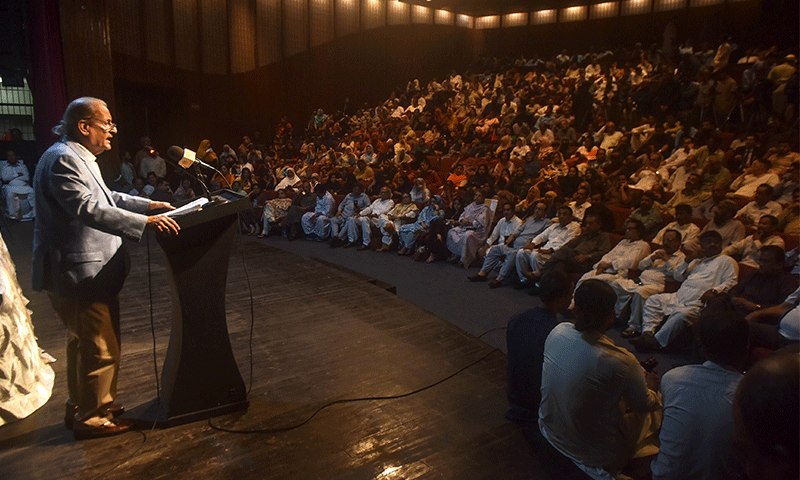
 KARACHI, April 29: It was a day marked for two extremely tempting programmes: the cricket World Cup final was scheduled to be telecast at six-thirty in the evening, and the celebrated satirist Mushtaq Ahmed Yousufi was delivering a lecture at six at the impressive auditorium of the Sindh Institute of Urology and Transplantation.
The invitation received on the mobile phone to a sitar and tabla jugalbandi at the Karachi Arts Council on the same day and at the same time, therefore, was a bit unsettling. I couldn’t help calling up Nafees to warn him about the likelihood of a thin turnout, if not an empty hall.
“The date cannot be changed,” said Nafees confidently.
“But it’s not fair. You must have a proper audience.”
“Don’t worry, they will come.”
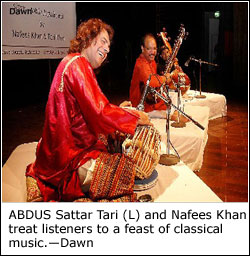
How correct he was! The hall was jam-packed with music lovers belonging to this city, once indifferent towards classical music. And what an audience! They gave a thundering ovation to the two exponents – sitarnawaz Nafees Ahmad Khan and US-based tabla maestro Sattar Tari. It was not difficult to realize that times had indeed changed. There was no need for pessimism and undue lamentation.
The programme started late -- at 8pm, instead of 7. The sitarist started the alap of raag Megh, his dexterous fingers exemplifying the contours of the raag, which is by no means as melodic as other raags of the Kafi scale. Being an odho (pentatonic) raag, it has five notes in the ascending and descending order – sa re ma pa ni; sa ni pa ma re. The mood of this raag is stately and it is presented in the rainy season and excites thunder and lightning.
After the alap (free improvisation with no measured rhythm), when he played the jore, (a medium-tempo musical progression), the soft and subtle clapping by Tari helped those not so familiar with the intricacies of classical music to get the hang of it. He played the alap and jore for more than 30 minutes. After this, the real action began and during the more than 60 minutes of bilampat (slow rendition) and durut (fast), that was played in the accompanying rhythms of teentaal (16 beats), ektala (12 beats) and an unusual five-and-a-quarter beat, the two maestros drew repeated and spontaneous applause from the alert and committed audience.
What is great is to see young boys and girls at classical music programmes in the city. Such programmes are quite frequent now, as Nafees mentioned several events lined up in May alone for himself, as well as for Ashraf Sharif Khan and Ikhlaq Husain – two young Pakistani sitarists who live abroad and are presently visiting the country.
Incidentally, the presence of young people at serious musical events was also noticed by both the Indian music director and sound-recordist of the film Ramchand Pakistani, being produced by Javed Jabbar and directed by his daughter, Mehreen. They were in Karachi recently to record songs for the film featuring the voices of Shobha Mudgal and Shafqat Amanat Ali.
“We don’t see this kind of interest and involvement of the young in classical music even in India,” remarked Debajyoti Mishra, the music director from Kolkata. Keeping this in mind, one could not help being intrigued by the inscription on the background screen sporting the words: “A musical treat for Karachiites.” I don’t know why, but somehow I don’t like the sound of this word, Karachiites! It is so unmusical.
Another observation: jugalbandi is a musical duet -- vocal or instrumental -- and we generally do not hear a jugalbandi of tabla and sitar, or any other instrument for that matter. Tabla is either played solo or as an accompanying instrument. But, perhaps, in the present environment of “fusion,” as also to emphasize the well-thought out presentation, it was decided to call it a jugalbandi.
Nafees Ahmad Khan was trained by his father, the famous sitarnawaz, Ustad Fateh Ali Khan, chief musician in the court of Patiala. Nafees presently heads the music department of NAPA. He has travelled widely and performed at various conferences in the country and abroad. Abdul Sattar Tari is the disciple of Ustad Mian Shawkat Husain. He lives abroad and had the distinction of playing with stalwarts like Professor Joge, Pandit Jasraj, L. Subramnium, and others.
The Arts Council of Pakistan, Karachi, deserves our applause too, for hosting the function. The place is now humming with art and culture activities and not a day passes without something interesting happening there. Spiritually speaking, Karachi is breathing fresh air at last.