0
0

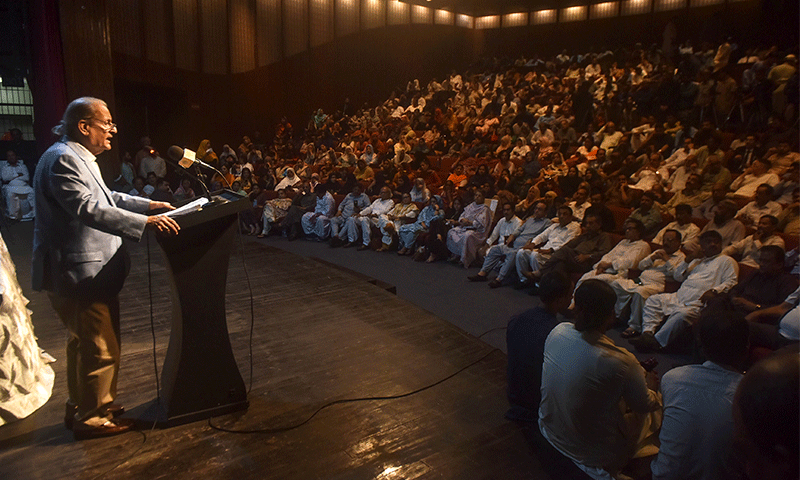
KARACHI, April 29: The judiciary should stand firm on their oath to defend the Constitution of Pakistan, said Justice (retd) Fakharuddin G. Ibrahim while delivering a lecture on “Judiciary and the People” in the weekly programme organised by the Pakistan People’s Party on Saturday evening.
He said, “The doctrine of necessity is dead. The LFO and the 17th amendment are ultra-virus to the constitution. Judgments by the courts should be made strictly within the perimeters of the constitution as it stood on 12th October, 1999.”
Justice (retd) Fakhruddin said every citizen should take a stand against tyranny at this critical juncture. He said, “If we do not speak up now, history may not give us another chance and we may be subjugated forever.”
He said constitution was the mother of all institutions and the living soul of the nation. It was the duty of the judiciary to protect the constitution. Unfortunately, he said, some judges failed to perform this primary duty. He said in Asma Jilani case the Supreme Court had held that there was no room under the constitution for usurping of power by the military. “However, just one day after the military takeover of General Zia, all the chief justices of the four High Courts very willingly agreed to serve under him as acting governors,” he said.
Besides, he said the Supreme Court in an unprecedented judgment opted for giving death sentence to the framer of the constitution, Zulfikar Ali Bhutto, even when three learned judges had pronounced him ‘not guilty’. Now, one of the judges, who had awarded the sentence, admitted that he had signed the death sentence under the government pressure, Mr Ibrahim said. “This admission on the part of the said judge alone had turned the balance of judgment in favour of Mr Bhutto. The Bhutto case should be re-opened and those confessing of sentencing him under pressure should be made to explain their misconduct as judges,” he said.
Mr Ibrahim paid tributes to late Justice Dorab Patel, who besides him, refused to take oath under General Zia’s PCO in 1981. Justice Dorab Patel was the next in line to become the chief justice, but, he showed courage.
After the military coup, he said, the Supreme Court voluntarily gave three-year time and the powers to amend the constitution to General Musharraf. He alleged there was no legality in the LFO or the 17th amendment. The review petition against the 17th amendment was lying with the Supreme Court for the last two years and was not even being heard. Now the regime had launched a direct attack against the Supreme Court to make judiciary completely subservient, he said.
Mr Ibrahim cautioned against arriving at any political settlement with the army, which was against constitutional provisions. He demanded the return of army to barracks, free and fair elections under the constitution as it stood on 12th October, 1999, and appointment of an election commissioner with the consensus of all political parties.
Senator Raza Rabbani, in his presidential remarks, said the regime had been trying to rewrite the civil-military equation. It had been trying to crush the judiciary, he said. The events of the 9th March had, however, broken that nexus and the nation could see the light at the end of the tunnel.
He said now the judiciary itself had showed its solidarity with the common cause by attending in large numbers the functions addressed by the chief justice in Sukkur, Quetta and Peshawar.
He hoped that the judges of the Punjab High Court would follow suit when the chief justice would address the Bar in Lahore on May 5.—PPI