0
0

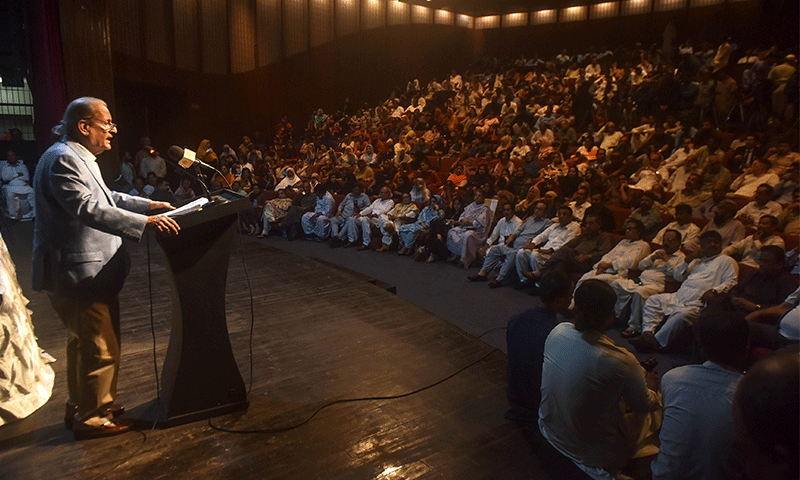
KARACHI, April 27: Speakers at a seminar titled ‘Present situation in the country and response of the civil society’ appealed to all segments of society to stand united and support the just stance adopted by Chief Justice Iftikhar Ahmed Chaudhry to strengthen judiciary and weaken the dictatorship.
“It is duty of all of us to stand united and support the chief justice and every individual and institution which could help us bringing real democracy back to this unfortunate soil,” Zahida Hina, eminent poet and columnist, said in her keynote address at the seminar organised by the Network for Women Rights at the PMA House on Friday.
She said supporting the CJP did not mean supporting an individual, but an institution, which had been attacked by the executive because judiciary had started giving judgments that the rulers foresaw could become a damper on their future wrongdoings for perpetuating their rule over the majority – the oppressed.
Justice (r) Rasheed A. Razvi, said he had not seen any movement in the history of Pakistan which had got such an overwhelming response from lawyers and other spheres of life. And no one has exhausted though the movement has entered the second month, he noted.
He claimed that protesters were being offered bribe by government quarters, adding that he believed no one would like to compromise on the supremacy of the judiciary.
He said the chief justice of Pakistan had been put under watch by the government agencies three months before he was implicated in a false case through the presidential reference to render him non-functional. The reason was that some of his decisions were people-friendly and against the interests of the rulers and the government had started feeling that he many become a big hurdle in its future adventures.
Mazhar Abbas, PFUJ secretary general, said that media and judiciary were the two only institutions to which the people always saw with great expectations of pleading their case. He was of the view that due to this, both the institutions had been subjected to constant intimidation and threats.
He narrated the ordeal of journalists, particularly those working in the danger zones like tribal areas, who were receiving threats from both extremists and the Establishment. He said many journalists in tribal areas had either been forced to migrate or quit the profession.
Dr Noman Ahmad, head of the NED University’s Department of Architecture, said the authorities were exploiting all resources and funds at their disposal for the mega projects undertaken by the government but these projects would benefit less to ordinary people. After exhausting all the funds, there might be nothing left for the smaller and useful projects that could bring some respite to the common man, he apprehended.
Mehnaz Rehman spoke about the plight of women while Saleha Athar gave introductory remarks about the Network for Women’s Rights.