0
0

ISLAMABAD, April 26: The International Commission of Jurists (ICJ) observed on Thursday that the current judicial crisis could worsen and cause irreversible damage to the constitutional order in Pakistan.
The commission urged the government to address the underlying causes of the crisis and restore the fundamental democratic principle which is pivotal to the rule of law in the country. It said the public show of strength by the government by bringing pro-Musharraf people on streets could not resolve the crisis.
“The commission considers that such public show is an inappropriate and ineffective way to resolve the current judicial crisis. This was seen clearly in the government demonstrations of March 24,” said a written statement of ICJ.
The interference of executive in the independence of judiciary, the commission said, was nothing new in Pakistan, adding that incidents like President Pervez Musharraf, in military uniform, seeking resignation from the Chief Justice of Pakistan at the Army House on March 9 could not take place in a civilised society.
“It was bizarre and unimaginable. Such a thing never happens in a civilised society,” observed Dato Param Cumaraswamy, former vice-president of the ICJ and representative of the commission’s mission to Pakistan.
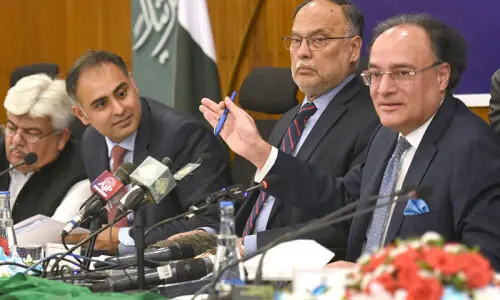
He was addressing a news conference at the conclusion of the ICJ’s seven-day mission to Pakistan to examine events and developments since President Musharraf directed the Supreme Judicial Council to examine allegations against Chief Justice Iftikhar Mohammad Chaudhry.
The mission visited Karachi, Islamabad, Peshawar and Lahore and met the chief justice, retired judges, office-bearers and members of bar associations, ministers of information and broadcasting and law, justice and human rights, law secretary and some lawyers representing the government.
Mr Cumaraswamy said there should be an open trial of the chief justice as according to the UN charter, when judges themselves desired open trial they should be provided the opportunity in order to uphold the independence of judiciary.
The mission was of the view that lawyers protesting against Gen Musharraf were exercising their legitimate right to freedom of expression and assembly.
Mr Cumaraswamy, also a former United Nations Rapporteur on Independence of Judges and Lawyers, said the mission was informed that the chief justice had been held in the Army House for nearly five hours, virtually incommunicado, save for the presence of a few other army generals. He said the mission had learnt that during those five hours, in the absence of the next senior-most judge, Justice Rana Bhagwandas, who abroad, and with undue haste, the next senior-most judge, Justice Javed Iqbal, was sworn in as acting chief justice.
When the chief justice left the Army House, the mission was informed, his entire protocol was immediately withdrawn, even to the extent of removing the flag from his car. He was not allowed to go back to his office in the Supreme Court. Instead, police escorted him to his residence. “It was virtually unprecedented in the legal annals of the world,” he observed.
The mission said that as a result of the recent events, there had been a pressure on journalists -– some subtle, such as the reduction of government advertisement, and some overt, such as letters and phone calls telling them to report in a particular manner.
The mission reiterated the importance of maintaining the media’s freedom of expression.