0
0

KARACHI, April 26: Political independence is a very vital fact of the world yet this independence is not possible without real need of an honorable compromise.
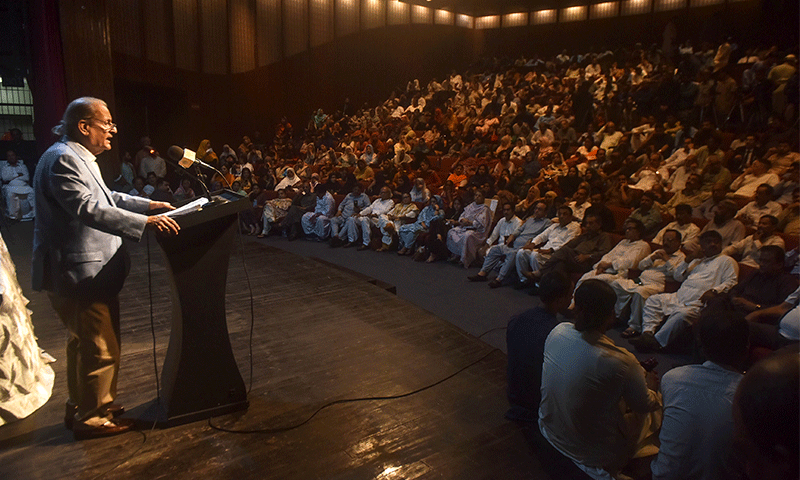
This was stated by former Pakistani ambassador Najmul Saqib Khan while delivering a lecture on ‘Rays of hope for peace with justice in the Middle East’, organised by the Department of International Relations, University of Karachi on Thursday under its programme on peace studies and conflict resolution.
The lecture discussed in length the Middle East as a region, full of conflicts and controversies. According to him, the creation of Israel is deeply rooted in the historical consciousness of the Jews as an oppressed nation. In the late 19th century, the Jews in Europe decided to form an independent sovereign state in the heart of Palestine.
He said Balfour Declaration in 1917 became a catalyst for the creation of Israel. “Now Israel has become a reality and it is true that there are real conflicts in the Middle East yet there are possibilities of peace, which can be properly handled and made use of,” said Mr Khan.
The former ambassador said the dilemma of the Arab-Israel problem was that the oppressed (Jews) had become oppressors. “Extremism and terrorism are the major consequences of unresolved conflicts in the Middle East”, he added.
He said in the current Middle Eastern political scenario, a new wave of hope was rising. In the recent efforts by the Saudi administration, he said, there were clear signs of a just and honorable peace with Israel.
“The problem of the Middle East is intimately connected to a just settlement of disputes without any use of force. The Arab world has now a chance to opt for a two-state solution”, he said.
He said there had been an international consensus over the two-state solution. “Only by this can there be an end to an unending phase of violence and militancy in the Middle East. Therefore both sides should try to traverse a path of mutually acceptable peace and conciliation”, he added.
Dr M Shamsuddin, dean, faculty of Arts, in his welcome address, said that only negotiations and dialogue should determine the fate of the conflict in the Middle East.
Dr Akhlaq Ahmed, pro-vice-chancellor of the KU, said that political sovereignty of the Palestinians was a workable solution in the Middle East.
Dr Moonis Ahmar, programme director, said that disputes in the Middle East needed immediate attention. Diplomacy, he added, had the potential to meaningfully bring the parties together.
Dr Talat Wizarat, chairperson, KU’s International Relations department, in her concluding remarks said that exploitation and injustice were the real causes of unrest in the Middle East. She said the historical dimensions of the Palestinian problem must be taken into consideration while analyzing the political scenario of the Middle East.
The programme was followed by a question and answer session.