



 0
0

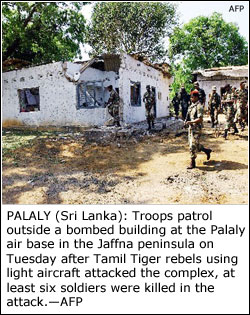 COLOMBO, April 24: Tamil Tiger rebels flying light aircraft bombed Sri Lanka’s main military complex in the Jaffna peninsula on Tuesday, killing at least six soldiers and wounding 13, officials and rebels said.
In their second air strike in two months, the Liberation Tigers of Tamil Eelam (LTTE) said two light aircraft flew over the key Palaly air field just after midnight and bombed military locations.
“We have carried out our second air attack... on the Palaly air field and their military stores,” LTTE spokesman Rasiah Ilanthiriyan said by satellite telephone from the north of the island.
“I spoke to the pilots after the attack and they said they did not come under any kind of fire,” Ilanthiriyan said, denying government claims that ground fire forced the low-flying aircraft to change their target.
“They had a cool flight,” he added, but stressed an immediate repeat of the air strike was unlikely as the rebels would be watching Sri Lanka play New Zealand in the semi-finals of the World Cup cricket tournament in Jamaica. “There may not be any attacks tonight (Tuesday) because we are also watching the match,” Ilanthiriyan said. Tamil Tiger chief Velupillai Prabhakaran is believed to be a cricket fan.
The government flew a group of photographers to the area and showed them three out of 22 places said to have been hit by Tiger shelling as well as the pre-dawn air strike.
Six troopers were killed and 13 wounded in the air attack, military sources said.
“Six of the soldiers who were killed are those who fired at the Tiger aircraft which flew at 100 metres,” the region’s top military commander Major-General G. A. Chandrasiri told reporters.
The latest Tiger air raid was an embarrassment to the air force, which announced last week it had acquired night-attack capability of knocking out rebel aircraft.
The rebels, whose separatist campaign has left more than 60,000 dead, staged their first air strike on Sri Lankan forces on March 26 using what were believed to be two single-engined, Czech-made Zlin Z-143 training planes.
Sri Lanka’s military operate a fleet of supersonic jets as well as Mi-24 helicopter gunships in addition to spy planes.
The first Tiger air attack saw the guerrillas drop six bombs on the island’s main military air base – which shares a runway with Sri Lanka’s only international airport – and get away unchallenged.
The government said the second Tiger air attack inflicted little damage.
“The security forces acted promptly, alerted through the air defence systems, and launched a counter air offensive at a suspected aircraft...forcing it to change course immediately,” the defence ministry said.
Army chief Lieutenant General Sarath Fonseka, however, said the rebel aircraft changed course to bomb a nearby army detachment from where the military casualties were reported.
Fonseka said the military switched off lights, rolled out heavy guns and opened fire. However, the guerrilla aircraft managed to escape.
The defence ministry said the Tigers were believed to have five light aircraft which they had smuggled in since a Norwegian-arranged truce went into effect in February 2002.—AFP



























