0
0

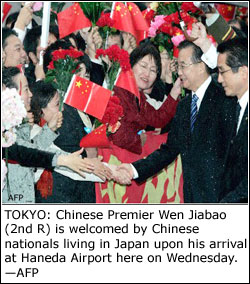 TOKYO, April 11: Chinese Premier Wen Jiabao and Japanese Prime Minister Shinzo Abe agreed on Wednesday to build a new “strategic” relationship, but Wen warned that disputes over the wartime past could still hurt the fragile rapprochement.
Wen’s three-day visit, the first by a Chinese leader since 2000, aims to showcase a thaw begun with a trip by Abe to Beijing in October.
“In today’s meeting with Premier Wen, we were able to agree to push forward many specific points of cooperation towards building a mutually beneficial strategic relationship,” Abe said in a banquet speech punctuated by smiles and anecdotes.Sino-Japanese ties grew chilly under Abe’s predecessor, Junichiro Koizumi, who made annual visits to Tokyo’s Yasukuni war shrine, seen in Asia as a symbol of Japan’s past militarism.
“China-Japan ties are at a crucial point of inheriting the past and opening up the future,” Wen said at the banquet.
“How the ties develop will have an important effect on the future of our two nations and Asia.”
Wen was blunter when the cameras weren’t rolling.
“If we can handle the history issue well, it would be a good foundation for the development of bilateral ties,” a Japanese official quoted Wen as telling Abe.
“If not, it will become an impediment to Sino-Japanese ties.”
Abe accepted an invitation by Wen to visit Beijing again this year, and the two sides issued documents on cooperation in energy and environmental protection, as well as a joint press release that included better dialogue on defence matters and an agreement to hold high-level economic talks in Beijing by the end of the year.
The two countries’ economies are already inextricably intertwined. China including Hong Kong is already Japan’s biggest trade partner, ahead of the United States, with two-way trade totalling nearly $240 billion last year.
But on one of the thorniest economic disputes – a feud over oil and gas fields in disputed waters in the East China Sea – the leaders agreed only to speed up talks and seek a report on ways to jointly develop the resources by autumn.
Even as they met, China’s state-owned CNOOC Ltd. said it had produced gas at a field in the East China Sea last year, despite Japanese objections to development.
Beijing and Tokyo are at loggerheads over the boundary between their exclusive economic zones, and Tokyo fears Chinese development might drain off its resources.—Reuters