0
0

ISLAMABAD, April 7: The judicial crisis that has kept the entire country on tenterhooks since the presidential action against Chief Justice Iftikhar Chaudhry a month ago, has now compelled President Pervez Musharraf and the country’s security establishment to discuss some drastic measures to resolve the issue.
No decision has yet been taken, and no dramatic announcement is expected in the next few days. But highly reliable sources have told Dawn that the various options being discussed clearly indicate the perceived magnitude of the crisis. Such options include a major shake-up in the government, possibly the replacement of the prime minister, to the president admitting that he was wrongly advised, or him directly taking the entire responsibility and restoring the chief justice.
In a series of background interviews, some top government functionaries have told Dawn that this was by far the biggest challenge to President Musharraf and his authority since he seized power more than seven years ago. One federal minister, seen as extremely close to the president, said it was a much bigger crisis than the Dr. A. Q. Khan affair.
Another feared that if not handled carefully, the crisis could potentially unravel the whole system, though conceding that the president appeared optimistic of emerging unscathed.
What has baffled the government, more so the president, has been the level of outrage, not just in the opposition’s ranks, but among the legal fraternity. Initially, Gen Musharraf was told by the intelligence apparatus that after a few days of protest, the situation would be brought under control. But those close to the president’s camp say now no one was in a position to say which way the verdict of the Supreme Judicial Council could go, and even if it was against the Chief Justice, whether it would find the much needed acceptability within the legal fraternity, and the general public.
DAMAGE CONTROL: Although the damage control exercise had been going on for the last three weeks, it took a feverish turn in the last three days, with the ruling Pakistan Muslim League President, Chaudhry Shujaat Hussain, having to abandon his treatment half-way and return from New York. “It’s true that I was to stay in the United States for at least another week to complete my treatment, but was sent a message through my party’s secretary general Mushahid Hussain Syed to return home,” Shujaat Hussain said.
“I am not sure what role I can play in this situation, but if asked, I would try and do whatever was possible,” was his way of presenting his role in tackling the crisis. Although the PML chief declined to say anything about his meeting with the president or the suggestions he has given to defuse the situation, those privy to the ongoing discussions said his was fast becoming a pivotal role. These sources said his meeting with President Musharraf since his return to the country has set in motion an entirely new exercise.
For instance, it has now been confirmed by three different sources within the government that in his meeting with the president, Chaudhry Shujaat Hussain did not mince words in questioning the wisdom of the action that precipitated the crisis. Earlier, similar views had been expressed by Mushahid Hussain, who along with Punjab Chief Minister Chaudhry Pervez Elahi, accompanied the PML leader and once again expressed serious reservations about the handling of crisis.
So intense was the discussion, say these sources, that the president’s meeting with the prime minister was delayed, and Mr Shaukat Aziz was kept waiting in an adjacent room for nearly 25 minutes.
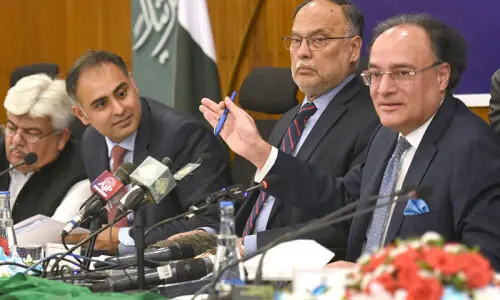
Since then, the president has also held a series of meetings attended by Mr Aziz and top government and intelligence officials to discuss and explore ways to tackle mainly the judicial crisis, but also the Lal Masjid-Hafsa madressa episode.
By this time it has also become quite clear that there are now at least three distinct views within the government, with a number of ministers and PML leaders insisting that Prime Minister Aziz should have played a more active role in averting the crisis. One such group also says he was the one who had cast the first stone in the campaign against the chief justice in the aftermath of the Supreme Court verdict to overturn the privatisation of Pakistan Steel. All other issues, say these sources, came later and together became instrumental in convincing the president to file the reference.
So, what are the possible scenarios in the wake of the ongoing judicial process and the back-channel efforts that have been started with Chaudhry Shujaat Hussain being brought onboard, and indirectly being asked to suggest options to defuse the situation?.
One is to let the judicial process take its course in the hope that the SJC would give its verdict against the Chief Justice. How the legal fraternity reacts to such a decision is, at this stage, not being taken seriously by the President, but some of his well-wishers are genuinely concerned.
A more challenging situation may occur if the SJC rules in favour of the CJ, whose judicial activism of the past makes his actions in the future a bit more unpredictable.
The third possibility being contemplated is that President Musharraf, either by himself taking the responsibility of the action or by holding those who advised him wrongly, decides to withdraw the reference and restore the CJ. Opinion remains divided on the CJ-government relations in such a situation, but senior government leaders believe things have not gone out of control and a workable solution can still be found. But in order to do that, some heads may have to roll. It can either be the case of someone being made a scapegoat, or being penalised for giving wrong or bad advice to the president.
The worst case scenario being talked about is of going for an extreme action, and to try and address all the issues in one go, including a major crackdown against religious extremists. This could be preceded by suspension of fundamental rights or even imposition of emergency. But the real fear is of an adverse reaction by the West. So, everyone in the government is hoping that such a stage doesn’t arrive.
Highly informed sources in the government say the crisis is serious, but no one was expecting any action in the next few days. However, their eyes are focused on the April 13 hearing, and a lot may depend on the way things unfold both inside and outside the Supreme Court on that day.
“The crisis is there,” says Railways Minister Sheikh Rashid Ahmed, “but it’s not correct to say that some kind of change is imminent.” However, he, too, would like everyone to watch the developments taking place on and after April 13.