0
0

KARACHI, April 4: Naheed Siddiqui, who was banned from dancing during General Ziaul Haq’s regime in 1978, explained some of the finer points of kathak and her oneness with the art she is acclaimed as the country’s foremost symbol.
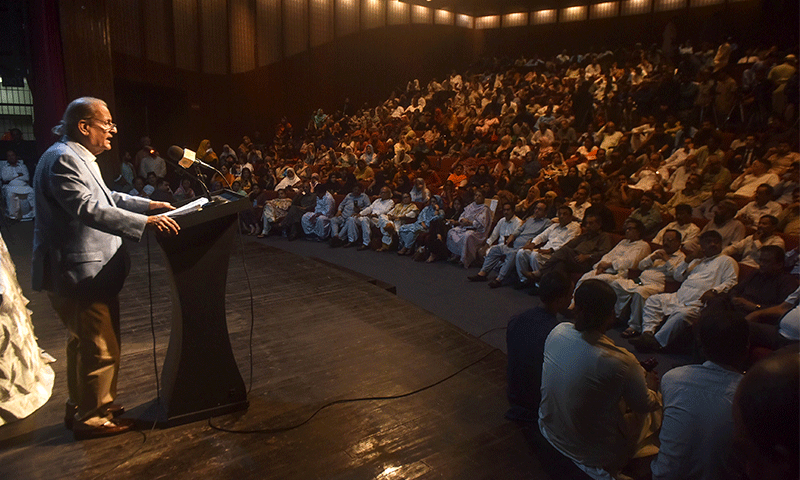
“When I dance I become one with the cosmos - there is no 'me' left. Dance is not an act for me. Rather, it is becoming or being the act. It is as if eternity itself is making me move,” she said while speaking on ‘Katha of the Soul’ as part of the Special Lecture Series, organised by the Aga Khan University in Karachi.
The appreciative audience included several members of the city’s fine arts fraternity were there to avail unique opportunity to learn about the finer points of this great art form. Explaining the ‘katha’ (tale) of the soul, Ms Siddiqui said dance was a “complete art form, allowing for total freedom through which an individual may express one’s own spirit.”
She gave examples of other types of dance, such as that of the Sufianic dance of the ‘Mevlavis’, the Whirling Dervishes, who, in the tradition of great Sufi saint Maulana Jalaluddin Mohammad Rumi, lose their selves in the devotional expression of their spirit. Continuing the ‘katha’, Ms Siddiqui said while she was “rooted in the classical tradition of the Kathak dance form,” she also expressed “emotions, themes and vocabulary according to my own aesthetics.” Elaborating, she talked on the blending of traditional and contemporary techniques, which indeed had contributed a no small part to the ‘katha’ of Kathak. True, she said, Kathak is that which comes from one’s very soul and thus soul and Kathak are inextricably linked. She explained that dance was something she felt and treated as an act of devotion.
Ms Siddiqui’s talk was interspersed with demonstrations of body movements, impressing the audience with the sheer intricacy and meaning, of each subtle delicate movement. The talk was followed by a question-and-answer session. Ms Siddiqui responded to questions by going into the minute background of the subject to enhance the comprehension and e knowledge.
According to the organisers, AKU’s Special Lecture Series programme is a part of its policy of encouraging broad-based education in which eminent personalities are invited to illuminate the University’s constituencies on meaningful and engaging topics of public interest.