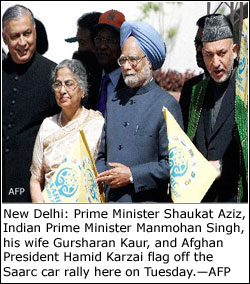
 NEW DELHI, April 3: Pakistan warned Saarc leaders assembled here on Tuesday that the South Asian club would become unhinged from its people’s expectations unless it moved towards a resolution of debilitating political disputes that dog member states, which also now include Afghanistan.
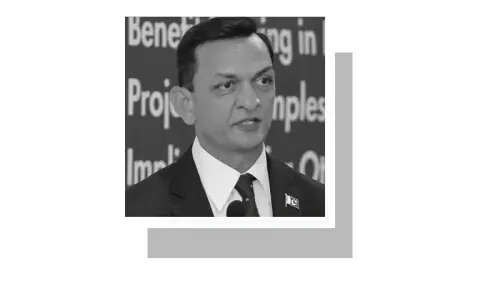
“We need to ask ourselves as to how relevant is Saarc to our people? How has it impacted their lives? In other words, where is the Saarc dividend for our people? These are some of the challenging questions that we, as leaders of South Asia, must answer. They can no longer be ignored or denied,” Mr Aziz said in his address to the 14th Saarc summit that got under way at Delhi’s heavily guarded Vigyan Bhavan.
He did not mention the Kashmir dispute by name at the forum but reserved his reference to the core issue at a meeting with senior Indian journalists he later addressed. Indian Prime Minister Manmohan, who spoke before Mr Aziz, also acknowledged that regional disputes were impeding Saarc’s growth, but he eventually confined his focus to terrorism as the main aspect of these disputes.
Mr Aziz said the chief reason why Saarc had been slow in catching up with the other regional organisations was self-evident. “The political environment in South Asia has remained vitiated by disputes and mistrust,” he said.
“We have remained mired in conflict management. The consequent drain on our energies has held us back from achieving the goals that we set out for ourselves in the Saarc Charter.”
Urging Saarc members to come to grips with the real challenges as individual nations and collectively as Saarc, he said: “We need to evolve a roadmap for the region that will enable us to leverage our assets and our advantages while overcoming our limitations. Only then will we be able to make a difference in the lives of our people.”
Mr Aziz listed five ‘milestones’ as essential to traverse for Saarc to become a cohesive and effective body with boundless potential. These milestones are:
“First, it is essential that we promote an environment of genuine peace and security in South Asia, since there is clearly a direct co-relation between security and development. This requires us to resolve the differences and disputes within and between our countries through dialogue and compromise.
“Second. And as a consequence of the first; build mutual trust and confidence, thereby removing the obstacle of the trust deficit, which has hampered meaningful cooperation in the region.
“Third. Reinforce and uphold the principles of peaceful coexistence — especially to ensure respect for sovereign equality among member states of Saarc.
“Fourth. Build interdependencies and sharing of best practices so that we help ourselves. A shared desire for regional cooperation will not suffice — we need to have real and tangible benefits that accrue equally to all sides in order to make such cooperation possible.
“Fifth. Promote a level-playing field for a truly effective
regional division of labour and production. As a first step, this would require truly open
environment for regional trade — devoid of all types of barriers to free trade.”
Mr Aziz claimed that his five suggestions were ‘practical and doable’ measures that were not beyond the grasp of South Asia’s collective endeavours. “Several examples exist before us where even greater hurdles to regional integration have been overcome.
“The initial requirement is for us to have a necessary political will. We must be able to rise above our differences for the greater good of our people and our future generations. These future generations will judge us by our actions, not by our words.”
Earlier, the Indian prime minister, who became Saarc’s new chairman at the summit, stressed that peace in the region was a precondition for its success as a viable region of economic prosperity. But he stayed clear of proposing a resolution of disputes to usher in peace.
“A primary requirement for the fulfilment of our vision of prosperity and cooperation in South Asia is peace,” he said. “We should therefore implement in a meaningful and sincere manner the commitments and pledges to root out terrorism so as to create the atmosphere in which our endeavours can succeed.”
Regional peace found an important reference also in the Chinese foreign minister’s brief intervention at the summit. Mr Li Zhaoxing, who was asked to speak as one of the five first time observers inducted by Saarc, said a peaceful, stable and prosperous South Asia was in China’s interest. “As the biggest neighbour of South Asia, China hopes that all South Asian will live in harmony and pursue development,” he said.
Mr Aziz is scheduled to have a one-on-one meeting with Dr Singh on Wednesday morning followed by an opportunity for them to exchange notes at a brief retreat at the Hyderabad House. The leaders would then assemble for a concluding ceremony, at which, all members traditionally make a second round of speeches, often taking into account their discussions with each other, formal and informal.