0
0

KARACHI, March 22: The academic council meeting of the Dow University of Health Sciences constituted a three-member committee to nominate three members for the Board of Advanced Studies and Research.
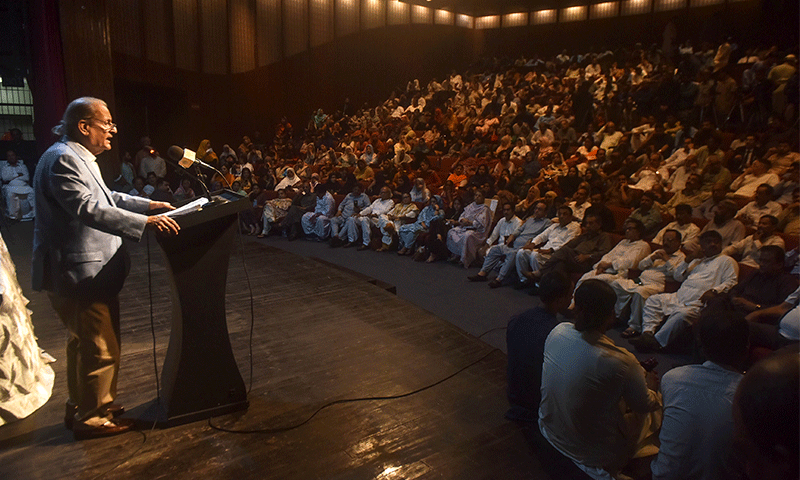
The Board of Advanced Studies and Research will comprise 10 members. Of them, three will be nominated by the academic council of the DUHS. The ninth meeting of the academic council, held here on Thursday and presided over by DUHS vice-chancellor Prof Masood Hameed Khan, named Prof Ilahi Bux Soomro, Prof Siraj and Prof Abdullah. The committee will recommend names of three members representing the academic council in the Board of Advanced Studies and Research.
Prof Masood told Dawn that the university planned to launch an MPhil programme in basic sciences at a larger scale leading to PhD for which the guidelines set by the higher education commission (HEC) have to be followed. The establishment of the board was one of the prerequisites, he added.
The academic council meeting also reviewed the security situation in the Dow and Sindh medical colleges, matter of combined clinical skills examination in third year professional, setting up of trauma centres in neurological and eye wards, and other issues.
The meeting suggested that the movement of private security guards be restricted to avoid any disturbance in the educational process and help remove the unrest among students. It decided to approach the chancellor to replace private security with government security comprising police and rangers. However, the security personnel could take action only with the prior permission of the vice-chancellor.
It was proposed that the clinical skill examination be conducted from third year instead of final year so that the skills of students could improve. A change in the methods of teaching was also stressed and it was recommended that all chairpersons of respective departments would prepare their proposals for change in teaching methods. Besides, the proposals from other universities in this respect would also be sought.
The meeting felt that alterations in those units of the Civil Hospital should not be made which could adversely affect the teaching process.