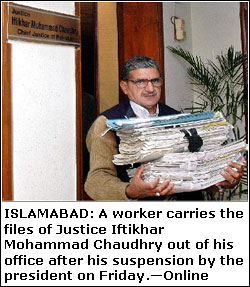
 ISLAMABAD, March 9: Chief Justice Iftikhar Muhammad Chaudhry, who was suspended on Friday, has several important judgments to his credit, the most significant being the case in which he overturned the privatisation of the Pakistan Steel Mills and another in which he forced the government to locate ‘missing’ persons.
During his 21-month tenure as chief justice, Justice Chaudhry initiated suo motu action even on a simple application filed by any aggrieved person. Despite his popularity among ordinary people, such moves were regarded by some members of the legal fraternity as being against the norms of the apex court.
There were so many suo motu actions against government officials, especially the police, that the chief justice had to set up a fully-fledged human rights cell in the apex court.
Contrary to public perception that victims of rape or other injustices were unlikely to get justice from lower courts, Justice Chaudhry opened the gates of the Supreme Court, bringing some relief to the needy.
In the privatisation of Pakistan Steel Mills, which is his most famous case, the chief justice’s detailed judgment of Aug 8, 2006, had put the government under severe pressure by accusing it of holding the mills’ privatisation in ‘indecent haste’.
In his judgment, the chief justice held that the entire transaction was the “outcome of a process reflecting serious violation of law and gross irregularities” in which various aspects of profitability and assets of the state-owned enterprise were totally ignored.
Likewise, on Feb 20, 2007, the Supreme Court upheld most parts of the Hasba Bill, re-legislated by the NWFP Assembly, though it asked for minor modification to clauses related to the definitions of the Mohtasib and religious scholars.
On June 27, 2006, the chief justice decided a case about Section 2A of the Services Tribunal Act 1973 and ruled that employees in most government corporations not governed by the statutory rules were not civil servants.
The most important and sensitive case to-date, which the chief justice had heard just a day before his removal related to ‘forced disappearances’ and he had expressed strong disappointment over the government’s failure to locate the whereabouts of the disappeared people because of their suspected links with Al Qaeda or other jihadi outfits.
On Jan 22, 2007, the chief justice, while leading a bench, had turned down the Punjab government’s request to approve its decision to briefly lift the ban on kite-flying during the spring festival and asked the provincial government to celebrate ‘Basant’ at their own risk. The apex court had taken suo motu notice on the reported deaths of children because of kite-flying.
Another important matter, which had deep political implications, was the case filed against educational degrees of Muttahida Majlis-i-Amal’s (MMA) members in parliament. They had been challenged on the grounds that the degrees issued by religious seminaries were not equivalent to graduate degrees.
On Jan 18, 2007, the chief justice had settled the custody dispute of UK-born Muslim girl Misbah Irum Rana through a compromise reached between her divorced parents.
On Jan 22, the chief justice had directed the Balochistan government to submit a detailed report about illegal allotments of 241,600 acres of land to ministers, politicians and other bureaucrats in Gwadar. The order was passed on a petition filed by Bibi Zahra against the the Balochistan government’s Board of Revenue.
The chief justice had also taken strict action against violators of the Supreme Court’s ban on meals in weddings, forcing the government to adopt a private member’s bill, allowing one-dish during marriages.
Due to the apex court’s intervention, the government also had to take action against fake drugs and the use of tobacco in public places.