Better funding for education
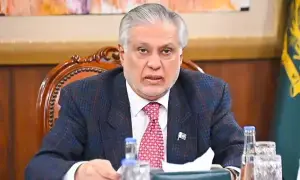
THE government seems to be serious about pumping in massive funds into the education sector. While briefing newsmen about the cabinet’s decisions on Wednesday, the prime minister announced that in 2007-08 the education budget will be increased to four per cent of the GDP. This will be a hefty increase from the present 2.7 per cent of GDP, which amounts to Rs160 billion. Considering the rising GNP, the money going into the education sector will more than double next year. How this money will be used is not clear because the education policy in the process of being drawn up has still to be announced. It is encouraging that the government has now seen the wisdom of investing in the education sector, but only when some positive results emerge will this move be vindicated.
The fact is that education in Pakistan has suffered grievously for many years because the budgetary allocations for this sector remained dismally low. As a result, expansion did not keep pace with the growing population and the demands of the time. Since 1999 the education budget has risen and has been more than doubled from Rs71 billion to Rs160 billion. Has this brought about any marked improvement in the quality and quantum of education? The literacy rate is said to have grown from 47 to 53 per cent but the number of children enrolled in government schools has hardly increased, if it has not actually declined. As for the quality of education being imparted in the public sector institutions, the less said the better. Had it not been for the private sector, education in the country would have virtually collapsed. Simply injecting funds into the education sector will not take us far without the necessary absorptive capacity created for its utilisation. In the absence of this capacity and infrastructure that should have been created concurrently as expansion took place, the education departments’ funds have either remained unutilised or have been embezzled. According to one report, 92 per cent of the funds (Rs51billion) earmarked for the five-year Education Sector Reforms Programme (2001-2006) has remained unutilised.
It is therefore time that the government attended to this aspect of the matter, namely capacity-building. The white paper prepared by the national education policy review team suggests that the increase in outlays must be gradual and linked to capacity development so that the funds are fully utilised. It is essential that the strategy for capacity building — in planning, implementation, monitoring and evaluation — is formulated carefully and the budgetary enhancements made accordingly. This will ensure proper utilisation of the allocations apart from containing corruption. One reason why the increase in funding has made little impact on education is that a lot of money is now available and it has led to embezzlement and graft. In the absence of checks and proper monitoring, there is no foolproof way of ensuring that the funds are utilised honestly and for the purpose they have been earmarked. Ghost schools, institutions without basic facilities such as toilets, water and boundary walls, and absentee teachers are clear symptoms of irregularities and mismanagement. Were the education authorities to exercise controls by associating the stakeholders, such as parents and public figures with the monitoring process, it might be possible to contain, even eliminate, corruption.
Fata security & uplift
WHILE aid-givers have promised more funds for security and development in Fata, both tasks pose a serious challenge to Pakistan. There can be no economic development without a pacification of the area; conversely, mere military means to crush the militants will not prove effective in the long run if the quality of tribal life does not change for the better. The havoc wrought in the tribal areas by the Soviet invasion of Afghanistan in 1979 and its aftermath have ruined the area’s economy. The industries that existed there were abandoned as a massive influx of Afghan refugees, the rise of religious militancy and the ramifications of the post-Soviet civil war completely tore the very fabric of tribal society. Even the informal trade, which had traditionally been a major source of tribal economy, was affected seriously, as all religious factions turned Fata into a base of operations for pursuing factional interests in the Afghan civil war. This period also saw the transformation of madressahs into centres of training and recruitment instead of what they were meant to be: institutions imparting religious education and producing imams for mosques.
One hopes that the “sustainable development programme” being finalised by the government and currently being scrutinised by the aid-givers, who include America, Britain and Norway, takes into account the harsh reality of all that is going on in South and North Waziristan. Sole reliance on force has never solved a political problem. The Sept 5 deal has only been marginally successful, and much more remains to be done for peace to prevail in Fata. The recent series of suicide bombings came as a shock and emphasised the need for greater cooperation by the forces on both sides of the Durand Line to check the on-going resurgence in Taliban activity. Fata is rich in forestry and mineral resources. The minerals that remain untapped include 35,000 million tons of copper, eight million tons of coal, 537,000 million tons of silica sand, 20,000 million tons of gypsum and 5,000 million tons of magensite, besides huge reserves of marble and limestone. However, without the pacification of the area, the sustainable development being planned is unlikely to materialise.
The selection farce
PAKISTAN’S build-up to the World Cup lurched from the shoddy to the shambolic on Tuesday with the announcement of a squad that reads like the who’s who of a casualty ward. Some of those selected are physically injured, while some others in the contingent are so mentally scarred that they may not be fit for the rigours of cricket’s premier tournament. The bodily wounded include the three front-line bowlers, all of whom could soon be ruled out of the World Cup. In the case of Shoaib Akhtar and Mohammad Asif, injury is not the only concern. If the two again test positive for nandrolone — a distinct possibility even if no fresh offence has been committed — they could be banned for life. While other teams are busy fine-tuning strategy, Pakistan is searching for 15 fit and dope-free players. This would be laughable if it weren’t for the seriousness with which cricket is followed in the country.
Even a sound move like bringing back Danish Kaneria must be seen in perspective. Kaneria has not been part of the one-day team for almost a year, yet he now finds himself bound for the West Indies. Giving him a few games before the World Cup would have helped the cause. Thrown in the deep end, he may try too hard to impress and thereby flounder. Then there is the big question mark over Kamran Akmal, a wicketkeeper critically low on self-belief. Despite his dismal form, there is no back-up keeper in the squad. The batting remains as fragile as ever and yet another opening pair is to be tried out in the Caribbean. This is a rag-tag team that is unlikely to perform wonders in the World Cup. Worse, a disastrous outing may trigger the sort of wholesale changes seen after the 2003 tournament. Starting from scratch every four years is not a viable policy.
Basis of an Islamic polity
THE religious right in Pakistan, as also in other Muslim states, want that the polity, laws and culture of the country should be modelled on Islamic injunctions.
But, apart from the viability of the proposition in the global context of the present century, the first and foremost step should be to catalogue such injunctions in respect of polity laws and culture which enjoy the acceptance of different Muslim sects in the country.
The juristical conflict may not be the main stumbling block in the path of Islamisation; and a via media to satisfy the priestly classes of the two main sects can be found. But the main deterrent exists beyond the country’s geographical boundary.Any system based on the ideal of the remote past, say, the precedent of the Islamic state of Madinah founded by the holy Prophet himself, is likely to be dubbed as pure 'theocracy’ not only by the non-Muslims (whose voice also matters for us) but also by a sizable section of ‘educated’ Muslims at home because theocracy has become a term of abuse in modern parlance.
Living in a world dominated by western thinkers and western powers, it will be difficult, if not outright impossible, to implement the penal laws without softening certain punishments. Protagonists of the idea that Pakistan should enforce the Shariah laws as the Kingdom of Saudi Arabia has done forget that the latter happens to be the spiritual centre of all the believers in the world and, at the same time, is sitting on one of the largest reserves of that precious liquid which turns the wheels of industry.
By theocracy what the western countries understand is the aggressive and intolerant role of the clergy they witnessed in the Middle Ages in their own backyard, or as seen in the post-Renaissance early 16th century Spain where that gruesome organisation called Inquisition run by the Church after the overthrow of Muslim rule, carried out the history’s most merciless genocide of Muslims and Jews on a scale yet to be matched.
In the words of Lane Poole; “Had the third Abdur Rahman (Arab ruler of Moorish Spain) been immortal, Spain would have been peaceful even to this day and we should never have heard of the persecution of the Jews and the Moors, the terrible work of the Inquisition.” (Moors in Spain).
To avoid that others do not call our Islamic system political, penal and fiscal -– a modern form of theocracy -— and be condemned on that count, it would be wiser to stop raising slogans that we must introduce the truly Islamic system, and instead reflect on what Islam really asks us to do, and then examine how it can be implemented, piecemeal and step by step, without causing a stir at home and abroad.
In this cool environment, we will realise that Islam does not concern itself so much with the form of government, because it has approved the benevolent rule of monarchs like Hazrat Daud and Hazrat Sulaiman (Biblical David and Solomon) and Malika Saba (Biblical Queen of Sheba). It is the function of the government on which the emphasis is laid; its prime duty being, in broadest terms, to quote the Quran, “to enforce the values recognised as 'maroof’ or, in plain English, good; and forbid those which are 'munkar’ or just abhorrent” (3:110).
No one would quarrel with this sensible and agreeable demand. Islam is not concerned whether laws are enacted to enforce maroof and forbid munkar by a popularly-elected parliament or in a super-imposed closed-door presidium. And if the laws are benign and not severe, binding only on those who register themselves as Muslims for obtaining identity cards or government jobs and leaving the other religious and minority groups free in the matter of personal, customary laws, then the Islamic theocracy cannot be equalled with that type of theocracy the West has known in its own historical experience.
It is unfortunate that the very mention of Shariah laws frightens people, as they consider them to be only applicable in a criminal case like theft, robbery and rape for which the offender might end up with the loss of a limb or loss of life at the hands of a stone-throwing mob (even though the last mentioned punishment is not prescribed in the Quran).
To do full justice with main theme of this piece, one would prefer reproducing the following excerpts from Marmaduke Pickthall’s 'Madras Lectures’: “Ideas and axioms the most abhorrent to the mind of the Christendom when it was Christendom, when the Christian Church dictated the ideas and practice of the western people, but which were present in Islam from the beginning, and are embodied in the Sacred Law, have one by one and, gradually, been accepted by the West.
“The duty of free thought and free inquiry; the duty of religious tolerance: idea that conduct and not creed or class distinction must be the test of a man’s worth in law and social intercourse; women’s right to full equality with man before the Law, her right to property, the licence to divorce and remarry; the duty of personal cleanliness; the prohibition of strong drinks: all these well-known ingredients of the Sacred Law of Islam, which were all anathema to Christian Europe, and are still regarded by the Church as either irreligious or purely secular, that is, outside the purview of religion – have been incorporated in the ideology of western Civilisation.”
These ideas have been incorporated in the West in connection with newly-discovered concept of ‘human rights’ or emancipation of women, or to guarantee freedom of thought and action without acknowledging the debt to Islam.
It would be pertinent to point out that the Quran does give the outlines of such an Islamic government which can implement the sacred laws of Shariah. The first characteristic of such a government is that it should not be headed by a person, or authority, that is comparable to a 'warder’ (Hafeez in Arabic text of the Quran 4:80) or a Jailor guarding prisoners in a jail. Secondly, the person or authority, heading the government, must “consult with them (i.e. pious, honest and sincere persons) upon the conduct of affairs” (3:159). Thirdly, the head of government should be “the noblest and best in conduct” (49:13). The translations of these Quranic verses are taken from Pickthall’s “The Glorious Quran.”
From the afore-said, it follows that three criteria set by the Quran are that head of the state, selected by 'mutual consultation’ (“Shurah baina hum”), will not be a fellow imposed from above like a warder or jailor posted to keep prisoners in check and that the selected person will function not arbitrarily or whimsically but with due process of consultation with representatives of people and that he/she will be like “the noblest and best in conduct”, not ideally but with reference to the existing milieu in the national setting.
These concepts are there for the benefit of all who turn to the Quran for guidance and for whom the practical example of the Prophet of Islam (PBUH), who founded and headed the first Islamic state in Madinah during his life-time is available.
Rousseau admits, as a political theorist, the practicability of the Islamic polity and records that “Muhammad held very sane views, and linked his political system well together; and as long as the form of his government continued under the Caliphs who succeeded him, the government was indeed one and so far good” (Social Contract).
The Obama card
RECENT polls indicate that black voters favour Sen Hillary Rodham Clinton by a substantial margin over Sen. Barack Obama, so political pundits are all a-titter, asking how this can be. The assumption, apparently, is that black support should cleave to the black man.
But then, is Obama really black? Of course he is. But that fact has done nothing to prevent the awkward dissection of Obama's cultural and racial affinities. Is he half black? Is he African American? African and American? And, if he's black, is he black enough? It's tempting to shrug off these questions — most recently aired with grave concern Sunday on CBS' "60 Minutes" — as outdated, but they're not. They are instructive and revealing.
The question of whether the rising Democratic star is black enough really translates to: Whose side is he on? Whose agenda will he favour? By definition, those agendas are distinct. Obama's family history — his father was a black Kenyan, his mother a white Kansan, and he spent his childhood in places such as Hawaii and Indonesia — makes him the personification of post-racial, melting-pot America; he straddles races and communities commonly described as opposites — black or white, native or immigrant.
And, as he stands in that intersection fielding queries about his identity, he is really answering the question Americans are too afraid to ask one another: Can we trust each other yet?
Concrete issues around race and equality in America remain unresolved. One of the reasons Clinton has substantial black support is that her husband was adept at recognizing America's unhealed racial wounds, appointing a record number of African Americans to key positions during his presidency and earning the famous (if ridiculed) nickname from writer Toni Morrison as our "first black president."
Obama's challenge in luring blacks away from the former first lady will hinge not on his racial authenticity but on his ability to demonstrate that, despite his inexperience, he would be a better president. But since his political star began to shine as a state senator in Illinois, that authenticity has been under scrutiny, often by blacks.
In 2004, conservative commentator and former GOP presidential candidate Alan Keyes said Obama did not share the black experience because his heritage did not include slavery, the unifying experience for most African Americans. And last weekend, the Rev. Al Sharpton told 10,000 people gathered at Hampton University in Virginia that "just because you're our colour doesn't make you our kind."
—Los Angeles Times
| © DAWN Group of Newspapers, 2007 |