0
0

 MUZAFFARGARH, Feb 3: The Punjab government will compensate farmers in Dera Ghazi Khan and Rajanpur districts for losses they incurred due to a delayed water supply to the Dera Ghazi Khan canal. This was announced by Irrigation Secretary Arif Nadeem who accompanied Punjab Irrigation Minister Amir Sultan Cheema to the Taunsa Barrage site on Saturday.
He said the Punjab government would not charge water cess and other related taxes from those who were dependent on the DG Canal.
Cheema said that the Jan 15 breach in an embankment of the Taunsa Barrage was not an unusual thing. An inquiry committee set up the Punjab government, he said, would present a report in two or three days. He said the breach had delayed water supply to the DG and Muzaffargarh canals for 10 to 12 days.
Answering newsmen’s questions, the irrigation secretary said the inquiry team would only determine technical complications developed due to the breach. He said the construction companies would not be paid any extra sum for the breach.
Work on the Taunsa barrage remodelling project was disrupted on Jan 15 when a 90-foot breach in an embankment swept away another embankment and machinery. The loss of machinery was estimated at Rs3 billion.
The minister said that the irrigation department was not responsible for the breach. Earlier, construction companies had blamed that the department had not informed them about the rising water level, which led to the collapse of the embankment.
The minister said the Taunsa Barrage was built in 1958 and in 1962 cracks were appeared in the barrage. He said that under the Taunsa remodelling and rehabilitation project, computerised gates would be installed here. The World Bank has funded the Rs11 billion project.
The irrigation secretary said that the delayed water supply had not affected much the wheat crop but those farmers who were dependent on the DG Canal would be compensated.
When he was told that mango and vegetable growers had also been affected due to the shortage of water in Muzaffargarh and elsewhere, the secretary said that a majority of farmers could irrigate their crops through tube wells.
About compensation for the farmers hit by the River Chenab erosion in Rangpur, the secretary said that the district government or other departments should provide relief to them. He said the irrigation department would build embankments in Rangpur before the next flood season.
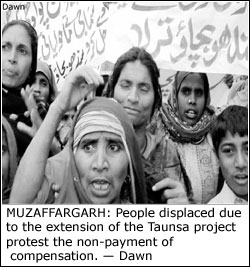
PROTEST: Dozens of people affected by the project held a protest demonstration against the irrigation department and demanded compensation for their lands and houses.
The protesters said they were displaced due to extension of the Taunsa Barrage project. Up to 57 houses were demolished and hundreds of acres were submerged due to the extension of the barrage.
The protesters gathered to press their demands as the irrigation minister arrived at the barrage site on Saturday.
Residents of the Basti Tausna said they had no shelter and the irrigation department had failed to honour its promise of providing shelter and land to them. They met the inister who promised that a survey would be carried out to determine their losses. He said that the government had allocated Rs20 million for the displaced people which would be given to them after the survey.
MULTAN CORRESPONDENT ADDS: Fazal Rub Lund and Zafar Iqbal Lund, Sindhu Bachao Tarla spokespersons, said the Taunsa project had created environmental, economic and social problems for people in Muzaffargarh, Dera Ghazi Khan, Rajanpur and Rahim Yar Khan districts. They said discharging of extra water in Muzaffargarh and Taunsa-Panjnad canals in 2006 had caused water logging and affected sugar cane, rice and cotton crops in Kotaddu tehsil.
They said the construction of a weir in the downstream of the Taunsa Barrage on the right bank had diverted water to left, which had eroded land on the left side of the barrage.
They said the Sindhoo Bachao Tarla had demanded that the World Bank and irrigation department form an independent commission to assess the losses of people but the demand was turned down. Cheema directed the authorities to build a drain for the seepage.