



 0
0

‘Hi, I’m Art Buchwald, and I just died’
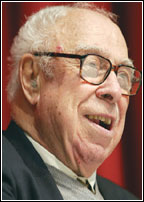 WASHINGTON: Art Buchwald, the Pulitzer-Prize winning columnist, made a career out of skewering Washington’s elite, then won even wider fame when he chose to let himself die rather than fight for every ounce of life. Now he has had the last laugh.
Buchwald died of kidney failure at home on Wednesday, surrounded by family, nearly a year after he stunned them by rejecting medical treatments aimed at keeping him alive. As it turned out, he lived another year instead of the mere weeks he was given by doctors. He was 81 when he died.
The political satirist went out with a twist: “Hi, I’m Art Buchwald, and I just died,” he announced with a grin, in a video posted on The New York Times website. Buchwald recorded the video interview last summer, to be shown after his death.
Buchwald said his months of dying were the time of his life. Neither he nor his doctors could explain why he kept living so long after he checked into a hospice last February, certain at the time that the end was near. “I have to thank my kidneys,” he told The Associated Press last year.
So, as he did during a half-century career that touched two continents, Buchwald decided to make the most of every last minute.
He held court daily in the parlour of his hospice room as friends streamed in to say goodbye. He resumed his twice-weekly column. When it came time to leave the hospice, he spent the summer at his home on Martha’s Vineyard, Massachusetts. He wrote “Too Soon to Say Goodbye,” a book about the experience, and worked book parties in Washington and New York from his wheelchair.
“He’s one of the few people I know who was able to write a script for his death,” Jack Valenti, former chairman and chief executive of the Motion Picture Association of America, said on Thursday.
Buchwald said the decision to forgo dialysis and let himself die was liberating. “When you make your choice, then a lot of the stress is gone. Everything is great because you accept that you are the one who made the choice.”
But when death didn’t come, he opined in a column that he had to scrap his funeral plans, rewrite his living will, buy a new cell phone and get on with his improbable life.
Carly Simon, who had been tapped to sing at his funeral, agreed to sing for him while he was still alive. She wrote a song for him that bears the same name as his book about dying, “Too Soon to Say Goodbye,” and sang it to him last summer on the Vineyard.
Known as the “Wit of Washington” during more than 40 years in the US capital, Buchwald became synonymous with political satire. He was known for having a wide smile and loving a good cigar.
Among his more famous witticisms: “If you attack the establishment long enough and hard enough, they will make you a member of it.”
“Arty kept us laughing, from Paris to hospice,” long-time friend Ethel Kennedy said in a statement. “Now heaven will be a lot more fun.”
Ben Bradlee, former Washington Post executive editor who remained friends with Buchwald after they met in Paris in 1950, said in an interview that Buchwald was “the humorist of his generation.”
“We won’t see his like again anytime soon,” added David Williams, president and chief executive of Tribune Media Services, which syndicated Buchwald’s column to US and foreign newspapers, including The Washington Post. At one time, the column appeared in more than 500 newspapers worldwide.
The most recent one ran Jan 2; it was an ode to the number 1 trillion.
Buchwald decided to stop writing again after taking a turn for the worse this month. He had undergone treatment for an infection in the stump of his right leg, which doctors amputated last January.
“That was when he said, ‘No, I can’t do any more columns,’” said Cathy Crary, his long-time assistant. In a goodbye column written for posthumous publication, Buchwald said he was at ease.
Buchwald attracted notice in the late 1940s in Paris. A former US Marine, he dropped out of the University of Southern California in 1948 and went to France, where he landed as a correspondent for Variety, the Hollywood newspaper, after his money ran out.
A year later, he took a trial column called “Paris After Dark,” filled with scraps of offbeat information about nightlife in the City of Lights, to The New York Herald Tribune and was hired.
He started another column in 1951, called “Mostly About People,” that featured interviews with celebrities in Paris. The next year, the Herald Tribune introduced him to US readers through yet another column, “Europe’s Lighter Side.”
Paris was Buchwald's usual beat, but he went far afield in search of a good story.
He marched in a May Day parade in East Berlin, chased goats up and down Yugoslavia’s mountains and went to Turkey for firsthand experience in a Turkish bath. He made a three-week trip across the Soviet Union in a chauffeured limousine.
Buchwald returned to the United States in 1962, at the height of Kennedy administration glamour. He set himself up in an office two blocks from the White House and began a long career lampooning Washington’s elite.
He later discovered the allure of show business and wrote the Broadway play “Sheep on the Runway” in 1970.
He also was known for a court battle over the Eddie Murphy movie “Coming to America”.
At 17, Buchwald ran away to join the Marines and spent three years in the Pacific during World War II, attaining the rank of sergeant and spending much of his time editing a Corps newspaper.
After the war, he became managing editor of the campus humour magazine at Southern California and a columnist for the student paper. He dropped out in 1948 and headed for Paris on a one-way ticket.
He married American Ann McGarry in London on Oct 12, 1952. Buchwald wrote more than 30 books, including “Leaving Home,” a 1995 memoir on his early years.
He won the Pulitzer, journalism’s top honour, in 1982 for outstanding commentary. Four years later, he was elected to the American Academy of Arts and Letters. In November, the National Press Foundation honoured “his grace, humour, astounding productivity and lifetime commitment to the craft” and was to present him with an award at a dinner in February.
Buchwald’s right leg was amputated below the knee last January because of circulation problems, and he had a major stroke in 2000. He also said he battled depression in 1963 and 1987.
“You do get over it, and you get over it a better person,” he once said of the illness.
Mike Wallace of CBS’ “60 Minutes,” who also fought depression, told the AP that when Buchwald learned it was affecting him, too, he called every night, even when Wallace was overseas on assignment. “He’d try to buck me up,” Wallace said.
Buchwald is survived by a son, Joel Buchwald; daughters Jennifer Buchwald and Connie Buchwald Marks; sisters Edith Jaffe and Doris Kahme; and five grandchildren.—AP
| © DAWN Group of Newspapers, 2007 |



























