ISLAMABAD, Dec 18: The government has formally launched the country’s first policy on renewable sources of energy and offered attractive incentives to investors willing to exploit this environment-friendly but largely unexplored sector especially for power generation.
The ‘Policy for Development of Renewable Energy for Power Generation – 2006’ has already been approved by the Economic Coordination Committee of the Cabinet.
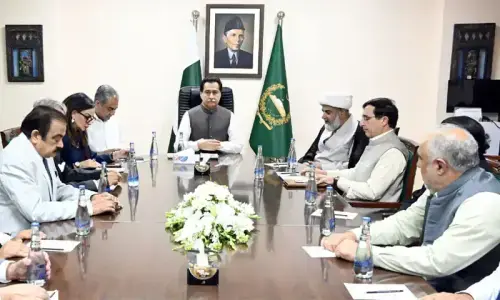
Federal Minister for Water and Power Liaquat Ali Jatoi announced the launch of the policy here on Monday.
The policy laid down very liberal and attractive incentives for investment aimed at putting Pakistan on the renewable energy map of the world, said Mr Jatoi while briefing the media. It would go a long way towards strengthening and improving power supply position of the country, he added.
Highlighting the salient features of the policy, he said it invited investment from the private sector for the following four categories:
i) Independent power projects (IPPs) for supply of power to the grid only; ii) Captive-cum-grid spillover power projects for self use and sale to utility; iii) Captive power projects for self or dedicated use; and, iv) Isolated grid power projects for small and stand-alone use.
“The policy comprises three phases: short term, medium term and long term. The short-term phase covers the period up to June 2008,” he said.
To encourage generation through renewable resources, small projects for self use would not require any permission from the government and would be able to sell surplus power to distribution companies, he said.
Under the policy, the National Transmission Dispatch Company (NTDC) and the Central Power Purchase Agency (CPPA) would purchase all electricity from renewable energy resources projects, he said, adding that the policy would allow investors to avail themselves the facility of delivering power on the existing infrastructure and receiving equivalent power for use at a location of their choice after paying “wheeling charges”.
The minister said small renewable energy projects would not require tariff determination from the National Electric Power Regulatory Authority (Nepra).
He said it had been allowed that the Alternate Energy Development Board (AEDB) would deal with the wind and solar projects, irrespective of their size. The power purchaser would bear the wind risk as well, he added.
Giving details of financial incentives to investors, he said there would be no custom duty or sales tax on equipment and spares meant for initial installation or for expansion of the projects.
Exemption had been allowed from income tax, including turnover rate tax and withholding tax on imports of machinery and equipment, he added.
He said: “Even though Pakistan has an abundant renewable energy potential, it has largely remained untapped, except in case of large hydroelectric projects.”—PPI