0
0

 USING energy efficiently is essential if we are to meet future energy needs and see a global transition to sustainable energy sources. It requires effective conservation and efficiency which are low cost options.
Pakistan should now focus on renewable energy sources as well as conservation and efficiency particularly in industry, the largest user of the different energy source, gradually expanding the domain to cover virtually all the end-users.
Industrial sector is characterised with wide variations in energy consumption among different units within the same industry. This can be attributed to lack of access to efficient technologies, accurate or adequate information about them or the time or capability to assess them; inability to visualise that the savings through these improvements can be more than the capital cost; and lack of motivation for making energy efficiency investments.
An energy efficiency (EE) policy should target the whole supply chain -manufacturers/builders, suppliers, contractors and users/consumers. For this, it should blend roles of all stakeholders (government, end-users i.e. industry, utilities, and private suppliers).
There is a rich worldwide experience from which the policy-makers can benefit. EE policy options and measures in other countries to improve energy efficiency in the industrial sector can be summarised as follows:
Regulations and standards are mandatory policies for improving energy efficiency. Regulations and standards are typically applied to particular pieces of equipment such as motors or boilers that are used in a variety of industrial processes. In addition, regulations can require that industrial facilities conduct energy audits, employ an energy manager, or adopt an energy management system.
Fiscal policies include imposition of taxes, tax rebates, investment tax credits, and establishing investment bank lending criteria for promotion of energy efficiency. Taxation policies are a mandatory means for influencing the introduction of energy efficiency. For example, Denmark has a mandatory CO2 emission tax.
Taxation policies can also influence energy efficiency through the use of tax rebates or investment tax credits. Both energy bonus taxes (subsidies to stimulate investments in energy efficient equipment) and investment grants and credits for combined heat and power systems have been used in the Netherlands. Similarly, investment banks can give higher priority for funding projects that improve energy efficiency.
Agreements to meet specific energy use or energy efficiency targets are used in the industrial sector and elsewhere. Such agreements, which are typically but not always voluntary, are defined as “agreements between government and industry to facilitate voluntary actions with desirable social outcomes, which are encouraged by the government, to be undertaken by the participants, based on the participants’ self-interest”.
An agreement can be formulated in various ways; two common methods are those based on specified energy efficiency improvement targets and those based on specific energy use or carbon emissions reduction commitments. Either an individual company or an industrial sub-sector, as represented by a party such as an industry association, can enter into such agreements.
Programmes or policies that promote or require reporting and benchmarking energy consumption have been implemented in some countries. Reporting facility energy use has been shown as an effective means of raising management awareness of internal energy consumption trends while benchmarking energy use provides a means to compare the energy use of one company or plant to that of others producing the same products.
Energy auditing is a proven effective energy management tool. However, many industries are often not aware of the benefits of energy audits and a clear information gap exists. Audits or assessments of industrial facilities provide managers with information regarding current energy use patterns as well as opportunities to reduce energy use through implementation of energy efficiency measures. Such audits can be done through a government programme.
Audits and assessments can also be performed by independent energy service companies (ESCOs). ESCOs typically assume the technical, financial, and operational risks associated with implementation of the identified energy efficiency measures and are paid through the realised energy savings.
Information dissemination and demonstration programmes provide industries with information on energy efficiency technologies and practices that may be difficult, costly, or time-consuming for individual enterprises to gather. This component is usually coupled with the benchmarking/reporting programme.
R&D is a horizontal policy measure that can be performed by private companies as well as by governments. An important aspect of R&D for developing countries is that of adaptation of technologies to local conditions. The technical operating environment in these countries is often different from that of industrialised countries. For example, different raw material qualities, lower labour costs, poorer power quality, higher environmental dust loads, and higher temperatures and humidity require energy efficiency solutions that differ from successful solutions in industrialised country conditions.
The most effective way to improve industrial energy efficiency is through an integrated approach, where a number of policies and programmes are combined to create a strong overall industrial energy efficiency policy that addresses a variety of needs in many industrial sectors.
Devising strategy: We have to pick up options that correspond closely to the specific needs of our industry , customising it to fit our requirements. The goal should be to remove barriers to efficient industrial energy use.
This calls for forging partnership between the government, industry (trade associations, training institutes, private sector suppliers of equipments and local energy consulting organisations), utilities along with foreign partners.
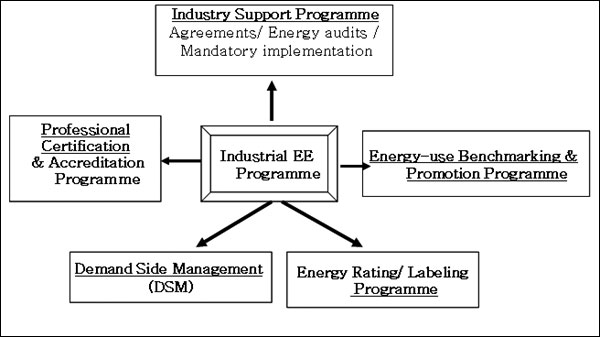
A model employing different policy measures to address need of the industrial sector is being proposed in the diagram.
Industry support: This component calls for Agreements to meet specific energy use / energy efficiency targets. These agreements should be between a government body and a company or a sector (as represented by associations). Based on the agreements the energy audits will be performed by an authorised energy consultant and verified by independent body/international consultants at a subsidised rate. The companies in turn will be bound to implement all “profitable” energy savings projects with a payback period of 3-4 years.
To catalyse the process, subsidies and financing arrangement can be made to provide for up to 30 per cent of the cost of these investments in energy-efficient project .This programme should span around a period of 04-06 years covering key energy intensive sectors such as cement, pulp and paper, textile, fertilisers.
Certification: Although there may be a number of local energy auditors, their professional competence and equality of outputs varies widely, primarily because there is no uniform or accepted qualification or prerequisites for entry into the profession. Hence, there is also wide variation in the veracity and practicality of energy audits being carried out. This could result in limited implementation of energy conservation measures and consequently limited cost savings, apart from reflecting poorly on the profession. Lack of professionally qualified persons also limits the efforts by industry to improve energy efficiency.
This component will be aimed at developing accreditation process and procedures for Energy Audit Firms .including handbook, syllabus/ curriculum and eligibility criteria for Energy Auditors .This would be achieved by selecting & training a National Certifying Agency which would, in turn, be responsible for developing mechanism for conducting periodic rating of Energy Audit Firms and review performance and accreditation process and procedures. This would ensure development of a cadre of professionally qualified energy managers and auditors in addition to higher professional standards in conduct of energy audits and bringing in credibility for energy audit services.
Benchmarking: It will be aimed at establishing industrial energy-use benchmarks; dissemination of end-use benchmarking information to industries, annual measuring and reporting; industry mean and best practice benchmarking. This could be effected through Online e-benchmarking community, publication of a quarterly newsletter etc.
Rating: The objective of Energy Rating/ Labeling Programme component is to provide information on energy efficient equipment and energy rating programs , label equipment in terms of their energy performance , set up an industrial testing facility to label equipment , standardise test procedures and develop performance test codes for equipments like boilers, furnaces, motors, fans and blowers, air compressors, heat exchangers, cooling towers, etc
Demand Side Management (DSM) programmes consist of the planning, implementing and monitoring activities of electric and gas utilities designed to encourage consumers to reduce their level and modify their pattern of energy usage. This will mitigate power shortages and drastically reduce capital needs for power capacity expansion.
Conclusion: The need for energy saving in a developing country like Pakistan is particularly important in view of limited energy resources and increasing gap between demand and supply. Efficient use of energy and its conservation is the key to sustainable development.
The writer works in Industry Support Cell Smeda, Sindh