0
0

 Dr Ali Mohammad Khushk & Nusrat Laghari
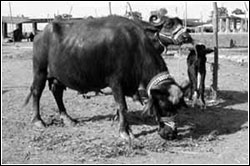
OUT of the total milk produced in Pakistan, buffalo contributes about 68 per cent, followed by cattle 27 per cent, and sheep/goat/camel about five per cent. There is about 6.3 million buffalo population. Buffaloes not only fulfil protein requirements but also provide the traction power for various agricultural purposes.
The total milk produced does not fulfil the population needs. Presently, dry milk is worth Rs1.1 billion is imported. If milk is compared with major crops, it is evident that the value of milk is more than the combined value of wheat and cotton and twice as that of sugarcane and rice.
Buffalo milk is preferred more than the cow's. Urbanisation has greatly increased milk demand, especially in big cities which has resulted in the creation of buffalo colonies. As there is no milk recording organisation, several animals are likely to be overlooked. For example, Nili-Ravi breed has the potential to produce more as compared to Kundi as it matures earlier, has shorter calving interval and dry period.
Buffalo meat production: Buffaloes are kept primarily for milk while male and dry buffaloes are used in carts and agricultural operations. Adult animals are normally slaughtered when they are uneconomical.
In Balochistan and the North Western Frontier Province (NWFP) buffalo meat is preferred to cattle’s, as it is considered free of disease due to buffaloes’ swimming habit which washes down the diseases. Right practices can make the buffalo meat a valuable business. The current situation is not satisfactory with respect to buffalo meat production. As almost 50 per cent male calves die in the first week. The remaining mostly one week olds are mostly sold to butchers. The remaining male calves, if any, stay weak and emaciated due to milk deficiency in their early life. Buffalo growth rate is compatible with other exotic cattle breeds. The Cattle Colony of Landhi, Karachi has the world's biggest concentration. Draught power: There is a trend to rear male cow calves, particularly those of draft breeds for work and female buffalo calves for milk. Buffalo males are sluggish and incapable of doing hard work in summer during hot parts of the day because of poorer heat regulation mechanism.
However, during winter months and cooler parts of the day, they are as good as bullocks and quite often work side by side by pulling carts or ploughing fields. A well built healthy buffalo bull can pull as much load in a two-wheeler as a pair of average bullocks. Long two-wheelers drawn by one buffalo bull are quite common in the cities of NWFP and the Punjab. The buffaloes possess strong large feet, strong legs and powerful quarters, which enable them to maintain balanced traction and overcome the opposing forces for ploughing in hard soil, sticky mud or pulling heavy loads in low land rice field.
The buffalo males are particularly useful for steady work in Persian wheel, oil expellers, and threshing of harvested crops. They are so trained, that they work automatically. They have broad backs and can carry an 8-10 mounds of load as pack animals over 25-30 miles working for 8-10 hours a day. The average speed is three miles an hour. Buffaloes as a draft animal have working capacity of 0.75 HP. In hot humid weather, it is necessary to let working buffaloes cool off preferably by wallowing.
Problems: Buffaloes have the potential to produce more but certain malpractices are affecting their potential. The use of oxytocin for milk let down and the BST to increase production is a common practice, resulting in infertility which sends them to slaughter houses, in hundreds.
High incidence of mastitis is another factor towards low productivity. The longer teats, its habit to sit in dirty muddy places, milking with folded thumb and use of calf for milk let down increases the risk of mastitis. Another setback is their smuggling to neighboring countries.
Buffaloes, despite being discriminated against, due to late age at first calving, long calving interval and some breeding problems continue to gain popularity. This state of affairs reflects on professional incompetence. The potential of buffalo could not be exploited due to certain biases. There has been deterioration rather than improvement of the stock due to indiscriminate breeding without considering the genetic merit of animals, particularly that of buffalo bulls.
In the absence of systematic milk recording, selection of animals particularly that of males has never been possible on scientific basis at farmer's level. Even at organised farms, the selection of males is based on pedigree and type, and also from high yielding buffaloes and cows. The bulls have never been assessed for their breeding values on the performance of their daughters. Along with certain other factors, the selection of bulls merely on the basis of pedigree and type has also been speculated for this impaired situation. Such bulls are in widespread use for artificial insemination in this country.
To obtain improvement in the productivity of buffaloes following line of action is suggested:
•Genetic parameters like genetic variation, heritability, repeatability, genetic correlation, should be worked out by using biometrical techniques. Elaborate genetic studies on buffaloes specifically of Nili-Ravi breed are scanty. This would provide basic information for adopting methods of selection for genetic improvement.
•Systematic milk recording is a pre-requisite for progeny testing and to evaluate the achievements made through artificial insemination services.
•Milk recording practices are inevitable but cannot be undertaken without formulation of Dairy Herd Improvement Association on cooperative basis.
•Progeny testing and evaluation of sire is a must for a breakthrough in dairy industry. Elaborate programmes for proving sires would provide opportunity for widespread use of quality sires thus used for upgrading the non-descript and low yielding buffaloes. The breeding values of sires and their evaluation according to their worth could be worked out by determining their predicted difference.
•The Predicted Difference (PD) is the difference between the daughter average and the herd mate average and is the best technique for evaluation and ranking sires. It would take five to 10 years in getting quite a few proven sires if extensive artificial insemination services are available.
•When the availability of semen from proven sires is assured, at least in certain areas, artificial insemination services should be made available to farmers without any problem, and castration of all potent non-descript males in such areas would be a feasible practice. This will minimize the chances of entry of detrimental genes in herds. It may be mentioned that these castrated calves would show a better growth rate, and produce good quality beef. This in turn will add substantially to the income of the farmer.
•The existing artificial insemination services need to be strengthened further. This would help in eliminating low fertility and scrub bulls and will accelerate the pace of genetic improvement of buffaloes. Needless to mention the significance of semen storage and transportation facilities at all centers.
•Research has clearly shown that balanced feeding would reduce the age at first calving. It is hoped that with selection and feeding, age at first calving could be reduced to about 30 months in buffaloes. Also, vaccination for brucellosis and such other diseases at appropriate timings would reduce the chances of contagious abortion so common in Pakistan.
•Growing high yielding fodder varieties and following improved agronomic practices should increase the production of green fodder. Most of our farmers are still practicing the conventional feeding practices. The animal herders at village level should be made aware to use urea and molasses with roughages to improve the production of their animals.
•There is a need for establishing modern milk processing and packaging facilities based on advanced technology to convert abundantly available raw milk ( surplus in winter specially) into high value-added dairy products.
•The other field which needs special attention of policy makers is to improve and extend livestock extension services to village level effectively. Again, due to scattered livestock herders in the villages, they should be organized in specific areas on community participation approach basis.