0
0

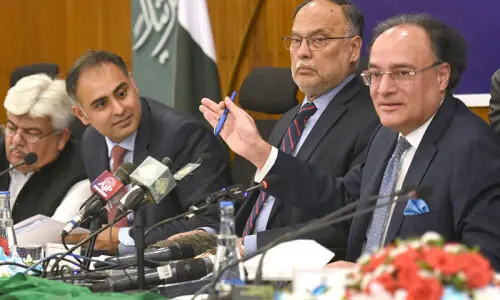
ISLAMABAD, Dec 2: Planning Commission Deputy Chairman Dr Mohammad Akram Sheikh has urged the Japanese government to set up a technical university in Pakistan to help it in developing highly skilled manpower and promote industrial growth in the country.
Speaking at a conference organised by the Japan International Cooperation Agency (JICA) to share its findings of a study on “Towards a Vision 2030: direction of industrial development in Pakistan”, he said that Pakistan had vast mineral resources, including gold, copper and diamond, and stressed the need for training people to exploit the natural resources.
He said developed countries, including Japan, should transfer technology to Pakistan to help achieve the goal of significant industrial development.
Mr Sheikh said Pakistan was part of the globalisation process which implied integration of each economy into the world economy.
He described consistency in policies as a prerequisite for sustained development to transform Pakistan into a developed, industrialised and prosperous country.
He said the morphology of dynamic and economically viable societies of the world suggest that such societies define their long-term vision first, and then mobilise their collective synergies to achieve it. “The pursuit of a long-term vision by a developing country, therefore, becomes all the more important to keep on track their development process along a defined trajectory,” he remarked.
Mr Sheikh said under the Vision 2030, the gross domestic product (GDP) would be raised from the existing $130 billion to $700 billion.
Ministry of Industries, Production and Special Initiatives Secretary Shahab Khawaja said that the direct foreign investment had to be in conformity with the country’s requirements.
He stressed that the DFI in ‘any shape’ should not be welcomed and said: “We should have clearly demarcated business plans.”
The author of Japan’s Official Development Assistance (ODA) plan for Pakistan and JICA Project Formulation Adviser Professor S. Hirashima said Japan would keep playing its role in economic development of Pakistan.
The JICA report suggested that Pakistan should focus on integral manufacturing instead of going for modular manufacture.
Explaining the difference between the two forms, Prof Hisaya Oda and Prof Hisaaki Mitsui said integral type of products were not so simple and the relationship between functions and components were highly intricate with each component affecting the other and determining the quality of final product. They said automobile was a typical example of integral manufacturing.
They said that the relationship between function and component was simple in the module type products. Each component has its self-contained module, which has a rather independent function. The typical module type products include personal computers, package software and bicycles.
The JICA report, based on six-month study, said that equipped with immense industrial power and cheap labour force, Chinese products were currently reaching every segment of the Pakistani market. The Chinese products were often looked down, as low quality and imitated products, but domestic consumers tend to be attracted to them because of their low prices.
Some local manufacturers imitate the Chinese competitors. “It is appropriate for the Pakistani manufacturers to avoid direct competition with the Chinese and to look for the other way to differentiate their products by making higher valued and higher quality goods,” the study said.