0
0

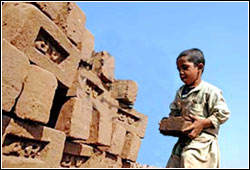 LAHORE, Nov 19: “A world fit for children” is a document the United Nations prepared in 2000 for protecting the childhood of the children of the 21st century. The same world, however, remains as unfit a place as ever for the 12-year-old Waqas, and millions of other Pakistani children who are forced into work by their unscrupulous or impoverished elders.
The World Children’s Day is being observed today with a lot more stress laid on taking steps for children’s protection and welfare by governments around the globe, but few will actually keep the vows taken today. Fewer still in the developing countries will have their children living a better life a year from now. Those stuck in a war zone, in Iraq, Palestine, Afghanistan, Darfur, etc., or those facing another harsh winter in the earthquake-hit region closer home, or indeed those famished in places like North Korea and Africa, will fare even worse.
Ironically, many a tormentor of such children, especially those waging war on them from the western hemisphere, will keep mum about them as they seek to better the lot of their own children back home.
The story of Waqas is no different than those of more than nine million children of Pakistan who are forced to work for whatever reason. A native of Jaranwala, Waqas left home at the age of nine when his stepfather thrashed him for failing to contribute to the family’s income whatever little he was expected to. Soon after the death of his father his mother had contracted a second marriage which left him and his six brothers and three sisters at the mercy of a stepfather.
“Like my two elder brothers, I had to quit the house after facing harsh treatment by our stepfather who wanted three of us to work, round-the-clock, if we had to, and hand over all of our hard-earned money to him,” Waqas recalls his ‘difficult’ time. “Whom do I blame for quitting my home? My mother, for her decision to remarry, or the greedy stepfather’s attitude? I really do not know. It was my destiny, perhaps.”
Waqas came to Lahore, where most of the runaway children from surrounding towns seek refuge, hoping he would have no problem of boarding and lodging as the city is home to the shrine of Data Sahib; and where footpaths serve as free beds for the poor.
Like many other runaway children, Waqas also found Bhati Gate (Data Darbar) a safe heaven for himself. He made friends with Nasir, Khalid and Usman who got him a job in a tea stall at the Lorry Adda. In his early days, in 2003, he earned Rs50 a day, of which he spent Rs10 each on breakfast and lunch and saved the rest. His savings, however, no longer remained safe from his friends who asked him to join them in glue-sniffing, which is known to give you a high, but which soon becomes an addiction.
He says he initially resisted the temptation but eventually gave in to the pressure of his friends. “Have you ever experienced it?” he questioned me, but was disappointed to hear a straight ‘no’. “You’ll never know how it helps clam your nerves,” he confided. His major chunk of income went to the addiction.
He also revealed that one of his friends and a man of Ali Park, in Heera Mandi, where they converged for sniffing glue, sexually abused him. “They threatened me that they would hand me over to the police if I told anyone about it. Then, a couple of months ago when I was busy with my friends inhaling the substance, a police team caught us and brought us to this place,” he said, meaning the Child Protection and Welfare Bureau on Montgomery Road.
Many other children roaming the street may never be this lucky. Waqas does not want to go home. He is interested in learning some technical work at the vocational centre set up by the bureau to help him earn a respectable livelihood as he steps into adulthood.
Be it a runaway child or one who is forced to work by his elders, social workers say most are at some point exposed to sexual abuse and exploitation. Most runaway children are also entrapped by one or another kind of addiction. Statistics show that most end up as beggars because of lack of guidance.
The CPWB, an effort by the Punjab government to rescue such children, offers a step-by-step plan to deal with the problems of runaway children. Since its inception in early 2005 in Lahore, the bureau has managed to rescue 2,700 children between the age of five and 15 from different parts of the city, besides housing and rehabilitating camel-jockey children rescued from the Gulf.
“I have handed over some 2,500 children back to their guardians so far. However, a lot more is needed to be done on this front because the problem is prevailing in other parts of the province as well.” The CPWB director, Zubair Ahmad, says that such bureaus are being established in Gujranwala, Multan, Sialkot, Faisalabad, Bahawalpur, Rahim Yar Khan and Rawalpindi shortly. The Lahore bureau houses an institution and a vocational centre for the education and training of children. Doctors and psychologists are also available for their treatment.
The Pakistan Railways Police have also kept an eye on the runaway children. The PR help centres in Lahore, Rawalpindi, Quetta, Rohri, Peshawar and Karachi railway stations have reunited a good number of children with their families. Those whose guardians are not traced have been shifted to the Edhi Centres.
Psychologists are of the view that most of the runaway children leave their homes because of the negligence of their parents, physical torture by elders or teachers and domestic, forced labour.
CHILD LABOUR: Following the international laws the government has banned child labour in hazardous professions like tanneries, scavenging, surgical instruments, glass-bangle making, coal mining and fishing. But nothing has been initiated for the implementation of the law. Some 3.4 million children aged between five and 14 years are estimated to be working as child labourers. Many are associated with household work, factories or engaged in a hazardous profession.